Google’s AI Overviews do not rank pages the way traditional search does. They extract, synthesize, and cite — pulling structured answers from pages that make extraction easy. Most content fails that test not because the ideas are weak, but because the markup is missing. Schema markup for AI Overviews is the layer that tells Google’s AI system what your content is, who wrote it, and which parts answer which questions. Without it, even excellent content competes at a structural disadvantage against pages that have given the AI system a clear extraction map. In 2026, that gap is measurable — and it is widening as AI Overview coverage expands across more query types.
Why Schema Markup Matters for AI Overviews
Schema markup reduces content ambiguity for AI systems — and lower ambiguity means higher citation probability. That is the core mechanic driving schema’s impact on AI Overview inclusion.
When Google’s AI Overview system processes a query, it does not read your page the way a human does. It parses structured signals alongside body copy, looking for explicit declarations of content type, authorship, topic boundaries, and question-answer relationships. Schema markup provides those declarations in a machine-readable format that AI systems can act on independently of how well-written the surrounding prose is.
This is the shift most SEO teams have not fully absorbed. Traditional SEO treated schema as a rich snippet enhancement — a way to earn star ratings or FAQ dropdowns in search results. For AI Overviews, schema serves a deeper function. It is a parallel information channel that AI crawlers read before, during, and after parsing body content. A page with strong schema gives the AI system a pre-structured extraction map. A page without it forces the AI to infer structure from prose alone — a process with far more error and ambiguity built in.
The practical consequence is that schema markup for AI Overviews is no longer optional for any content strategy targeting AI citation visibility. It is foundational infrastructure, in the same category as having a crawlable site structure or a valid llms.txt file. For the broader GEO strategy context that schema fits into, our GEO long-tail keyword strategy guide explains how structured data connects to citation velocity across Perplexity, Gemini, and ChatGPT simultaneously.
💡 Pro-Tip: Always implement schema in JSON-LD format inside a
<script>tag in the page<head>— not as inline microdata. JSON-LD is the format Google’s AI systems parse most reliably, and it keeps your markup separate from your HTML structure, making it easier to validate and update without touching content.
Schema Types Ranked by AI Overview Impact
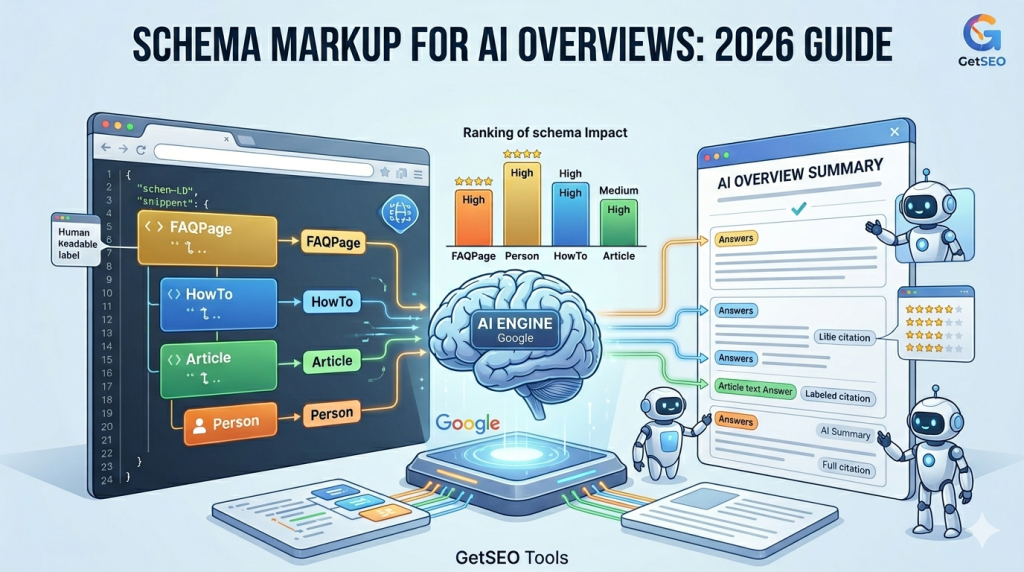
Not all schema types influence AI Overview inclusion equally — FAQPage and HowTo schema have the highest direct impact, while Article and Person schema build the authority layer that makes citations stick.
FAQPage schema ranks at the top for informational queries. When a page carries valid FAQPage markup, Google’s AI Overview system can extract individual question-answer pairs as discrete citation units. Each pair is independently quotable, which is exactly the format AI Overview generation requires. According to Search Engine Land’s 2025 structured data research, FAQ schema appears in 41% of AI Overview slots for how-to and informational queries — a citation rate no other single schema type matches.
HowTo schema ranks second for instructional content. Its step-level structure mirrors the claim-evidence-source extraction pattern that AI Overview systems use when building multi-step answers. Each HowToStep is a discrete, self-contained instruction that AI systems can pull and sequence without needing the surrounding context. Pages with valid HowTo schema consistently outperform unstructured equivalents in AI-generated instructional responses.
Article schema is the baseline layer that every page should carry. It provides the content type declaration, publish date, and author reference that AI systems use to evaluate recency and credibility. On its own, Article schema has moderate direct impact on AI Overview inclusion — but it amplifies the effect of every other schema type on the same page. Think of it as the container that makes FAQPage and HowTo signals more credible.
Person and Organization schema operate at the authority layer. Gemini applies E-E-A-T signals before selecting citation sources, and Person schema with verified sameAs links is one of the clearest E-E-A-T signals available in structured data. According to Moz’s entity schema research, entities with confirmed Person schema are cited 2.3 times more frequently in AI-generated summaries than content with no author entity markup. That multiplier applies regardless of content quality — schema is doing signal work that prose cannot replicate.
How Schema Markup Improves AI Retrieval
Schema improves AI retrieval by converting implicit content signals into explicit machine-readable declarations that AI extraction systems can act on without inference.
Here is the problem schema solves at the technical level. AI systems parsing web content for Overview generation face a fundamental challenge: most pages mix content types, authorship signals, topic boundaries, and navigational elements into a single undifferentiated HTML document. Extracting a clean, citable answer from that structure requires the AI to make a series of inferences — about where the answer starts and ends, who wrote it, whether it is current, and how confident the author was in the claim.
Every inference is a point of failure. An AI system that has to guess whether a paragraph is an answer or a transition sentence may skip that paragraph entirely. One that cannot confirm author identity may downweight the page’s E-E-A-T score. Schema eliminates these inference points by providing explicit declarations. FAQPage schema tells the AI exactly where each question ends and each answer begins. Person schema tells it exactly who wrote the content and where to verify their credentials. Article schema tells it when the content was published and last updated.
The result is that schema-marked content requires less AI processing effort to extract — and content that is easier to extract gets extracted more often. This is not a secondary benefit of schema. It is the primary mechanism connecting structured data to AI citation rates.
This also explains why schema validation matters so much for GEO. A malformed JSON-LD block does not just fail to help — it can actively introduce noise into the AI extraction process. For teams dealing with existing schema errors, our guide on schema errors that kill AI visibility covers the most common validation failures and how to fix them systematically.
💡 Pro-Tip: After adding or updating schema on any page, run it through Google’s Rich Results Test immediately — not after publishing. The test catches structural errors before they reach AI crawlers, and it shows you exactly which schema types were detected and parsed successfully. A clean Rich Results Test result is your green light to publish.
Combining Schema Types for Maximum AI Coverage
Layering multiple schema types on a single page gives AI systems more extraction surfaces — and more extraction surfaces mean more citation opportunities per page.
The most effective combination for informational content is Article + FAQPage + Person. Article declares the content type and establishes recency. FAQPage provides the discrete question-answer pairs that AI Overview generation prefers. Person schema adds the author authority layer that Gemini’s E-E-A-T evaluation requires before it will cite a source. Together, these three schema types cover the content, format, and credibility dimensions that different AI platforms prioritize.
For instructional content — tutorials, guides, step-by-step processes — replace FAQPage with HowTo or layer both. A page that walks through a technical process and also answers common follow-up questions legitimately carries both schema types. The @graph structure in JSON-LD handles multiple schema types cleanly on a single page without conflicts.
Here is the combination we use on every article at getseo.tools: Article as the base, FAQPage for the questions section, and Person + Organization for author and brand authority. On instructional pages, HowTo is added as a third content schema. This layered approach ensures that regardless of which AI platform is processing the page — whether Perplexity pulling citation paragraphs, Gemini evaluating E-E-A-T, or Google’s AI Overview system extracting answers — there is a relevant schema signal available for each platform’s specific citation logic.
The full JSON-LD implementation details, including complete code examples for FAQ and HowTo schema, are covered in our deep-dive on FAQ and HowTo schema for AI citations. For the author and organization entity setup that completes the authority layer, see our guide on Person and Organization schema for E-E-A-T signals.
Schema Markup for AI Overviews: Full Comparison Table
| Schema Type | AI Overview Impact | Best For | Primary AI Benefit | Use With |
|---|---|---|---|---|
| FAQPage | ★★★★★ Highest | Informational, Q&A content | Discrete Q&A extraction units | Article, Person |
| HowTo | ★★★★☆ High | Instructional, step-based content | Step-level claim-evidence structure | Article, FAQPage |
| Article | ★★★☆☆ Medium-High | All content pages | Content type + recency declaration | FAQPage, HowTo, Person |
| Person | ★★★★☆ High (Gemini) | Author pages, bylined content | E-E-A-T authority signal for Gemini | Article, Organization |
| Organization | ★★★☆☆ Medium | Brand pages, sitewide deployment | Publisher credibility and sameAs verification | Article, Person |
| BreadcrumbList | ★★☆☆☆ Supporting | All pages with hierarchy | Topic context and site structure signal | Article |
The impact ratings above reflect consistent patterns across AI Overview research through early 2026. FAQPage and HowTo dominate because they provide pre-structured extraction units — discrete blocks of content that AI systems can lift and use directly. Article, Person, and Organization schema build the credibility layer that determines whether those extraction units are trusted enough to cite.
Frequently Asked Questions
Which schema type has the biggest impact on Google AI Overviews?
FAQPage schema has the highest impact on AI Overview inclusion for informational queries. HowTo schema dominates instructional responses. Combining Article schema with either type on the same page consistently outperforms single-schema implementations in AI Overview extraction.
Does schema markup guarantee inclusion in Google AI Overviews?
No. Schema markup improves AI extraction probability by reducing content ambiguity, but it does not guarantee inclusion. Content quality, E-E-A-T signals, and topical authority all influence whether Google’s AI Overview system selects a page as a citation source.
Can I use multiple schema types on a single page?
Yes, and you should. Layering Article schema with FAQPage and Person schema on a single page gives AI systems multiple extraction surfaces. Each schema type signals a different content dimension — topic, format, and author authority — which compounds citation probability.
Does Person schema affect AI citation rates?
Yes. According to Moz research, entities with verified Person schema and sameAs links are cited 2.3 times more frequently in AI-generated summaries than unattributed content. Gemini in particular applies E-E-A-T signals before selecting citation sources.
What is the correct way to implement schema markup for AI Overviews?
Use JSON-LD format inside a script tag in the page head. Structure your @graph array to include Article, FAQPage, and Person or Organization entities on the same page. Validate with Google’s Rich Results Test before publishing. Avoid inline microdata — JSON-LD is the format AI systems parse most reliably.
Key Takeaways
- Schema markup is foundational infrastructure for AI Overview visibility — it provides a parallel information channel that AI systems read independently of body content quality.
- FAQPage schema has the highest direct impact on AI Overview inclusion, appearing in 41% of AI Overview slots for informational queries according to Search Engine Land’s 2025 research.
- HowTo schema dominates instructional responses because its step-level structure mirrors the claim-evidence-source extraction pattern AI systems use when building multi-step answers.
- Article schema is the required baseline on every page — it declares content type, recency, and authorship in a format that amplifies all other schema signals on the same page.
- Person and Organization schema build the E-E-A-T authority layer that Gemini evaluates before selecting citation sources — entities with verified sameAs links are cited 2.3× more frequently than unattributed content.
- Layering multiple schema types compounds citation probability — Article + FAQPage + Person covers the content, format, and credibility dimensions that different AI platforms each prioritize.
- Validate every schema block with Google’s Rich Results Test before publishing — a malformed JSON-LD block introduces noise into AI extraction and can actively reduce citation probability.