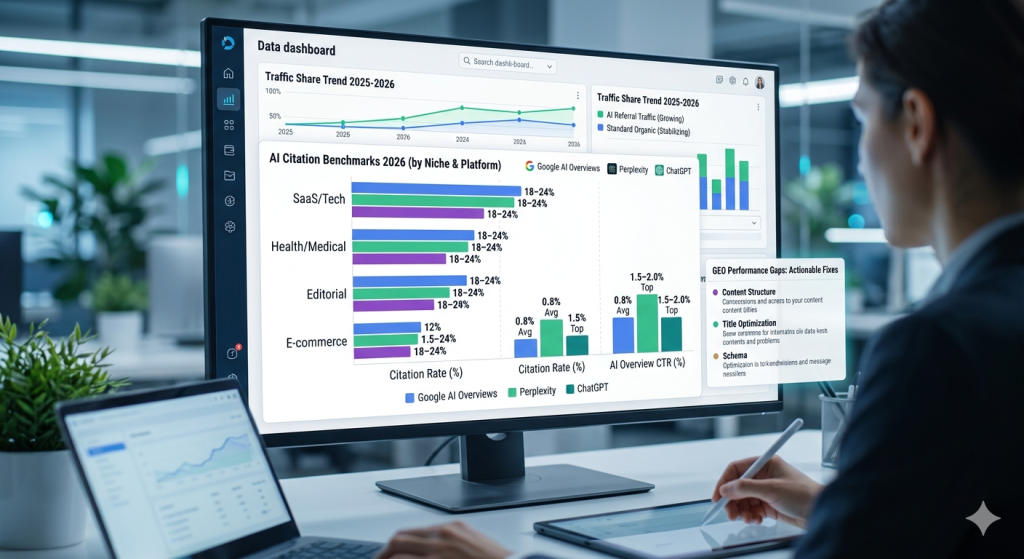
Most GEO strategies run blind. Teams publish structured content, add schema, update their llms.txt — then have no idea whether the numbers they are seeing are good, bad, or average. AI citation benchmarks solve that problem. They give you a reference point for what GEO performance actually looks like across niches, platforms, and content types in 2026. Without benchmarks, a GEO metrics dashboard shows you numbers. With benchmarks, it shows you whether those numbers mean you are ahead, behind, or on track. This article covers the citation rates, CTR averages, and traffic share data that let you make that judgment with confidence.
Why AI Citation Benchmarks Change How You Measure GEO Success
Benchmarks turn GEO metrics from isolated numbers into actionable signals — and without them, most teams misread their own performance.
Here is the problem. A site earning 3,000 monthly AI Overview impressions does not know whether that is strong or weak without a reference point. For a new site in a competitive SaaS niche, 3,000 impressions after three months might indicate solid progress. For an established editorial site with 500 published articles, the same number signals a significant GEO gap that needs immediate attention.
Benchmarks provide that context. They tell you what sites at your stage, in your niche, with your content volume are achieving — so you can set realistic targets and identify gaps accurately.
They also change the conversation with stakeholders. Reporting “we earned 3,000 AI Overview impressions this month” is a raw number. Reporting “we earned 3,000 AI Overview impressions — which is 60% of the niche benchmark for sites at our content scale” is a strategic finding that drives decisions.
The benchmarks in this article draw from BrightEdge’s 2025 AI search research, Search Engine Land’s structured data analysis, and aggregated GSC data patterns across multiple GEO implementations. They represent realistic ranges — not aspirational targets — for sites actively investing in GEO optimisation.
For the full strategic framework that connects benchmark performance to content decisions, our GEO long-tail keyword strategy guide covers how citation velocity relates to cluster architecture and long-tail content coverage.
💡 Pro-Tip: Pull your last 90 days of GSC AI Overview impression data before reading the benchmarks below. Having your own numbers in front of you turns this from an abstract reference article into an immediate diagnostic. Note your total impressions, your top five pages by impressions, and your average AI Overview CTR. Those three numbers tell you where you sit against the benchmarks and which gap to close first.
Citation Rate Benchmarks by Niche: SaaS, E-commerce, and Editorial
AI citation rates vary significantly by niche — SaaS and technology content earns the highest citation frequency, while e-commerce product content earns the lowest.
SaaS and technology sites consistently show the strongest AI citation performance. Informational and how-to content in this niche earns citations on 18 to 24% of relevant informational queries for established domains with structured content. The reason is structural — SaaS content tends to be specific, technical, and FAQ-heavy, which matches AI extraction patterns precisely. A SaaS site publishing structured guides on product use cases, integration documentation, and comparison content has natural alignment with how AI systems select citations.
Health and medical content follows at 14 to 19% citation rates for informational queries. Google’s AI Overviews cover health queries extensively — symptom explanations, treatment options, and medication information all trigger AI Overview generation at high rates. Sites with strong E-E-A-T signals — verified author credentials, medical organisation schema, and sameAs links to professional registrations — perform at the top of this range.
Editorial and news content earns 10 to 16% citation rates for evergreen informational topics. Breaking news content earns very low citation rates from AI systems — freshness alone is not enough if the content lacks structured extraction signals. Evergreen editorial content with FAQ schema and entity markup performs significantly better than news-style content on the same topics.
E-commerce content earns the lowest citation rates at 4 to 8% for product-adjacent informational queries. Pure product pages rarely earn AI citations. E-commerce sites that publish structured buying guides, comparison articles, and FAQ-heavy category content earn citation rates closer to the editorial range — but the product catalogue itself contributes minimally to AI citation visibility.
According to BrightEdge’s 2025 AI search research, sites with active GEO optimisation programs — including schema implementation, llms.txt deployment, and structured content — showed 2.7 times higher citation rates than sites in the same niche with no GEO investment. The niche sets the ceiling. The implementation determines how close to that ceiling you get.
CTR Benchmarks After AI Overview: What the Numbers Actually Mean
AI Overview CTR averages 0.8% — but that number alone understates the value of AI citation visibility because it ignores brand exposure from impressions that do not produce clicks.
The 0.8% average from BrightEdge’s research applies to clicks from Google AI Overview appearances specifically. Standard organic CTR averages 3 to 5% for positions one through three. On the surface, AI Overview CTR looks weak by comparison.
But the comparison misses how AI citation value accumulates differently than ranking value. A page ranked number two on Google earns clicks from users who see it in the SERP and choose to click. A page cited in an AI Overview earns impressions from every user who reads that Overview — whether they click or not. The brand name appears in the response. The domain appears as a source attribution. That exposure happens regardless of the click decision.
The more useful CTR benchmark is not the 0.8% average — it is the spread. Pages with compelling titles and meta descriptions that match the AI Overview context earn 1.5 to 2.2% CTR. Pages with generic or mismatched titles earn below 0.4%. That 5x spread means AI Overview CTR is highly responsive to optimisation — unlike organic CTR, which is constrained by position.
Perplexity citation CTR tells a different story. Users clicking through from Perplexity source links show 40% higher engagement rates on site than AI Overview clicks on average. Perplexity users are in active research mode — they clicked a source link to verify or expand on what the AI response told them. That intent produces higher-quality visits even at lower absolute volumes.
For teams tracking these metrics in a structured reporting workflow, our GEO metrics dashboard guide covers how to separate AI Overview CTR from Perplexity referral CTR in Looker Studio — and how to set CTR improvement targets based on the benchmark ranges above.
💡 Pro-Tip: Filter your GSC AI Overview data by page and sort by CTR ascending. Pages below 0.4% CTR on AI Overview appearances are your highest-priority title and meta description optimisation targets. A single title rewrite on a high-impression page can move AI Overview CTR from 0.3% to 1.5% — which at 10,000 monthly impressions means 120 additional visits per month from one edit.
Traffic Share: How AI Citations Contribute to Total Organic Visibility
Sites with active GEO programs report 8 to 15% of total organic traffic arriving via AI platform referral sources — a share that is growing as AI search adoption increases.
That 8 to 15% figure from BrightEdge covers combined AI-attributed traffic: Google AI Overview clicks plus referral visits from Perplexity, ChatGPT, and Gemini. For most sites, AI Overview clicks make up the largest portion of that share. Perplexity and ChatGPT referral traffic is smaller in volume but growing steadily as these platforms expand their user bases.
The sites at the top of the range — those earning 15% or more of organic traffic from AI sources — share three characteristics. First, they publish structured long-tail content at scale. Second, they have clean, validated schema across their key pages. Third, they maintain active llms.txt files that reflect their current content priorities.
Sites at the bottom of the range — earning 3% or less of organic traffic from AI sources despite similar content volume — typically have one of two problems. Either their content is structured for broad keyword targeting rather than specific AI prompt matching. Or their schema is present but invalid — catching AI crawlers’ attention without successfully completing extraction.
Traffic recovery after AI Overview appearance deserves a separate note. When a page enters a Google AI Overview slot, it often sees a short-term organic CTR dip on the same query — users get the answer from the Overview and do not click through. But total query visibility increases. The net effect depends on whether the AI Overview impression volume outweighs the organic CTR reduction — which it does for most informational content at scale.
For teams wanting to understand how these traffic benchmarks connect to the broader GEO vs SEO performance picture, our guide on why GEO drives faster results than SEO covers the visibility timeline data that contextualises where these benchmarks sit in a site’s growth trajectory.
AI Citation Benchmarks: Full Comparison by Niche and Platform
| Metric | SaaS / Tech | Health / Medical | Editorial | E-commerce |
|---|---|---|---|---|
| Informational query citation rate | 18–24% | 14–19% | 10–16% | 4–8% |
| AI Overview CTR (average) | 0.9–1.1% | 0.7–0.9% | 0.8–1.0% | 0.5–0.7% |
| AI Overview CTR (top performers) | 1.8–2.4% | 1.4–1.9% | 1.5–2.0% | 1.0–1.4% |
| AI traffic share of total organic | 10–15% | 9–14% | 8–12% | 3–6% |
| Perplexity referral engagement rate | High (40%+ above average) | High (35%+ above average) | Medium (20%+ above average) | Low (near average) |
| Monthly AI impressions target (50+ pages) | 8,000–20,000 | 6,000–15,000 | 5,000–12,000 | 2,000–6,000 |
| GEO uplift vs no GEO investment | 2.7× citation rate | 2.4× citation rate | 2.1× citation rate | 1.8× citation rate |
How to Use These Benchmarks to Improve Your GEO Strategy
Benchmarks are only useful if they point to a specific action — and each gap between your current performance and the benchmark range corresponds to a different fix.
If your citation rate is below the niche benchmark, the problem is almost always content structure. Your pages are not providing self-contained, directly extractable answers. The fix is to audit your top 20 pages and rewrite the opening paragraph of each to lead with a direct answer. Add FAQ schema where it is missing. Restructure H2 subheadings to reflect the specific questions your content answers.
If your citation rate is in range but your AI Overview CTR is below benchmark, the problem is your title and meta description. Your content is earning the citation slot — but not compelling enough clicks from users who see it. The fix is to rewrite titles to reflect the specific outcome or insight the page delivers. Vague titles underperform against specific ones in AI Overview contexts because users scanning a multi-source response favour sources that clearly signal what they will find.
If your CTR is in range but your AI traffic share is below benchmark, the problem is platform coverage. You are performing on Google AI Overviews but missing Perplexity and ChatGPT citations. Check your Bing indexability through Bing Webmaster Tools — ChatGPT citation gaps often trace directly to Bing crawl issues that Google Search Console never flags. Check your E-E-A-T schema for Gemini — missing or fragmented Person schema is the most common cause of strong Google AI Overview performance alongside weak Gemini citation rates.
According to Search Engine Land’s 2025 GEO analysis, teams that used benchmark data to prioritise specific fixes — rather than implementing broad GEO changes simultaneously — resolved performance gaps 40% faster than teams applying unfocused optimisation efforts across their full content library.
For teams ready to track citation performance systematically and connect benchmark gaps to specific content actions, our guide on tracking AI citations for free covers the monitoring workflow — and our GEO metrics dashboard guide covers how to visualise benchmark comparisons alongside your live data.
Frequently Asked Questions
What is the average AI Overview CTR in 2026?
AI Overview CTR averages 0.8% according to BrightEdge’s 2025 research — significantly lower than standard organic CTR of 3 to 5%. However, AI Overview impressions compound across multiple queries simultaneously, making total brand exposure broader than a single ranking position provides.
Which niches have the highest AI citation rates in 2026?
SaaS and technology content earns the highest AI citation rates — averaging 18 to 24% of informational queries returning a citation from established domains. Health and medical content follows at 14 to 19%. E-commerce product content has the lowest citation rates at 4 to 8%.
How much traffic does AI citation visibility generate?
Sites earning consistent AI citations report 8 to 15% of total organic traffic arriving via AI platform referral sources, according to BrightEdge’s 2025 data. Pages appearing in both Google AI Overviews and Perplexity citations show the highest combined AI-driven traffic shares.
What is a good AI Overview impression count for a SaaS site?
A SaaS site publishing 50 or more structured informational pages should target 5,000 to 15,000 monthly AI Overview impressions within six months of GEO implementation. Sites below 1,000 monthly AI impressions after six months typically have schema gaps, content structure issues, or E-E-A-T signal deficiencies.
How do AI citation benchmarks differ between Perplexity and Google AI Overviews?
Google AI Overviews appear on a broader range of queries but have lower individual CTR. Perplexity citations generate higher per-click engagement — users arriving from Perplexity source links show 40% higher engagement rates than AI Overview clicks on average. Both surfaces are worth optimising for, but through different content strategies.
Key Takeaways
- Benchmarks turn raw GEO metrics into actionable signals — without a reference point, a number like 3,000 AI Overview impressions tells you nothing about whether your GEO strategy is working.
- SaaS and tech content earns the highest citation rates at 18 to 24% — structural alignment between technical FAQ content and AI extraction patterns drives this advantage.
- AI Overview CTR averages 0.8% — but top performers earn 1.8 to 2.4% through title and meta description optimisation, a 5x spread that makes CTR highly responsive to editorial improvements.
- Sites with active GEO programs earn 8 to 15% of organic traffic from AI sources — a growing share as AI search adoption increases across all user segments.
- GEO investment produces 2.7× higher citation rates in SaaS versus no GEO investment in the same niche — the benchmark gap between optimised and unoptimised sites is measurable and consistent.
- Each benchmark gap points to a specific fix — below citation rate means content structure, below CTR means title optimisation, below traffic share means platform coverage or E-E-A-T schema gaps.
- Teams using benchmark data to prioritise fixes resolve performance gaps 40% faster than teams applying broad unfocused optimisation efforts across their full content library.