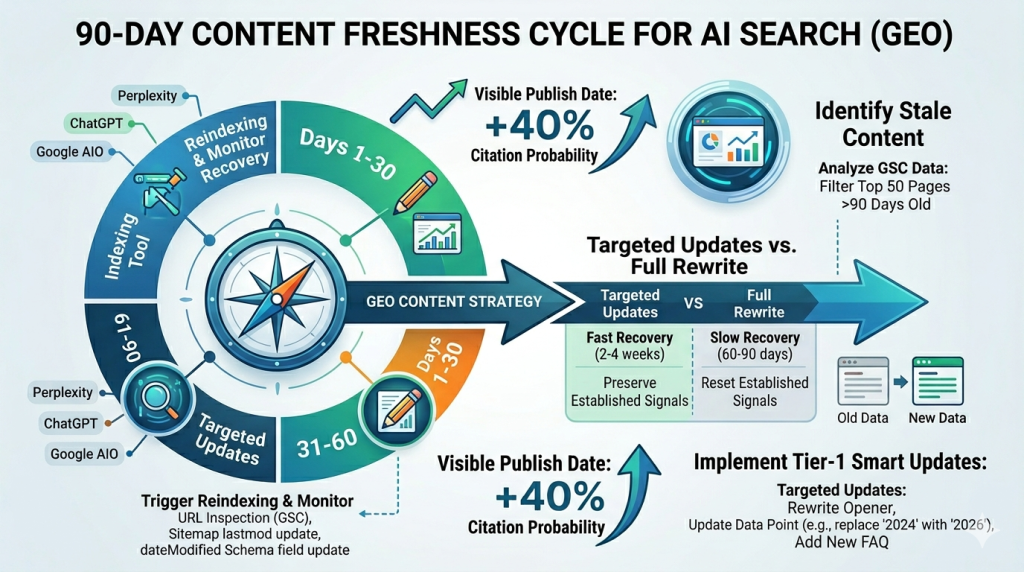
A page that earned strong AI citations six months ago is not guaranteed to earn them today. Content freshness for AI search is an active maintenance requirement — not a one-time task. Perplexity reindexes actively covered topics every 30 to 90 days. When it does, recently updated pages compete more strongly than stale ones — even when the original content was better. Most GEO strategies invest heavily in earning the first citation and almost nothing in keeping it. A 90-day refresh cycle built around the right update types is the difference between sustained AI citation presence and a slow, invisible decline.
Why Content Freshness Matters More for AI Than for Google
AI systems weight freshness more aggressively than Google because they are designed to provide current answers — and stale content signals lower reliability.
Google’s algorithm applies freshness as one signal among hundreds. A well-linked, authoritative page can hold its ranking for years on evergreen topics. Accumulated authority buffers freshness decline.
AI citation systems have no equivalent buffer. Perplexity and ChatGPT do not have a backlink-based authority score. They apply freshness as a primary trust signal — especially for topics that evolve: tool comparisons, pricing data, best practices, and statistics.
A page last updated 18 months ago competes against fresher pages regardless of how strong the original content was. There is no accumulated authority to offset the freshness gap.
According to BrightEdge’s 2025 AI search research, visible publish dates boost AI citation probability by approximately 40% compared to undated content. Pages updated within the past 90 days consistently outperform older content on the same queries.
That 40% gap is not marginal. It is the difference between holding a citation slot and losing it to a competitor who simply published a fresher page on the same topic.
For the broader topical authority architecture that freshness maintenance supports, our guide on building GEO topical authority with content clusters covers how fresh cluster pages contribute to pillar-level AI knowledge graph authority.
💡 Pro-Tip: Sort your content inventory by last modified date in your CMS. Any page not updated in the past 120 days that sits in your top citation-earning set is a freshness risk. Flag it for the next refresh cycle — before citation drops appear in your monitoring data.
How AI Crawlers Detect Content Freshness
AI crawlers detect freshness through four signals: the dateModified field in Article schema, the visible on-page date, sitemap lastmod timestamps, and substantive content changes detectable through crawl comparison.
The dateModified field in your Article schema is the most direct signal. AI crawlers read this before processing the full content. A recent date signals the content is worth re-evaluating for citation eligibility. An outdated date signals staleness — even if the content is accurate.
The visible on-page date provides a second confirmation layer. Some AI crawlers cross-reference schema dates with visible dates. If the schema says last week but no visible date appears on the page, signal confidence drops. Display your dateModified prominently — below the H1 or in a byline block.
Sitemap lastmod timestamps tell AI crawlers which pages changed since the last crawl cycle. Accurate lastmod values ensure updated pages enter the priority crawl queue rather than waiting in the standard queue.
Substantive content changes are the fourth signal — and the most important. AI crawlers that cache previous crawl versions detect whether actual content changed. Adding new data, new FAQ questions, or a revised opening paragraph produces a detectable content delta. Updating only the date does not.
For the full validation workflow that confirms your schema date fields and freshness signals are working correctly, our guide on schema errors that kill AI visibility covers the Rich Results Test and GSC Enhancement report checks that catch freshness signal failures before they affect citations.
The 90-Day Refresh Cycle: What to Update and Why
A 90-day refresh cycle targets the content elements that produce the strongest freshness signals — without requiring full rewrites that disrupt pages already earning citations.
Ninety days aligns with Perplexity’s reindex window for actively covered topics. It covers two full Google crawl cycles for most content categories. Running a refresh every 90 days means your priority pages are always within the freshness window when AI crawlers visit.
Three updates produce the strongest freshness signals per unit of effort.
First, update at least one data point with a current source. Replace a 2024 figure with a 2026 figure. Update a vague “as of last year” reference with a specific current date. This change is substantive, verifiable, and signals that someone reviewed the content for currency.
Second, rewrite the opening paragraph to reflect any changes in the topic landscape. Not a complete rewrite — just an update that acknowledges current context. “In 2026, AI Overview coverage has expanded to include…” signals freshness to both AI crawlers and human readers.
Third, add one new FAQ question addressing an active query pattern from your citation monitoring. This expands the extraction surface and signals content growth. The new question also extends the page’s citation eligibility to the new query it addresses.
These three updates typically take 30 to 45 minutes per page. For a site with 20 priority citation pages, the full 90-day refresh cycle takes 10 to 15 hours of editorial work.
To identify which pages need freshness updates most urgently, our AI citation tracking guide covers the monitoring workflow that surfaces citation share losses before they compound.
💡 Pro-Tip: When adding a new FAQ question as part of a freshness update, choose one that appears in your Perplexity citation checks as an active query — one where a competitor is currently earning the citation slot. Freshness update and citation gap fill become a single edit.
Reindexing Signals: How to Tell AI Systems Your Content Changed
Triggering fast reindexing after a content update requires three parallel actions: GSC URL Inspection request, sitemap lastmod update, and dateModified schema field update.
Google Search Console’s URL Inspection tool is the fastest path to Google reindexing. After publishing freshness updates, paste the URL and click “Request Indexing.” This places the URL in Google’s priority crawl queue — typically resulting in recrawl within 24 to 72 hours.
Sitemap updates handle Perplexity and ChatGPT reindexing indirectly. Both platforms use sitemaps to identify updated content. Ensure your sitemap’s lastmod field reflects today’s date for each updated URL. Most WordPress SEO plugins handle this automatically — verify it is regenerating correctly after each update.
The dateModified schema field update is the third action. It should reflect the actual update date in YYYY-MM-DD format. AI crawlers parse this field before processing the full page content — a current date positively influences retrieval scoring immediately.
A changelog note at the bottom of the page adds a fourth optional layer. “Updated May 2026: Added current benchmark data from BrightEdge Q1 2026 research.” This visible signal confirms the update to both AI crawlers and human readers while improving E-E-A-T by demonstrating ongoing author engagement.
For teams tracking whether freshness updates are producing measurable citation recovery, our AI citation benchmarks guide provides the niche-level citation rate data that tells you whether updated pages are performing within expected ranges.
And to view freshness recovery trends in a structured reporting format, our GEO metrics dashboard guide shows how to track AI Overview impression changes tied to specific content update events in Looker Studio.
Freshness Update vs Full Rewrite: What the Data Shows
Targeted freshness updates consistently outperform full rewrites for citation recovery — because they preserve established signals while adding the freshness delta that triggers reindexing.
The instinct when a page’s citation performance declines is to rewrite it from scratch. That instinct is usually wrong for GEO purposes.
A full rewrite creates a new content version that AI crawlers treat as new content. The citation history, structural signals previously indexed, and entity relationships established — all are disrupted. The page re-enters the citation pool as a new candidate. Recovery takes longer than with a targeted update.
A targeted freshness update preserves everything the page has established while adding the freshness signal that triggered the decline. The AI crawler sees the same structural signals it previously indexed — schema, entity declarations, internal link topology — plus a content delta confirming the page is current.
According to Search Engine Land’s 2025 content refresh analysis, targeted updates on pages that lost AI citation share recovered 78% of their previous citation frequency within 30 days. Full rewrites on the same pages took an average of 60 to 90 days to reach equivalent performance — nearly three times longer.
Update Types and Their AI Impact
| Update Type | Time Required | Freshness Signal Strength | Citation Recovery Speed | Recommended Frequency |
|---|---|---|---|---|
| Update data point with current source | 15–30 min | High | Fast (2–4 weeks) | Every 90 days |
| Rewrite opening paragraph for current context | 20–40 min | High | Fast (2–4 weeks) | Every 90 days |
| Add new FAQ question with schema update | 20–30 min | High — also expands citation surface | Fast (1–3 weeks) | Every 90 days |
| Add changelog section | 5–10 min | Medium — E-E-A-T trust signal | Moderate (3–5 weeks) | Every update cycle |
| Update dateModified schema only | 5 min | Low — flagged without content changes | Minimal | Never without content change |
| Full page rewrite | 3–6 hours | High — but resets established signals | Slow (60–90 days) | Only when content is fundamentally outdated |
Frequently Asked Questions
How often do AI systems reindex content for freshness?
Perplexity reindexes actively covered topics every 30 to 90 days. Google AI Overviews follow Google’s crawl cycle, accelerated for pages requesting reindexing via Search Console. ChatGPT citations update through Bing — typically within 24 to 72 hours for sites with active sitemaps. A 90-day refresh cycle covers all three platforms reliably.
Does updating a publish date without changing content improve AI freshness signals?
No. Updating only the publish date without substantive content changes does not improve AI freshness signals. Google can detect date manipulation without corresponding content changes. Effective freshness updates require actual additions or revisions alongside schema date field updates.
What content changes trigger AI reindexing most effectively?
Three changes trigger AI reindexing most reliably: updating a data point with a current source, rewriting the opening paragraph for current context, and adding a new FAQ question addressing an active query pattern. These changes signal meaningful content evolution rather than superficial edits.
How much does freshness affect AI citation rates?
According to BrightEdge’s 2025 research, visible publish dates boost citation probability by approximately 40% compared to undated content. Pages updated within the past 90 days consistently outperform older content on the same queries — even when the older content was originally stronger.
Should I do a full rewrite or targeted updates for content freshness?
Targeted updates outperform full rewrites for freshness purposes. A full rewrite resets the page’s content history and disrupts signals AI systems have already indexed. Targeted updates signal evolution rather than replacement and produce faster citation recovery.
Key Takeaways
- Freshness matters more for AI than for Google — AI systems have no backlink authority buffer to offset stale content. Freshness is a primary trust signal, not a secondary one.
- Visible publish dates boost citation probability by 40% — according to BrightEdge’s 2025 research, dated content consistently outperforms undated content across AI platforms.
- A 90-day refresh cycle is the minimum for sustained citation presence — it aligns with Perplexity’s reindex window and covers two Google crawl cycles for most content categories.
- Three updates produce the strongest freshness signals: updating a data point with a current source, rewriting the opening paragraph for current context, and adding a new FAQ question with schema update.
- Never update the date without changing content — AI systems detect date manipulation without corresponding content changes.
- Targeted updates outperform full rewrites — they preserve established signals while adding the freshness delta. Full rewrites recover 3× slower.
- Trigger reindexing actively — GSC URL Inspection, sitemap lastmod updates, and dateModified schema field updates together accelerate AI crawler recrawl cycles after each freshness update.