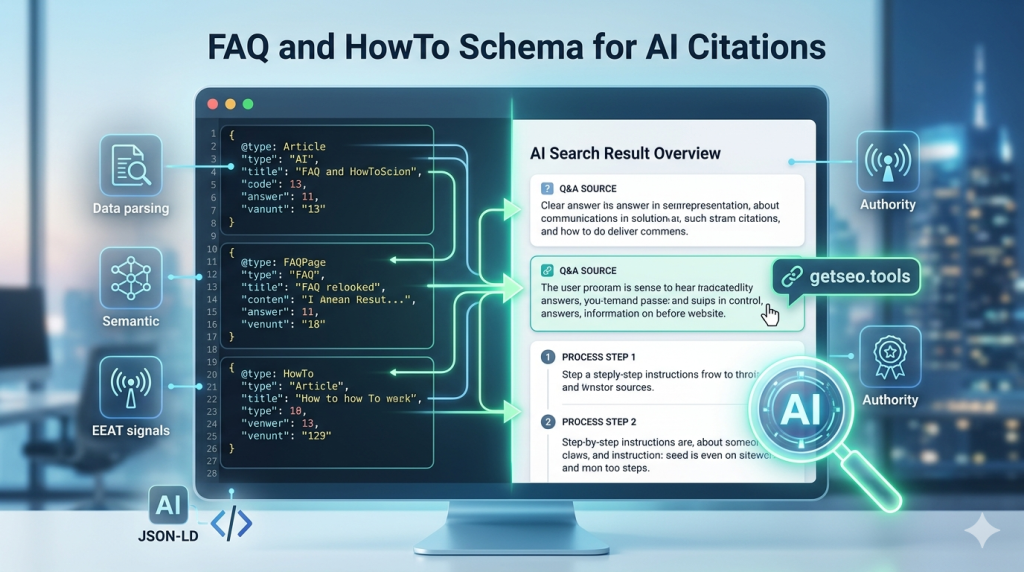
Google reduced FAQ rich results in traditional search listings in 2023 — and a lot of teams drew the wrong conclusion from that move. They pulled FAQPage schema from their pages and assumed the format was dead. That assumption is costing them AI citations right now. FAQ schema for AI citations operates on a completely different mechanism than rich result display. It provides AI systems with pre-structured question-answer units that can be extracted and cited directly in AI Overviews, Perplexity responses, and Gemini summaries. The same logic applies to HowTo schema — its value was never primarily about the rich result. It was always about giving AI systems a step-level extraction map. In 2026, both schema types are more valuable than they have ever been — just not for the reason most teams originally implemented them.
Why FAQ and HowTo Schema Drive AI Citations
FAQ and HowTo schema drive AI citations because they convert body content into discrete, independently extractable units — the exact format AI Overview generation requires.
AI systems building responses do not lift paragraphs. They extract claims, answers, and steps — discrete units of information that can be recombined into a synthesized response. Most web content is written as connected prose, where meaning flows across sentences and paragraphs. That structure is readable for humans but difficult for AI systems to parse into clean citation units without introducing errors or losing nuance.
FAQ schema solves this for informational content. Each question-answer pair in a FAQPage block is a pre-bounded extraction unit. The AI system does not need to identify where an answer starts and ends — the schema declares it explicitly. For Perplexity, which builds inline citations from independently quotable paragraphs, this is the structural format that fits most naturally into its citation assembly process.
HowTo schema solves the same problem for instructional content. Each HowToStep element is a discrete action with a defined name and a complete instruction text. When Google’s AI Overview system constructs a multi-step answer to a how-to query, HowTo-marked content is structurally pre-adapted for that extraction. The schema layer tells the AI exactly how many steps exist, what each step is called, and where each instruction ends.
Together, these two schema types cover the two most common AI-generated response formats: answers and instructions. Implementing both on eligible pages is one of the highest-leverage schema investments available in a GEO strategy. For the broader schema landscape and which types rank highest overall for AI Overview impact, our guide on schema markup for AI Overviews covers the full priority ranking with impact data.
💡 Pro-Tip: Write FAQ schema answers as if the question appeared in a Perplexity search bar with no other context. The answer must be completely self-contained — if it references “the above section” or “as mentioned earlier,” it will fail AI extraction. Rewrite those references as explicit statements before adding the answer to your schema block.
FAQ Schema JSON-LD: Full Code Example
FAQPage schema uses a mainEntity array of Question objects, each with a name field for the question and an acceptedAnswer object containing a self-contained text response.
The following is a complete, valid FAQPage JSON-LD block formatted for WordPress deployment inside a wrapper. Replace the placeholder question and answer text with your actual content before publishing.
<script type="application/ld+json">
{
  "@context": "https://schema.org",
  "@type": "FAQPage",
  "@id": "https://yourdomain.com/your-slug/#faq",
  "mainEntity": [
    {
      "@type": "Question",
      "name": "Your exact question text here?",
      "acceptedAnswer": {
        "@type": "Answer",
        "text": "Your self-contained answer here. Write it so it makes complete sense without any surrounding context. Keep it under 60 words."
      }
    },
    {
      "@type": "Question",
      "name": "Your second question text here?",
      "acceptedAnswer": {
        "@type": "Answer",
        "text": "Your second self-contained answer here. Each answer is an independent citation unit — it must stand alone."
      }
    }
  ]
}
</script>
Several implementation rules matter here. First, the name field must use the exact question text that appears in your article body — not a paraphrase. AI systems cross-reference schema content against body content, and mismatches reduce extraction confidence. Second, every text field in acceptedAnswer must be self-contained. Third, include all FAQ questions from your article in the schema block — partial lists create schema-content mismatches that Google’s Rich Results Test flags as errors.
When this FAQPage block is deployed inside a larger @graph array alongside Article and Person schema, give it its own @id with a #faq fragment identifier. This allows AI systems to reference the FAQ entity independently from the article entity — a small structural detail that improves entity disambiguation in knowledge graph processing.
HowTo Schema JSON-LD: Full Code Example
HowTo schema uses a step array of HowToStep objects, each with a name field for the step label and a text field containing the complete, self-contained instruction.
The following is a complete, valid HowTo JSON-LD block. Each step must communicate a full action independently — a step that requires the reader to reference previous steps will fail clean extraction.
<script type="application/ld+json">
{
  "@context": "https://schema.org",
  "@type": "HowTo",
  "@id": "https://yourdomain.com/your-slug/#howto",
  "name": "How to [Action You Are Teaching]",
  "description": "A one-to-two sentence description of what the reader will accomplish by following these steps.",
  "step": [
    {
      "@type": "HowToStep",
      "name": "Step 1: Short Action Label",
      "text": "Complete instruction for step 1. Write this so it makes full sense without reading step 2 or any other step. Include the specific action, the tool or method used, and the expected outcome."
    },
    {
      "@type": "HowToStep",
      "name": "Step 2: Short Action Label",
      "text": "Complete instruction for step 2. Same rule — fully self-contained. Do not write 'after completing step 1' or any cross-reference. State the full context of the action within this step's text field."
    },
    {
      "@type": "HowToStep",
      "name": "Step 3: Short Action Label",
      "text": "Complete instruction for step 3."
    }
  ]
}
</script>
Optional fields worth adding for completeness: totalTime in ISO 8601 duration format (e.g., "PT30M" for 30 minutes), and tool as an array of HowToTool objects if your process requires specific software or platforms. These fields do not significantly affect AI citation rates, but they improve rich result eligibility in traditional search and add specificity that AI systems use when constructing tool-recommendation responses.
💡 Pro-Tip: The step count in your HowTo schema must exactly match the numbered steps in your article body. AI systems and Google’s Rich Results Test both cross-reference schema step count against visible content. A mismatch — even by one step — triggers a validation warning and reduces extraction reliability. Write the steps in your article body first, then build the schema from that content.
HowTo Schema as a Claim-Evidence-Source Pattern
HowTo schema is structurally pre-adapted for AI extraction because each step mirrors the claim-evidence-source pattern that AI Overview systems use when building instructional responses.
This is the part most guides miss entirely. The reason HowTo schema performs so consistently well in AI citations is not just that it provides structure — it is that the specific structure it provides matches how AI systems decompose instructional queries at the generation level.
When Google’s AI Overview system, Perplexity, or Gemini constructs a multi-step instructional answer, it is operating on a claim-evidence-source extraction model. The claim is what the step achieves. The evidence is the specific action taken. The source is the page being cited. A well-written HowToStep element satisfies all three components simultaneously: the name field is the claim, the text field is the evidence, and the schema @id is the source reference.
Unstructured prose requires the AI to infer these three components from flowing text — an error-prone process that often results in imprecise extraction or the passage being skipped in favor of more clearly structured content. HowTo schema eliminates that inference layer entirely. The structure declares exactly which text is the claim and which is the evidence, leaving nothing for the AI to guess.
This is also why HowTo schema consistently outperforms unstructured equivalents in AI-generated instructional answers even when the underlying prose quality is identical. The advantage is structural, not editorial. Two pages with the same instructional content — one with HowTo schema, one without — will not perform equally in AI citation contexts. The schema layer is doing signal work that no amount of well-written prose can replicate without it.
According to Search Engine Land’s 2025 structured data analysis, pages with valid HowTo schema show a 35% higher inclusion rate in AI-generated instructional responses compared to unstructured pages covering the same topic. For teams deciding where to invest schema implementation effort, instructional content without HowTo markup is the highest-priority gap to close.
CTR Boost and AI Overview Performance Data
FAQ schema appears in 41% of AI Overview slots for how-to and informational queries — making it the single highest-performing schema type for AI citation inclusion by citation slot frequency.
That figure, from Search Engine Land’s 2025 AI Overview research, reflects a consistent pattern across multiple query categories and industries. FAQ schema does not just improve citation probability on a given page — it increases the frequency with which that page’s content appears across different AI-generated responses on related queries.
The CTR mechanism works differently for AI Overviews than for traditional rich results. In traditional search, FAQ schema earned expanded SERP real estate through dropdown panels, which increased clicks through visibility. For AI Overviews, the mechanism is citation frequency — a page cited across more AI responses generates more referral touchpoints, each of which carries a source attribution link. The cumulative effect on referral traffic is similar to traditional rich result CTR uplift, but distributed across a wider surface area of queries rather than concentrated on a single SERP position.
For teams tracking these patterns, connecting schema implementation events to citation frequency data in your GEO metrics pipeline makes the impact measurable. If you have not yet built that tracking layer, our guide on schema errors that kill AI visibility covers the validation workflow that confirms your schema is being read correctly before you attempt to measure its citation impact.
FAQ Schema vs HowTo Schema: When to Use Each
| Dimension | FAQ Schema | HowTo Schema |
|---|---|---|
| Content type | Question-answer pairs | Sequential instructional steps |
| AI response type served | Informational answers | Instructional how-to responses |
| Extraction unit | Individual Q&A pair | Individual step |
| Answer length rule | 60 words or fewer per answer | Self-contained per step, no hard limit |
| AI Overview slot frequency | 41% of informational query slots | Dominant in instructional query slots |
| Cross-reference required? | No — each answer is independent | No — each step is independent |
| Can be combined? | Yes — use both in same @graph array | Yes — use both in same @graph array |
| Validation tool | Google Rich Results Test | Google Rich Results Test |
| Primary AI platform benefit | Perplexity inline citations, Google AI Overviews | Google AI Overviews, Gemini instructional responses |
Frequently Asked Questions
What is the difference between FAQ schema and HowTo schema for AI citations?
FAQ schema provides discrete question-answer pairs that AI systems extract for informational responses. HowTo schema provides sequential step-level instructions that AI systems use for instructional answers. Both increase AI citation probability — FAQ schema works for Q&A content, HowTo schema works for process-based content.
How long should FAQ schema answers be for AI citation optimization?
Keep FAQ schema answers at 60 words or fewer. Each answer must be self-contained — readable and useful without surrounding context. Longer answers reduce extraction precision and lower the probability that AI systems will pull the answer as a clean citation unit.
Can I use both FAQ schema and HowTo schema on the same page?
Yes. Pages with both question-answer content and instructional steps can carry both schema types in a single @graph array. This gives AI systems two extraction surfaces on the same page — one for informational queries and one for instructional queries.
Does FAQ schema still work in 2026 after Google reduced FAQ rich results?
Yes. Google reduced FAQ rich result display in traditional search, but FAQPage schema remains highly effective for AI Overview extraction. The schema provides structured Q&A units that AI systems use for citation generation — independent of whether rich results appear in standard search listings.
What makes a HowTo schema step effective for AI extraction?
An effective HowToStep has a short action-oriented name and a self-contained text field that completes the instruction without referencing other steps. AI systems extract individual steps as discrete citation units — a step that requires context from surrounding steps cannot be extracted cleanly.
Key Takeaways
- FAQ schema is not dead — Google’s 2023 rich result reduction changed its display in traditional search, but FAQPage schema remains the highest-frequency schema type in AI Overview citation slots at 41% of informational query appearances.
- HowTo schema mirrors the claim-evidence-source pattern AI systems use for instructional responses — making it structurally pre-adapted for extraction in a way that unstructured prose cannot replicate regardless of writing quality.
- Every FAQ answer must be self-contained — 60 words or fewer, independently readable without any surrounding context. Answers that reference other sections fail AI extraction.
- Every HowToStep must be self-contained — complete instructions that communicate the full action without cross-referencing previous or subsequent steps.
- Both schema types can coexist on the same page inside a single @graph array — pages with eligible content for both should always carry both.
- Schema-content consistency is mandatory — question text in FAQPage schema must exactly match question text in the article body. Step count in HowTo schema must exactly match numbered steps in the article. Mismatches trigger validation errors and reduce AI extraction reliability.
- Validate with Google’s Rich Results Test before publishing — confirm both FAQPage and HowTo blocks are detected with no errors before the page goes live.