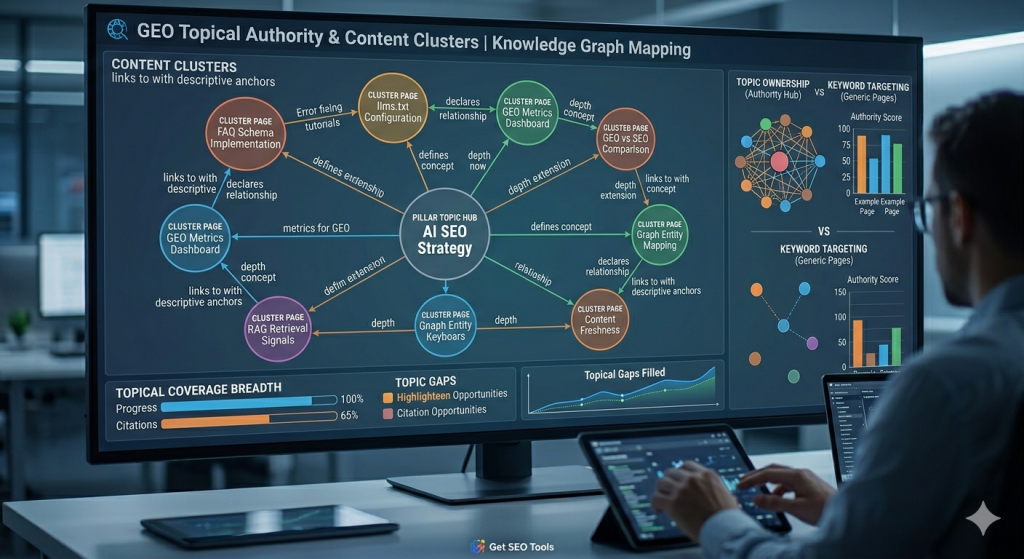
AI systems do not cite pages. They cite topics. When Perplexity decides which source to pull for a question about schema markup, it does not evaluate individual pages in isolation. It evaluates which domain owns the topic at the knowledge graph level — which site has the deepest, most consistently structured coverage of that subject area. That evaluation is GEO topical authority. And it is built differently from SEO domain authority. It does not require years of backlink accumulation. It requires a deliberate content architecture that AI knowledge graphs can map, verify, and trust. Most sites have the content to build it. Almost none have the structure.
Why Topical Authority Drives AI Citations — Not Just Google Rankings
AI systems use topical authority as a proxy for source reliability — and they measure it through content cluster coverage, not domain age or backlink count.
Google’s ranking algorithm built domain authority as a trust signal over three decades. Backlinks from credible sources accumulate into a domain-level score that predicts ranking reliability. That model works for search because search ranking is retrospective — it rewards past behaviour with future visibility.
AI citation systems work differently. They need to assess source reliability in real time, for topics that may be niche or emerging, on domains that may not yet have extensive backlink profiles. They use topical depth as the proxy. A site with 15 interconnected pages on schema markup — pillar overview, individual schema type guides, error fixing tutorials, tool comparisons — signals deep topical knowledge through its content architecture. An AI system processing a schema question can map that architecture and infer: this domain owns this topic.
A site with one broad schema overview page — even a well-written, heavily linked one — signals a topic touchpoint, not topic ownership. The difference in citation frequency between those two site architectures is significant and measurable.
This is the shift that most content teams have not fully absorbed. SEO rewards individual pages for individual keywords. GEO rewards site architectures for topic ownership. Building topical authority for GEO means designing your content inventory as a knowledge system — not as a collection of individually optimised pages.
For the full strategic framework connecting topical authority to long-tail keyword coverage and AI citation velocity, our GEO long-tail keyword strategy guide covers how cluster architecture drives citation frequency across Perplexity, Gemini, and ChatGPT simultaneously.
💡 Pro-Tip: Before building new content, map your existing content against a topic hierarchy. List every page you have on your core subject areas and group them by topic, not by keyword. The groups with one or two pages are your thinnest authority signals. The groups with five or more interconnected pages are your strongest AI citation assets. That map tells you where to invest next — filling gaps in strong topic groups produces more citation value than starting new topic areas from scratch.
Pillar-Cluster Architecture: How AI Systems Map Topic Ownership
A pillar-cluster architecture signals topical authority to AI knowledge graphs by creating a structured hub-and-spoke content topology that maps directly onto how AI systems organise information.
The pillar page is the topic hub. It covers the subject at the overview level — defining the concept, mapping the subtopics, and linking to each cluster page that covers a specific subtopic in depth. The pillar page does not need to be the longest or most detailed page on the topic. It needs to be the most comprehensive in terms of scope — touching every relevant subtopic and signalling that the site has depth coverage on each.
Cluster pages are the topic depth layer. Each cluster page owns a specific subtopic — a single well-defined aspect of the pillar topic that can be covered completely without overlapping the territory of other cluster pages. The boundaries matter. A cluster page that covers the same ground as another cluster page creates topical ambiguity in AI knowledge graph processing. Each cluster page should be describable in one precise sentence that does not overlap with any other page in the cluster.
For AI knowledge graph processing, the key signal is the combination of topical coverage breadth and internal linking specificity. A pillar with eight cluster pages — each linked with descriptive anchor text that names the subtopic precisely — creates a knowledge graph node with mapped relationships. Gemini and Google’s AI systems can navigate that node structure to identify the domain as an authority source on the pillar topic and all covered subtopics simultaneously.
The minimum viable cluster for meaningful AI authority signalling is five to eight cluster pages per pillar. Below five, the coverage appears incomplete. Above twelve, individual cluster pages start competing with each other for similar subtopics rather than adding distinct coverage. The sweet spot produces breadth without overlap — which is the topology AI knowledge graph processing is designed to recognise.
Internal Linking Topology: The Signal Most GEO Guides Skip
Internal linking topology — the specific pattern of how cluster pages connect to each other and to the pillar — is one of the strongest GEO topical authority signals available, and almost no GEO guide covers it in depth.
Most internal linking advice focuses on SEO PageRank flow. Link from high-authority pages to pages you want to rank. Use keyword-rich anchor text. Keep link depth shallow. That advice is correct for SEO. For GEO, it is incomplete.
AI knowledge graph processing reads internal links as relationship declarations. When cluster page A links to cluster page B with the anchor text “HowTo schema step-level markup,” it declares a topical relationship: these two pages are part of the same knowledge domain and the second page is a depth extension of the concept named in the anchor. That relationship declaration builds a knowledge graph edge between the two entities.
Enough edges between enough pages on the same topic cluster build a knowledge graph subgraph. AI systems recognise that subgraph as evidence of topic ownership — not just topic coverage. The difference is that coverage means you have pages on a topic. Ownership means the pages are structured as a coherent knowledge system with declared relationships between them.
The practical implication is that anchor text specificity matters more for GEO than for SEO. Generic anchor text — “read more,” “click here,” “this article” — passes SEO link equity but declares no topical relationship. Specific anchor text — “how to implement FAQ schema for AI citations” — passes link equity AND declares a precise topical relationship that AI knowledge graph processing can map.
Every internal link is a double-duty signal when the anchor text is specific: SEO equity transfer plus GEO relationship declaration. Generic anchor text is a missed GEO opportunity on every page that uses it.
💡 Pro-Tip: Audit your current internal links by exporting your site’s link data from Ahrefs or Semrush and filtering for anchor text containing only generic phrases. Count how many internal links are using “here,” “read more,” “this guide,” or “click here” as anchors. Each one is a GEO relationship signal you are not sending. Replacing them with specific descriptive anchors requires no new content — just a systematic find-and-replace across your existing pages.
Building Cluster Coverage: How to Identify and Fill Topic Gaps
Topic gaps in your cluster architecture are the most direct cause of missing citation share on queries your content should be winning.
Here is how gaps form. A site publishes a pillar page on GEO strategy and three cluster pages covering schema, llms.txt, and metrics. A competitor publishes the same pillar plus eight cluster pages — adding content freshness, knowledge graphs, topical authority, GEO vs SEO comparison, and a unified strategy guide. On queries related to the five topics the competitor covers that you do not, the competitor earns citations. You do not appear — not because your existing content is weaker, but because you have no pages in those citation slots at all.
Identifying gaps requires mapping your cluster coverage against the full topic space. Start with your pillar topic. List every distinct subtopic a comprehensive treatment of that subject would require. Then check which of those subtopics you have cluster pages for. Each uncovered subtopic is a gap. Each gap is a citation opportunity your competitor can own by default.
Prioritise gaps by query demand. Some subtopics generate high AI citation activity — many users ask AI systems about them. Others are peripheral. Use your GSC query data and manual Perplexity checks to identify which uncovered subtopics are actively generating citations for competitors. Those high-demand gaps are your priority content investments.
For teams connecting gap identification to a structured content freshness strategy, our guide on content freshness signals for AI search covers how to refresh existing cluster pages to maintain citation share while new gap-filling content is being published.
The Topic Ownership Audit Framework
The topic ownership audit is a practical diagnostic that separates pages that genuinely own a topic from pages that merely target a keyword — and the difference in AI citation performance between those two categories is significant.
The audit runs on a single test applied to every page in your content inventory. The test: can you describe what this page owns in one sentence as a concept rather than a keyword phrase?
A page that passes the test has a clear topic ownership statement. “This page owns the complete process for implementing FAQ schema in JSON-LD — from writing the markup to validating it and deploying it in WordPress.” That is a concept. It describes a knowledge domain the page covers completely.
A page that fails the test has only a keyword target. “This page targets ‘FAQ schema JSON-LD examples’.” That is a keyword. It describes a search query, not a topic the page owns. Pages that fail this test are keyword-targeted rather than topic-owned — and they consistently underperform in AI retrieval regardless of how technically optimised they are.
Run the audit on your top 20 pages by organic impressions from GSC. Apply the single-sentence test to each. Pages that fail become your restructuring list — each needs to be expanded into a full topic hub that covers related questions, subtopics, and named entities explicitly. Pages that pass are your existing GEO authority assets — confirm they have valid schema, specific internal links, and current content before moving on.
The audit output is a prioritised action list. Not a content calendar filled with new pages — a specific list of existing pages that need to become topic hubs rather than keyword targets. This restructuring produces faster GEO authority gains than creating new content because you are deepening existing pages that already have organic impressions and crawl history.
For teams connecting this audit to entity-level optimisation and knowledge graph mapping, our guide on GEO knowledge graph and entity mapping covers how to connect the topic ownership structure identified in this audit to the entity relationships that feed AI knowledge graph confidence scoring.
Topical Authority: Keyword Targeting vs Topic Ownership
| Dimension | Keyword Targeting | Topic Ownership |
|---|---|---|
| Page purpose | Rank for a specific search query | Own a complete knowledge domain |
| Content scope | Covers what the keyword requires | Covers the full topic including adjacent questions |
| Internal linking | Links for PageRank flow and anchor text match | Links declare topical relationships with specific anchor text |
| AI knowledge graph signal | Topic touchpoint — site covers this keyword | Topic hub — site owns this knowledge domain |
| Citation pattern | Cited occasionally when the exact keyword query appears | Cited consistently across all related queries in the topic cluster |
| Authority building speed | Slow — depends on backlink accumulation | Faster — depends on content architecture and schema |
| Audit test | Fails the one-sentence concept test | Passes the one-sentence concept test |
| GEO performance ceiling | Limited to queries matching the target keyword | Extends to all queries within the owned topic domain |
Frequently Asked Questions
What is GEO topical authority and how is it different from SEO authority?
GEO topical authority is recognition by AI systems that your site owns a specific topic area — built through cluster coverage, internal linking topology, and entity schema. SEO authority is built through backlinks over time. GEO authority is built through structural topic ownership that AI knowledge graphs can map and verify directly from your content architecture.
How many cluster pages does a pillar need to signal topical authority to AI systems?
A pillar page needs a minimum of five to eight cluster pages covering distinct subtopics to signal meaningful topical authority to AI knowledge graphs. Each cluster page must address a different specific question or use case. Coverage breadth matters more than cluster page length for AI authority signalling.
Does internal linking affect GEO topical authority?
Yes. Internal links with descriptive anchor text signal topical relationships to AI knowledge graph processing. A pillar page linked from five cluster pages with specific anchor text creates a clear topic hub signal. Generic anchor text provides no topical relationship signal — it only passes link equity for SEO purposes.
How do I identify gaps in my GEO topical authority?
Export your top 20 pages by impressions from Google Search Console. For each page, apply the topic ownership test: can you describe what this page owns in one sentence as a concept rather than a keyword? Pages that fail this test are keyword-targeted rather than topic-owned. Each failure is a gap in your topical authority architecture.
Can a new site build GEO topical authority faster than SEO authority?
Yes. GEO topical authority builds through content cluster coverage and schema — neither of which requires external validation through backlinks. A new site can establish AI knowledge graph recognition for a specific topic within 60 to 90 days by publishing a complete pillar-cluster architecture with valid entity schema. SEO domain authority takes 6 to 12 months minimum.
Key Takeaways
- AI systems cite topics, not pages — GEO topical authority is built through content cluster architecture that AI knowledge graphs can map as a coherent knowledge system, not through individual page optimisation.
- Pillar-cluster architecture is the core GEO authority signal — five to eight cluster pages per pillar, each covering a distinct subtopic, creates the knowledge graph subgraph that AI systems recognise as topic ownership.
- Internal link anchor text specificity is a double-duty signal — specific descriptive anchors pass SEO link equity AND declare topical relationships for AI knowledge graph processing simultaneously.
- Topic gaps directly cause missing citation share — on queries related to uncovered subtopics, competitors earn citations by default regardless of how strong your existing content is.
- The topic ownership audit separates topic owners from keyword targeters — pages that cannot be described in one sentence as a concept are keyword-targeted and will consistently underperform in AI retrieval.
- Restructuring existing pages produces faster GEO authority gains than creating new content — deepening pages that already have crawl history and organic impressions beats building new pages from scratch.
- GEO topical authority builds faster than SEO domain authority — a complete pillar-cluster architecture with valid entity schema can establish AI knowledge graph recognition within 60 to 90 days.