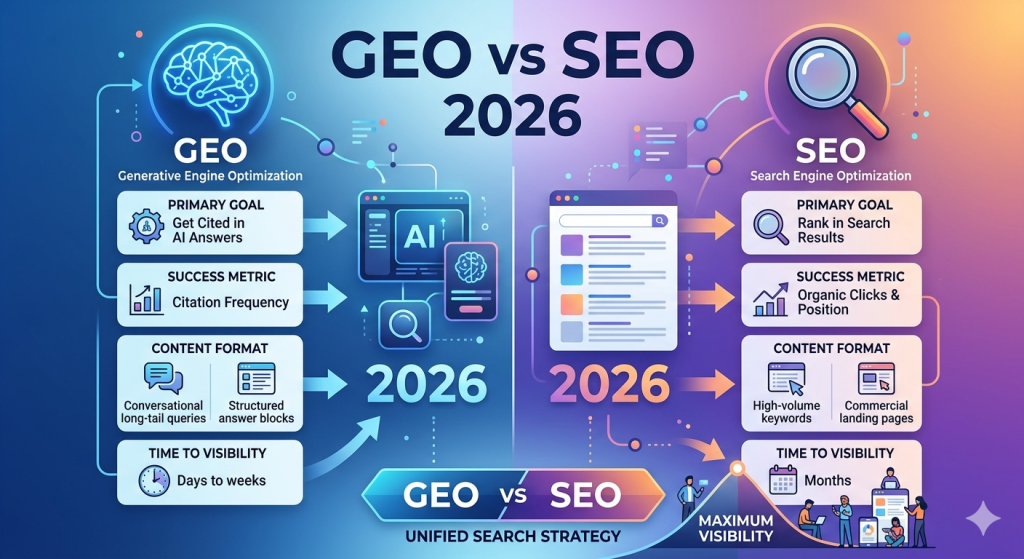
Search changed in 2026 — and most teams are still optimising for the version that no longer dominates. GEO vs SEO is not a debate about which strategy is better. It is a question of which surface you are optimising for. SEO targets Google’s ranking algorithm. GEO targets the citation logic of AI systems like Perplexity, Gemini, and ChatGPT. Both surfaces now carry real traffic. Both require different content structures, different signals, and different success metrics. Running only one means leaving visibility — and revenue — on the table.
What GEO and SEO Actually Are — and Why 2026 Changed the Balance
SEO optimises for ranking. GEO optimises for citation. The distinction sounds simple — but the implications run deep.
SEO — Search Engine Optimisation — has been the dominant visibility strategy since the late 1990s. It works by earning ranking positions in Google through a combination of backlinks, keyword targeting, technical health, and content relevance. The goal is a high position in Google’s results page. Success is measured in organic clicks and ranking positions.
GEO — Generative Engine Optimisation — is the newer discipline. It focuses on getting your content cited inside AI-generated answers. When a user asks Perplexity a question, the response cites sources inline. When Gemini generates an AI Overview in Google Search, it pulls from specific pages. When ChatGPT answers a research question, it references its sources. GEO is the process of making your content the one that gets selected for those citation slots.
The old thinking was: rank on Google, and the rest follows. The new reality is: AI systems now handle a significant and growing share of information queries — and they do not use Google’s ranking algorithm to decide what to cite. A page that ranks number one on Google can still be invisible in AI-generated answers if it lacks the structured signals GEO requires.
That shift is what makes the GEO vs SEO question relevant in 2026. For the strategic framework that connects both disciplines into a single content system, our GEO long-tail keyword strategy guide covers the full unified approach — including how long-tail content serves both ranking and citation simultaneously.
💡 Pro-Tip: Audit your top 10 traffic pages in Google Search Console. Then manually query their main topics in Perplexity and ChatGPT. If your pages appear in Google rankings but not in AI responses, you have a GEO gap — not a content quality problem. The fix is structural and schema-based, not editorial.
Where GEO Wins and Where SEO Wins
GEO wins on speed, long-tail coverage, and brand authority in AI responses. SEO wins on sustained traffic volume, commercial intent queries, and local search.
GEO performs best on informational queries — the kind users ask conversationally. “What is the best way to structure schema for AI?” or “How does Perplexity decide what to cite?” These are the queries AI systems handle directly. Long-tail conversational content built for GEO intercepts these queries at the AI layer before they ever reach Google’s results page.
GEO also builds brand authority in a way traditional SEO cannot replicate. When your content is cited repeatedly in AI-generated answers, your brand name appears as a trusted source across thousands of responses. That visibility compounds. Users who see your brand cited multiple times across different AI responses develop familiarity and trust — without ever clicking through to your site from a Google result.
SEO still dominates commercial intent. “Buy project management software,” “best CRM for small business,” or “accountant near me” — these queries still route through Google’s results page. The purchase intent is there, and Google’s shopping and local search features serve it better than any current AI response format. For conversion-focused traffic, SEO remains the more direct path.
SEO also wins on sustained volume. A well-ranked page on Google can drive consistent organic traffic for years with minimal maintenance. AI citation patterns shift more frequently — new content enters the citation pool regularly, and older content can lose citation share as fresher alternatives appear. SEO provides a more predictable traffic floor. GEO provides faster initial visibility and broader topic coverage.
Traffic vs Citations: The Real Metric Difference
SEO success is measured in organic clicks. GEO success is measured in citation frequency — how often your content appears as a named source in AI-generated responses.
This metric difference matters more than it looks. A page cited frequently in Perplexity responses generates referral traffic through source attribution links. According to BrightEdge’s 2025 AI search research, AI Overview CTR averages 0.8% compared to organic CTR of 3 to 5% for traditional results. The click rate is lower — but the brand exposure from citation is significantly broader than a single ranking position provides.
Citations also compound differently than rankings. A page that ranks number three on Google competes with positions one and two for the same click. A page that earns citations across multiple AI platforms — Perplexity, Gemini, and ChatGPT — accumulates visibility across three separate surfaces simultaneously. Each citation is an independent brand touchpoint.
The practical implication for reporting is that GEO requires different dashboards and different KPIs than SEO. Tracking Google ranking positions tells you nothing about AI citation performance. For teams building GEO measurement workflows, our guide on how to track AI citations for free covers the monitoring methods that connect citation frequency to measurable traffic outcomes.
💡 Pro-Tip: Set up a weekly manual citation check. Query your five most important topics in Perplexity and ChatGPT. Note whether your domain appears as a cited source. Track this consistently for 90 days and you will have a reliable baseline that shows whether your GEO strategy is gaining or losing ground — without needing any paid tool.
Per-Platform Citation Mechanics: How Each AI System Cites Differently
Perplexity, Gemini, and ChatGPT each use a different citation logic — and content that satisfies all three simultaneously requires a unified approach, not three separate strategies.
Perplexity requires independently quotable paragraphs. Each paragraph must make complete sense without surrounding context. Perplexity pulls discrete content units from indexed pages and assembles them into inline citations. Content written as flowing prose — where meaning builds across paragraphs — is structurally harder for Perplexity to cite than content written as standalone answer blocks.
Gemini applies E-E-A-T signals before citation selection. Author schema, organizational authority, and external source credibility all feed into Gemini’s decision. A page with strong content but no verified author entity is at a structural disadvantage against a weaker page that carries confirmed Person schema with LinkedIn and Google Scholar sameAs links.
ChatGPT routes citations through the Bing index. Bing crawlability and domain authority directly influence which pages ChatGPT selects when building responses. Many teams track Google Search Console closely but never check their Bing Webmaster Tools data — which means they have no visibility into a signal that directly affects ChatGPT citation frequency.
The three mechanisms are not competing requirements. They overlap and reinforce each other. Independently quotable content satisfies Perplexity. Author and organization schema satisfies Gemini’s E-E-A-T filter. Bing indexability satisfies ChatGPT’s source routing. A single well-structured page with valid schema and clean Bing indexing can earn citations across all three platforms simultaneously.
This unified framework is covered in depth in the GEO long-tail keyword strategy guide — which owns the full cross-platform citation mechanics as a reference framework. For teams ready to combine GEO and SEO into a single operational funnel, our guide on unified GEO and SEO strategy for SaaS sites covers the practical integration at the content and conversion level.
GEO vs SEO: Full Comparison Table
| Dimension | SEO | GEO |
|---|---|---|
| Primary goal | Rank in Google search results | Get cited in AI-generated answers |
| Success metric | Organic clicks, ranking position | Citation frequency, AI impression share |
| Primary platform | Perplexity, Gemini, ChatGPT, Google AI Overviews | |
| Content format preference | Broad informational pages, commercial landing pages | Long-tail conversational content, FAQ blocks, structured guides |
| Key signals | Backlinks, keyword relevance, Core Web Vitals, technical health | Schema markup, entity authority, independently quotable structure, llms.txt |
| Time to visibility | 3 to 12 months for competitive terms | Days to weeks for long-tail AI queries |
| CTR benchmark | 3 to 5% average organic CTR | 0.8% average AI Overview CTR (BrightEdge 2025) |
| Best for query type | Commercial intent, local search, navigational queries | Informational, conversational, research queries |
| Authority building | Domain authority through backlinks over time | Entity authority through schema and verified profiles |
| Monitoring tools | Google Search Console, Semrush, Ahrefs | Manual citation checks, Authoritas, SE Ranking, GSC AI impressions |
| Traffic floor stability | High — rankings are relatively stable once established | Medium — citation patterns shift as new content enters the pool |
| Can replace the other? | No — does not cover AI citation surfaces | No — does not cover Google ranking or commercial intent |
Decision Framework: When to Prioritise GEO, SEO, or Both
The right prioritisation depends on your content type, timeline, and the search surfaces your audience actually uses.
Prioritise GEO first if your primary content is informational, your audience uses AI tools for research, and you need visibility faster than a 6-month SEO build cycle allows. Early-stage SaaS companies, research-heavy blogs, and technical documentation sites all fit this profile. GEO can generate citation visibility within weeks for well-structured long-tail content — without the link-building investment SEO requires at the start.
Prioritise SEO first if your primary goal is conversion-focused traffic — product pages, service landing pages, or local visibility. Google still owns commercial intent. A GEO-first strategy for a transactional page is solving the wrong problem. Build the Google ranking foundation first, then layer GEO signals on top as the content matures.
Run both simultaneously if you are an established site with existing content that can be retrofitted for GEO. Adding schema, improving entity markup, and restructuring content for independent quotability does not require creating new pages. It upgrades existing ones. For most sites past their initial launch phase, the correct answer is not GEO or SEO — it is GEO and SEO, applied to the right content types in the right sequence.
According to Search Engine Land’s 2025 AI search analysis, sites running combined GEO and SEO strategies showed 34% higher total search visibility than sites running either strategy in isolation. The gains were additive — GEO did not cannibalise SEO performance, and SEO authority reinforced GEO citation credibility.
Frequently Asked Questions
What is the main difference between GEO and SEO?
SEO optimizes content to rank in Google’s search results through backlinks, keywords, and technical signals. GEO optimizes content to be cited by AI systems like Perplexity, Gemini, and ChatGPT through structured data, entity authority, and independently quotable content. Both target search visibility — but through different mechanisms.
Is GEO faster than SEO for getting visibility?
Yes. Perplexity and ChatGPT reindex content faster than Google’s 90 to 180 day authority build cycle. Well-structured content targeting long-tail queries can appear in AI citations within days of publishing. SEO ranking for competitive terms typically takes months of link building and authority development.
Should I choose GEO or SEO for my site in 2026?
Most sites need both. SEO drives Google ranking and organic traffic. GEO drives AI citation visibility and brand authority in AI-generated answers. Running both simultaneously gives you coverage across traditional search and the growing AI search surface — which now accounts for a significant share of information queries.
Does GEO replace SEO?
No. GEO does not replace SEO — it extends it. Google still drives the majority of search traffic. GEO adds a parallel visibility layer that captures users querying through Perplexity, ChatGPT, and Gemini. The strongest content strategies in 2026 treat GEO and SEO as complementary, not competing.
What content works best for GEO but not necessarily for SEO?
Long-tail conversational content, structured FAQ responses, and step-level instructional guides perform best in GEO. These formats match AI prompt patterns precisely. In traditional SEO, broad informational pages with high search volume often outperform narrow long-tail content — the priority logic is reversed.
Key Takeaways
- GEO and SEO target different surfaces — SEO targets Google’s ranking algorithm, GEO targets AI citation logic. Both surfaces now carry real traffic and both require separate optimisation strategies.
- GEO wins on speed and long-tail coverage — well-structured content can appear in AI citations within days. SEO ranking for competitive terms takes months of authority building.
- SEO still dominates commercial intent — purchase-driven queries, local search, and navigational queries still route through Google. GEO does not cover these effectively.
- Each AI platform cites differently — Perplexity requires independently quotable paragraphs, Gemini requires E-E-A-T schema signals, ChatGPT routes through the Bing index. One well-structured page can satisfy all three simultaneously.
- AI Overview CTR averages 0.8% versus 3 to 5% for organic results — but citation visibility compounds across multiple platforms and queries simultaneously, creating broader brand exposure than a single ranking position.
- Sites running both GEO and SEO show 34% higher total search visibility than sites running either strategy alone, according to Search Engine Land’s 2025 analysis.
- The correct default in 2026 is both — GEO for informational and long-tail content, SEO for commercial and high-volume terms, applied to the right content types in the right sequence.