
Most teams have no idea whether their content is being cited by AI platforms. They publish articles, optimise for Google, and assume GEO is working — or not working — based on gut feel. That assumption is expensive. Tracking AI citations is the only way to know whether your GEO strategy is actually producing results, which platforms are citing you, and where competitors are taking citation share you should be winning. The good news is that a reliable monitoring workflow does not require a paid tool. It requires a clear process and about 30 minutes per week.
Why Tracking AI Citations Is Not Optional in 2026
If you are not tracking AI citations, you are making GEO decisions without data — and most of those decisions will be wrong.
Here is the problem. GEO optimisation takes effort. You restructure content. You add schema. You update your llms.txt file. But without citation tracking, you have no idea whether any of it is working. You might be earning strong Perplexity citations and missing Gemini entirely. Or your top competitor might be taking citation share on your most important queries while you optimise pages that were never in contention.
Citation tracking gives you three things you cannot get any other way. First, it tells you which of your pages are actually earning citations — not which ones you think should be earning citations. Second, it shows you which platforms are citing you and which are not, which reveals which specific GEO signals are missing. Third, it tells you when a competitor enters a citation slot you previously held — which is the earliest warning signal that your content needs a refresh.
The old approach was to wait for traffic changes in Google Analytics and work backwards. By the time a traffic drop shows up in your analytics, you have already lost weeks of citation share. Proactive citation monitoring catches those shifts while they are still recoverable.
💡 Pro-Tip: Before building your monitoring workflow, audit your top 10 pages in Google Search Console for AI Overview impressions. Any page already earning AI Overview impressions is a confirmed GEO asset — start your manual citation checks on those pages first. They are the ones where citation monitoring will produce the most immediately actionable data.
Manual Tracking: How to Query AI Platforms Directly
Manual citation checking is the fastest way to confirm whether your content is appearing in AI responses — and it costs nothing except time.
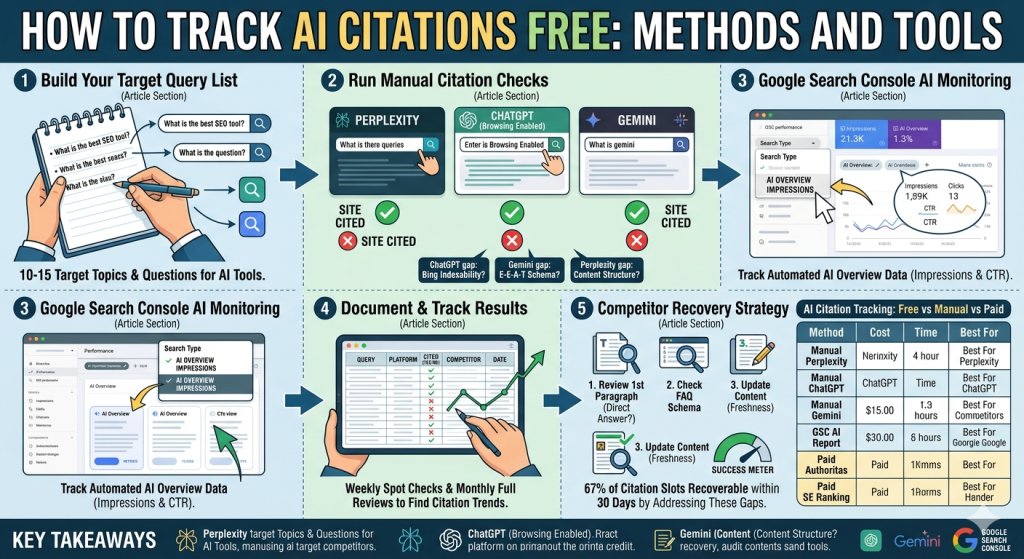
The process is straightforward. Open each AI platform — Perplexity, ChatGPT with web browsing enabled, and Gemini — and enter the specific queries your content targets. Not broad topic keywords. Specific questions that match the long-tail prompts your pages are built around.
On Perplexity, check the sources panel that appears alongside every response. Your domain either appears there or it does not. If a competitor appears instead, note which domain it is and what page they are citing. That page is the benchmark your content needs to beat for that query.
On ChatGPT, enable web browsing before running queries. ChatGPT with browsing routes citations through Bing. If your content does not appear, the likely causes are Bing indexability issues or weak domain authority on Bing specifically — neither of which shows up in Google Search Console data.
On Gemini, pay attention to which sources appear in the AI Overview when it generates a response. Gemini applies E-E-A-T signals before selecting citations. If you are missing from Gemini responses but present in Perplexity, the gap is almost always author schema or organisation entity markup — not content quality.
Document every check in a simple spreadsheet. Query, platform, cited or not, competitor cited if applicable, date. After 60 days of consistent tracking, patterns emerge clearly — which platforms cite you reliably, which queries you are losing, and which content updates are producing measurable citation improvements.
💡 Pro-Tip: When checking ChatGPT citations, run the same query twice — once with web browsing enabled and once without. If your content appears with browsing but not without, your site is Bing-indexed but not in ChatGPT’s training data. If it appears neither time, you have a Bing indexability gap. Knowing which gap you are dealing with changes the fix completely.
Free Tool Tracking: What Google Search Console Actually Shows You
Google Search Console is the only free tool that gives you automated AI citation data — specifically for Google AI Overviews — without requiring manual platform checks.
GSC now separates AI Overview impressions from standard organic impressions in the Search Results report. Navigate to the Performance section, then filter by search type. You will see AI Overview impressions as a distinct metric alongside clicks, position, and CTR data for each query and page combination.
This data tells you three important things. First, which of your pages are appearing inside Google AI Overviews — confirming which content Google’s AI system is extracting as citation-worthy. Second, which queries are triggering AI Overview appearances for your content — showing you the actual query patterns driving your GEO visibility. Third, the CTR from those AI Overview impressions — letting you compare AI Overview click performance against standard organic results on the same queries.
According to BrightEdge’s 2025 AI search research, AI Overview CTR averages 0.8% compared to 3 to 5% for standard organic results. That lower CTR does not mean AI Overviews are not valuable — it means the brand exposure from citation is broader than the click count suggests. A page with 10,000 AI Overview impressions and 80 clicks is still generating significant brand visibility across every one of those impressions.
GSC does not track Perplexity or ChatGPT citations. For those platforms, manual checking remains the primary free method. Specialist tools — Authoritas and SE Ranking both offer AI Overview and citation tracking features — add automation but come with subscription costs. For teams not ready for paid tools, the GSC plus manual workflow covers the essentials reliably.
Building a Monitoring Workflow That Does Not Take Over Your Week
An effective AI citation monitoring workflow takes under 30 minutes per week and produces actionable data within 60 days of starting.
The key is separating weekly spot checks from monthly full reviews. Weekly spot checks cover your five most competitive queries — the ones where citation share matters most and where competitor movement is most likely. Monthly full reviews cover your complete query list and include a GSC AI impression data pull.
Weekly workflow — under 15 minutes:
- Enter your top 5 queries in Perplexity. Note cited or not cited for each.
- Enter the same 5 queries in ChatGPT with browsing. Note cited or not cited.
- Update your tracking spreadsheet with results and date.
Monthly workflow — under 30 minutes:
- Run full query list across Perplexity, ChatGPT, and Gemini.
- Pull GSC AI Overview impression data for the past 30 days.
- Note any queries where citation share changed — gained or lost.
- Flag pages that lost citation share for content review.
- Update your query list to reflect any new content published that month.
The 90-day baseline is the milestone to target. After 90 days of consistent tracking, you have enough data to see trends rather than individual data points. Citation gains after a schema update become visible. Citation losses after a competitor publishes new content become detectable. That trend data is what turns citation monitoring from a passive record-keeping exercise into an active GEO performance lever.
For teams ready to move beyond manual tracking and build a full GEO performance dashboard, our guide on building a GEO metrics dashboard covers the full dashboard build — including GSC integration, citation API connections, and how to visualise GEO performance in Looker Studio.
What to Do When a Competitor Is Cited Instead of You
When a competitor earns a citation your page should be winning, the problem is almost always one of three things: their content answers the query more directly, their schema is cleaner, or their content is more recently updated.
Start by opening the competitor’s cited page and reading the first paragraph. If their opening sentence answers the target query directly and yours does not, that is the fix. Rewrite your introduction to lead with a direct answer — under 50 words, self-contained, immediately useful. That single change resolves more lost citation slots than any other edit.
If their first paragraph is similar to yours, check their schema. Run both pages through Google’s Rich Results Test. If they have valid FAQPage schema and you do not — or if their schema covers the specific query topic and yours covers something adjacent — schema is the gap. Add or update your FAQ schema to address the specific query pattern you are losing.
If content quality and schema are comparable, check the publish and update dates. AI systems apply freshness signals. A competitor’s page updated three months ago will often beat your page last updated 18 months ago — even if your original content was stronger. A targeted update that adds new data, a new FAQ question, or a revised opening section is often enough to recapture the citation slot.
According to Search Engine Land’s 2025 GEO analysis, 67% of citation slot losses to competitors were resolved within 30 days when teams addressed the first-paragraph structure and schema gaps identified through manual citation checking. The fixes are not complex. The monitoring is what makes them findable.
AI Citation Tracking Methods: Free vs Manual vs Paid
| Method | Cost | Platforms Covered | Time Required | Best For |
|---|---|---|---|---|
| Manual Perplexity checks | Free | Perplexity | 5 min per query set | Weekly spot checks on top queries |
| Manual ChatGPT checks | Free (basic) / Paid (browsing) | ChatGPT | 5 min per query set | Bing indexability verification |
| Manual Gemini checks | Free | Gemini | 5 min per query set | E-E-A-T signal gap identification |
| GSC AI Overview report | Free | Google AI Overviews only | 10 min monthly pull | Automated impression and CTR data |
| Authoritas | Paid | Google AI Overviews, some Perplexity | Automated | Scale monitoring across large query sets |
| SE Ranking | Paid | Google AI Overviews | Automated | AI Overview tracking integrated with SEO workflow |
Frequently Asked Questions
How do I check if my site is being cited by Perplexity?
Open Perplexity and enter the specific queries your content targets. Check the sources panel in the response — if your domain appears there, your content is being cited. Do this weekly for your top queries and document the results. No paid tool is required for basic citation monitoring.
Can Google Search Console track AI citations?
Google Search Console tracks AI Overview impressions separately from organic impressions. It shows which pages are appearing in Google’s AI Overviews and which queries trigger them. It does not track Perplexity or ChatGPT citations — those require manual checking or specialist tools like Authoritas and SE Ranking.
Are there free tools to track AI citations automatically?
Google Search Console is the only free tool with automated AI citation data — specifically for Google AI Overviews. Perplexity and ChatGPT citation tracking requires manual checks or paid tools like Authoritas and SE Ranking. A consistent manual workflow covering your top 10 queries takes under 30 minutes per week.
How often should I check my AI citation presence?
Check your top five queries weekly and your full query list monthly. AI citation patterns shift faster than Google rankings — a page that earns citations this week may lose them to a competitor’s fresher content next month. Weekly spot checks catch those shifts early enough to respond.
What does it mean if a competitor is cited instead of my site?
It means the competitor’s content is better structured for AI extraction on that query. Review their page for three things: whether their first paragraph answers the query directly, whether they have FAQ schema on that topic, and whether their content is more recently updated. These are the three most common reasons a page loses citation share to a competitor.
Key Takeaways
- Citation tracking is the only way to know if GEO is working — without it, you are making optimisation decisions without data and most of those decisions will be wrong.
- Manual platform checks cost nothing — querying Perplexity, ChatGPT, and Gemini directly with your target queries is the fastest way to confirm citation presence without any paid tool.
- Each platform gap reveals a different signal problem — missing from ChatGPT means a Bing indexability issue, missing from Gemini means an E-E-A-T schema gap, missing from Perplexity means a content structure problem.
- Google Search Console is the only free automated tool for AI citation data — it tracks Google AI Overview impressions and CTR separately from standard organic results.
- A weekly workflow under 15 minutes covers your top queries — five queries across Perplexity and ChatGPT, documented in a spreadsheet, gives you enough data to spot trends within 60 days.
- 67% of lost citation slots are recoverable within 30 days by fixing first-paragraph structure and schema gaps — but only if monitoring identifies the problem early enough to act on.
- The 90-day baseline is the turning point — after 90 days of consistent tracking, citation trends become visible and monitoring shifts from record-keeping into an active GEO performance lever.