
Table of Contents
- Definition
- Why It Matters
- How the System Works
- Common Problems
- Implementation Guide
- Real-World Example
- Best Practices
- Implementation Checklist
- Tools
- FAQ
Definition
Many sites do not fail because they lack content. They fail because the content they publish covers query terms without covering the entities those terms actually represent. That gap — between ranking for a keyword and demonstrating real conceptual depth — is what an entity coverage strategy is designed to close.
In practical terms, an entity coverage strategy is the systematic process of identifying, classifying, and distributing semantically relevant entities across a content cluster. The goal is to ensure search engines can construct an accurate knowledge representation of a site’s topical domain — not just pattern-match against query strings. Rather than organizing content around keyword frequency, entity coverage operates at the level of meaning: mapping named concepts, attributes, and relationships that collectively define a topic.
In modern semantic search, an entity is any uniquely identifiable concept — a person, place, organization, technology, process, or abstract domain. Search engines maintain structured records of entities and the relationships between them. When a page consistently references a coherent set of entities, the engine gains confidence about what that page — and by extension, the site — authoritatively covers.
The distinction between keyword targeting and entity mapping is structural, not stylistic. Keywords are surface-level query signals. Entities are the underlying concepts those queries reference. A page can rank for a keyword without demonstrating entity depth. But long-term authority in competitive niches requires that a site’s content cluster reflect the full topical scope of a subject — its core entity, its supporting entities, its attributes, and the relationships between them.
Within a topical authority system, entity coverage serves as the semantic foundation. Before cluster architecture, internal linking, or content scheduling can produce compounding ranking effects, the entities assigned to each piece of content must be both complete and strategically distributed. This is the role an entity coverage model plays in a mature SEO infrastructure.
Why It Matters in SEO
The shift from keyword-based indexing to semantic understanding is not incremental — it fundamentally changes what makes content rankable. Google’s systems now interpret queries through conceptual relationships rather than lexical matching. A query like “best CRM for sales teams” is not evaluated as a string of tokens; it is mapped to entities (CRM software, sales teams, evaluation criteria) and matched against content that has demonstrated coverage of those relationships.
Entity completeness is the degree to which a page or cluster covers all entities relevant to a topic. Incomplete entity coverage creates gaps that competitors with more thorough documentation can exploit. A site that covers the core entity but ignores supporting entities will consistently underperform against one that maps the full conceptual scope — search engines use these gaps to calibrate topical confidence.
From a SERP coverage perspective, a strong entity mapping strategy expands the surface area of ranking opportunities. When entities are distributed intelligently across cluster articles — each page covering distinct but related facets — the cluster as a whole captures a broader set of search intents without cannibalization. This is distinct from simply publishing more content; it requires deliberate entity assignment so each article reinforces, rather than duplicates, the cluster’s overall semantic profile.
Topic authority reinforcement through entity coverage also stabilizes rankings over time. Sites that depend on keyword density are vulnerable to algorithm updates that recalibrate term weighting. Sites that have built deep entity coverage are more insulated — their authority is encoded in the coherence of the content network, not in surface patterns that can be devalued by a single core update.
There is also a direct relationship between entity coverage and authority cluster design. Cluster architecture defines the structural skeleton of a content network. Entity coverage fills that skeleton with semantic meaning. Without deliberate entity mapping, even a well-structured cluster can fail to communicate clear topical signals to search engines.
How the System Works
Understanding the mechanism behind entity-based indexing requires looking at how search engines process content at a semantic level. The following steps describe how entities move from raw content into search engine representations, and how a well-executed entity expansion strategy shapes that process.
1. Entity Discovery
Before mapping can begin, the full entity landscape of a topic must be identified. This involves extracting all named concepts associated with the target domain — including primary entities (the core subject), secondary entities (directly related concepts), and tertiary entities (contextual signals that reinforce relevance). Tools like Google’s Natural Language API can surface how the engine categorizes entities within existing content, providing a benchmark for entity recognition rates.
2. Entity Classification
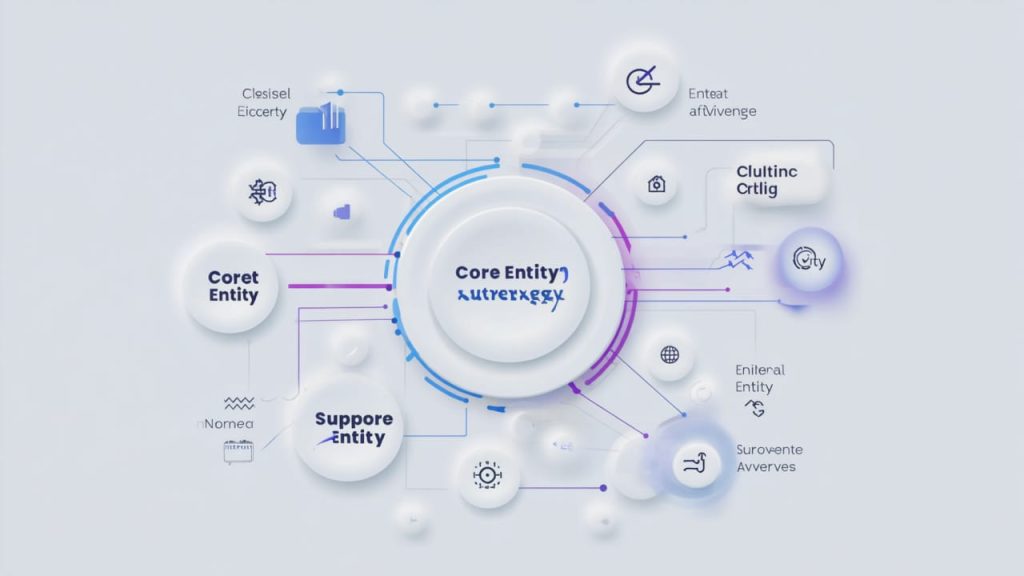
Not all entities carry equal weight. Classification separates core entities (those that define the topic’s primary identity) from supporting entities (those that add contextual depth) and relational entities (those that connect the topic to adjacent domains). This hierarchy determines how entities are assigned across cluster pages — core entities appear in pillar content, supporting entities populate cluster articles, and relational entities appear where topical adjacency adds value.
3. Entity Mapping
Topic entity mapping is the process of assigning specific entities to specific pages within a cluster. The goal is to ensure that no critical entity is absent from the cluster, that no two pages compete for the same primary entity, and that each page’s entity set forms a coherent semantic unit. Mapping is typically done at the cluster planning stage, before content is written.
4. Entity Distribution Across Pages
Distribution determines how entities are spread across the content network. High-value entities should receive dedicated coverage — their own pages or substantial sections — rather than shallow mentions spread across multiple articles. A single piece that thoroughly covers an entity’s attributes, use cases, and relationships signals more authority than five articles that each reference it briefly.
5. Entity Reinforcement Through Internal Linking
Internal links are not only a structural tool — they carry semantic weight. When page A links to page B using anchor text that references a shared entity, search engines interpret that as a declared relationship between the two pages. A deliberate authority internal linking strategy reinforces entity associations across the cluster, strengthening the entity graph that search engines construct from the site’s content.
6. Semantic Consistency Across the Cluster
Entity coverage must be consistent in terminology and representation. If the same concept is referred to by different labels across cluster articles without clear bridging, engines may treat them as distinct entities and fail to consolidate authority. Maintaining a controlled vocabulary for key entities — and using structured data to disambiguate where necessary — ensures the cluster’s signals remain coherent rather than fragmented.
Common Problems
Most entity coverage failures are not the result of ignoring the concept entirely — they occur when practitioners apply keyword logic to what is fundamentally a semantic problem. The following patterns are consistently responsible for ranking instability in sites that otherwise have strong technical foundations.
Keyword-focused content with no entity depth. Articles written purely around search volume targets often cover the surface of a topic while ignoring the conceptual relationships that give it meaning. The result is content that matches query terms but fails to satisfy the entity completeness signals that modern ranking systems evaluate. Rankings are initially achievable but unstable, particularly after broad core algorithm updates.
Entity duplication across cluster pages. Assigning the same primary entity to multiple articles creates internal competition and dilutes topical signals. Search engines interpret duplicated entity coverage as redundancy rather than depth. This is a structural problem that requires entity mapping to resolve — it cannot be fixed by rewriting individual articles without addressing the cluster architecture.
Missing supporting entities. A cluster that covers the core entity comprehensively but omits supporting entities leaves semantic gaps that competitors can exploit. Supporting entities are the contextual scaffolding that helps search engines understand the full scope of a topic. Their absence signals incomplete coverage, regardless of how thoroughly the primary entity is addressed.
Broken semantic coverage across cluster articles. When entity terminology is inconsistent — the same concept described differently across pages without structured reconciliation — the cluster fails to project a unified identity. This is particularly problematic in large content operations where multiple writers contribute without a shared entity vocabulary. The result limits topical authority consolidation across the entire cluster.
These problems reinforce each other. A cluster with duplicated entities is also likely to have missing supporting entities, because coverage resources were allocated to redundancy rather than breadth. Addressing entity coverage requires a systematic audit of the entire cluster, not incremental fixes to individual pages.
Implementation Guide
The following steps provide a practical framework for implementing a semantic entity coverage model within an existing or planned content cluster. Each step builds on the previous; skipping ahead tends to produce gaps that require backtracking.
Step 1: Identify the Core Topic Entity
Define the single primary entity that the cluster is built to represent. This is the concept for which you want search engines to recognize your site as an authoritative source. Specificity matters — “project management software” is more actionable than “project management” because it is a bounded entity with defined attributes and relationships.
Step 2: Extract the Entity Graph
Map all entities associated with the core topic. Use the Google Natural Language API to analyze top-ranking competitor content and surface the entity categories and salience scores that search engines associate with the topic. Supplement this with Ahrefs’ topic research tools and InLinks’ entity gap analysis. The output should be a structured list of entities organized by type and priority level.
Step 3: Map Entities to Cluster Pages
Assign entities to specific pages based on semantic proximity and content depth requirements. Pillar content covers the core entity and its primary attributes. Cluster articles each take ownership of a distinct supporting entity or entity relationship. No two pages should share a primary entity assignment. This mapping document becomes the source of truth for content planning and auditing.
Step 4: Assign Entity Coverage Per Article
For each article in the cluster, define three things before writing begins: the primary entity it covers, the supporting entities that provide context, and the relational entities that connect it to adjacent cluster articles.
A practical example for a cluster built around technical SEO auditing:
- Core entity: Technical SEO audit
- Supporting entities: crawl budget, Core Web Vitals, canonical tags, index coverage, structured data
- Relational entities: log file analysis, site architecture, page speed optimization
Each supporting entity becomes a dedicated cluster article. Each relational entity informs how those articles link outward to adjacent content. Writers briefed on entity targets produce content with stronger semantic signals than those briefed on keyword targets alone.
Step 5: Validate Entity Saturation
After content is published, use the Google NLP API to verify that the entities you intended to signal are being recognized at appropriate salience levels. Compare your entity profile against top-ranking competitors. Gaps in entity recognition often indicate that coverage is present but not prominent enough — entities are mentioned but not explained, contextualized, or reinforced through internal linking.
Step 6: Reinforce Entities Through Internal Linking
Map internal links so that entity relationships are reflected in the linking structure. Pages covering related entities should link to each other with anchor text that references the shared entity relationship. This is the operational layer of content network building — it transforms a collection of individual articles into an interconnected semantic graph that engines can traverse and interpret as a unified knowledge resource.
For teams managing this at scale, the process integrates naturally with a broader authority content strategy — where entity mapping, publishing cadence, and internal linking decisions are governed by a single planning framework rather than managed in isolation.
Real-World Example
SaaS Websites
A SaaS company in the project management space building topical authority around its core product category will typically start with a pillar article covering “project management software” as the core entity. Supporting entities — task tracking, Gantt charts, team collaboration, resource allocation, project templates — each receive dedicated cluster articles. The entity mapping ensures that each supporting article links back to the pillar using anchor text referencing the core entity, and that cross-links between cluster articles reflect the semantic relationships between supporting entities. Over six to twelve months, this structure consistently outperforms competitor sites that published more content but without entity-level planning.
Ecommerce Websites
In ecommerce, entity mapping is applied across product category guides. A retailer in the outdoor equipment space might identify “hiking boots” as a core entity, with supporting entities including waterproofing technology, sole construction, boot fit systems, and terrain categories. Each supporting entity receives a dedicated guide that links to relevant product listings and back to the core category page. The entity coverage model here serves dual purposes: it builds topical authority for organic rankings while also creating semantic context that helps Google’s shopping algorithms correctly classify and surface products.
Large Content Publishers
Large editorial publishers operate entity coverage at scale using content taxonomy systems. A technology media brand covering “artificial intelligence” maintains a master entity list that governs which subtopics — machine learning, neural networks, AI regulation, foundation models — receive dedicated coverage hubs. Editorial teams assign entity ownership to specific verticals, ensuring that coverage depth exists at the entity level rather than just the category level. This systematic approach is what allows major publishers to maintain broad SERP presence across competitive topics while avoiding the cannibalization that plagues less structured content operations. The same logic applies when implementing programmatic topical authority at scale.
Best Practices
| Practice | Description | SEO Impact |
|---|---|---|
| Entity-first content briefs | Brief writers on target entities before keyword targets. Define primary, supporting, and relational entities per article. | Increases entity recognition rates and reduces semantic gaps in published content. |
| Controlled entity vocabulary | Standardize terminology for key entities across all cluster articles to prevent fragmented knowledge graph signals. | Consolidates topical authority across the cluster rather than distributing it across terminology variants. |
| Entity-aware internal linking | Use anchor text that reflects entity relationships, not just navigation labels or generic “read more” patterns. | Strengthens entity association signals between linked pages. |
| Regular entity gap audits | Periodically analyze competitor entity profiles to identify entities the cluster is missing or under-covering. | Prevents coverage gaps from compounding and allows proactive authority expansion. |
| Structured data for disambiguation | Use schema markup (Article, FAQPage, HowTo) to reinforce entity identity and help search engines correctly classify page content. | Improves entity recognition accuracy and eligibility for rich result features. |
| Avoid entity duplication across pages | Assign unique primary entity coverage to each cluster article; review entity mapping before publishing new content. | Prevents internal competition and ensures each page adds distinct semantic value to the cluster. |
| Map entities before content production | Complete entity mapping at the cluster planning stage, not retrospectively after publishing. | Reduces the need for costly post-publication restructuring and ensures coherent semantic coverage from the start. |
Implementation Checklist
- Define the core topic entity for the cluster with specificity — avoid broad categorical labels that lack entity boundaries.
- Extract the full entity graph using NLP tools and competitor content analysis; document entity type, salience, and priority level.
- Create an entity-to-page mapping document assigning unique primary entity coverage to each planned or existing cluster article.
- Identify and flag missing supporting entities — entities present in top-ranking competitor clusters but absent from yours.
- Update content briefs to include entity targets alongside keyword targets for all new and revised articles.
- Establish a controlled entity vocabulary and distribute it to all content contributors working within the cluster.
- Audit existing internal links and update anchor text to reflect entity relationships rather than generic navigation patterns.
- Implement structured data markup (JSON-LD) on all cluster pages to reinforce entity classification signals.
- After publishing or updating content, run NLP analysis to verify that target entities are recognized at appropriate salience levels.
- Schedule quarterly entity gap audits comparing your cluster’s entity profile against the top three competitors in the SERP.
Tools
Ahrefs — Useful for identifying content gaps and topic clusters that indicate missing entity coverage. The Content Gap and Keywords Explorer tools surface what competitors rank for, which often corresponds to entities your cluster is not yet addressing. Site Explorer also reveals which pages are drawing topical authority signals, helping prioritize where entity depth is most needed.
Semrush — The Topic Research and Keyword Magic tools can surface semantic variations and related concepts that map to supporting entities. Semrush’s On-Page SEO Checker provides recommendations based on competitor content analysis, some of which reflect entity-level signals even when framed as keyword suggestions.
Google Natural Language API — The most direct tool for understanding how Google’s own systems classify entities within your content. Submitting page content returns entity types, salience scores, and Wikipedia entity links — a precise view of what entity signals are being extracted. This is the preferred tool for entity saturation validation.
InLinks — Purpose-built for entity SEO. InLinks maps entity relationships within a site’s content, identifies entity gaps relative to competitors, and provides internal linking recommendations based on entity co-occurrence patterns. It is one of the few tools that operates natively at the entity level rather than the keyword level.
Screaming Frog — Valuable for auditing entity consistency at scale. Custom extraction configurations can pull structured data, heading content, and anchor text across an entire site, making it possible to audit vocabulary consistency and internal link anchor text patterns across large content clusters.
Google’s Knowledge Graph Search API — Allows direct lookup of how Google represents specific entities in its Knowledge Graph, including entity type, description, and related concepts. Useful for validating that your target entities have clear Knowledge Graph representations and for identifying the canonical entity labels Google uses — which should match the terminology in your content.
FAQ
What is entity coverage in SEO?
Entity coverage refers to how thoroughly a page or content cluster addresses the entities — named concepts, relationships, and attributes — semantically associated with a target topic. Complete entity coverage means a cluster represents not just the core topic entity but all the supporting and relational entities that give the topic full context in a search engine’s knowledge representation.
How do search engines understand entities?
Search engines identify entities through Named Entity Recognition (NER) algorithms, Knowledge Graph lookups, and contextual language models. When a page references a concept consistently and with sufficient depth, the engine assigns it an entity classification linked to existing records in its knowledge base. Internal links, structured data, and external co-citation patterns reinforce those associations and help resolve ambiguity.
Are entities more important than keywords in modern SEO?
They operate at different layers. Keywords remain the surface signal that connects user intent to content — they are not obsolete. But entities determine long-term ranking stability. A strategy that targets keywords without mapping the underlying entities produces rankings that are volatile and difficult to defend. Integrating both — keywords for query capture, entities for semantic authority — outperforms either approach in isolation.
How do you audit entity coverage?
An entity coverage audit involves three phases. First, extract the entity profile of your existing content using the Google Natural Language API and compare it against top-ranking competitor pages. Second, identify entities that appear consistently in competitor content but are absent or under-represented in yours. Third, map identified gaps to specific cluster articles — either assigning them to existing pages for expansion or flagging them as requirements for new content. Audits should be conducted at the cluster level to capture both depth and distribution quality.
Can structured data improve entity coverage signals?
Structured data does not directly create entity coverage — it reinforces and disambiguates it. Schema markup helps search engines confirm entity classifications already inferred from content and resolves ambiguity when the same term refers to multiple possible entities. It is most effective when applied on top of content that already demonstrates genuine entity depth, not as a substitute for it.
How does entity coverage relate to topical authority?
Entity coverage is the mechanism through which topical authority is built. A site earns authority recognition when its content cluster covers the full entity graph of a topic — not just popular queries, but the complete set of concepts and relationships that define the subject. This is why entity mapping is an upstream activity in the programmatic topical authority planning process, not a retrospective optimization.