
I inherited a schema implementation that technically validated perfectly but created operational chaos. The previous team had implemented 14 different schema types across 40 templates with no documentation, no consistent property naming, inconsistent entity identifiers, and three different approaches to handling the same Organization entity depending on which developer touched which template. Every content update risked breaking schema somewhere. Every new template required reverse-engineering existing patterns to maintain consistency. The technical debt had accumulated to the point where fixing one issue reliably introduced two others.
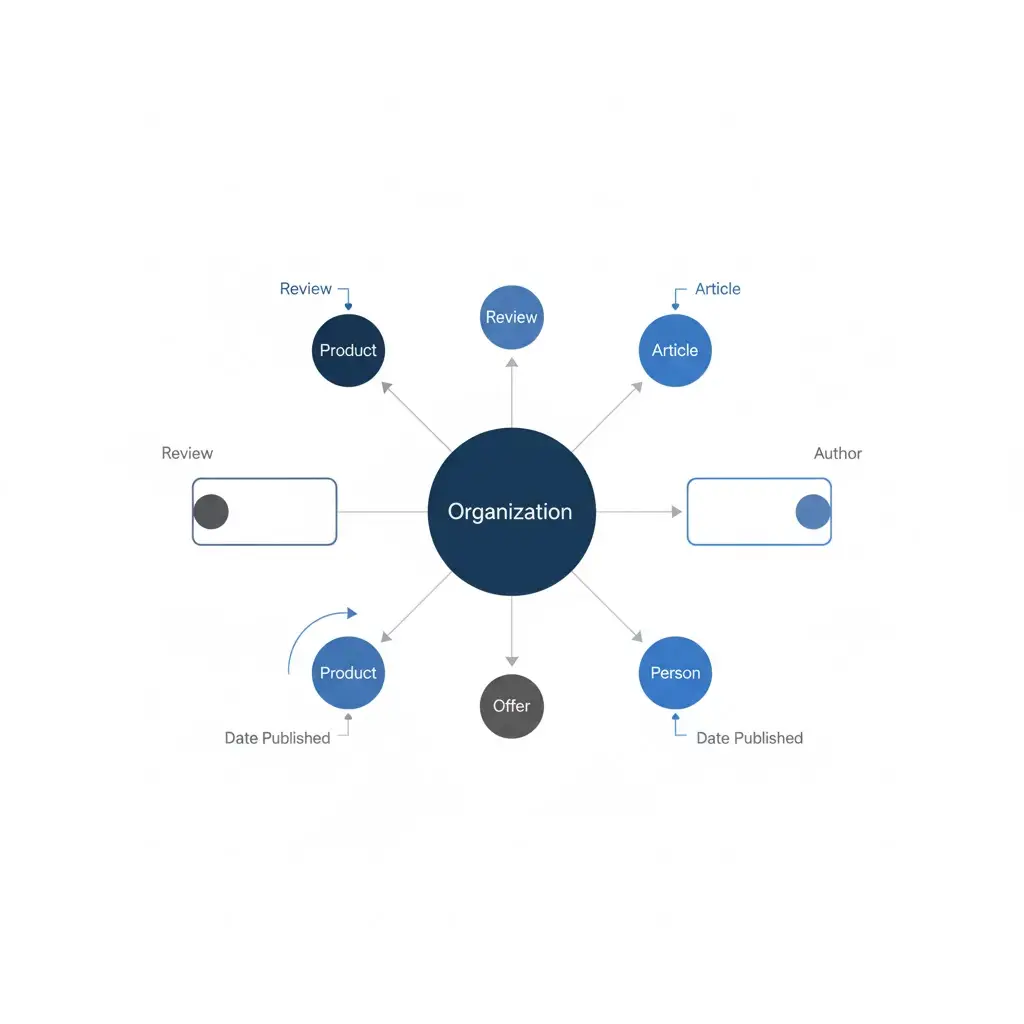
Six months of architectural redesign transformed that mess into a coherent system where Organization schema declared once propagated across all templates through centralized configuration, product templates inherited from base commerce schemas with override capabilities, and entity relationships mapped explicitly through consistent identifier patterns. New content types integrated cleanly because the architecture defined clear patterns for extension. Schema maintenance shifted from constant firefighting to quarterly reviews catching edge cases.
That experience taught me structured data requires architectural thinking, not just implementation tactics. Sites treating schema as isolated markup deployed page-by-page accumulate the same technical debt that plagued that inherited codebase. Strategic architecture treats schema as an entity relationship system where careful design decisions compound into long-term maintainability advantages.
The difference between schema implementations that scale gracefully versus those that collapse under their own complexity isn’t technical sophistication—it’s whether someone designed a coherent architecture before writing any code. Architecture establishes entity models, property naming conventions, template inheritance hierarchies, and governance processes that prevent chaos as implementations expand.
Why Schema Needs a Strategic Architecture
Unplanned schema accumulation creates predictable failure patterns that emerge gradually as sites evolve. The failures aren’t dramatic single-point breakdowns but rather accumulated friction that makes every change more difficult until the system becomes unmaintainable.
Entity ambiguity develops when different templates declare the same real-world entity with inconsistent identifiers. Your homepage Organization schema uses one entity ID while product pages reference a different Organization ID for the same company. Google’s parser encounters conflicting signals about entity identity and relationships. The disambiguation that structured data should provide instead introduces confusion.
The problem compounds when you operate multiple brands, locations, or subsidiary organizations. Without clear entity hierarchy and identifier conventions, templates inconsistently declare which entity they represent. Products might reference parent brand entities that don’t exist elsewhere. Location pages might declare standalone businesses rather than properly linking to parent organizations. The entity graph that should clarify relationships becomes a tangled mess.
Property inconsistency emerges when developers implement similar schema types independently without coordinating property naming and structure. One product template uses “manufacturer” while another uses “brand” for identical supplier information. Some templates include extensive address details while others provide minimal location data. Users encounter different information density and quality depending on which template generated the page they’re viewing.
Search algorithms notice these inconsistencies and reduce trust in your structured data overall. If you’re inconsistent about basic factual properties—company name spelling, phone number formatting, address structure—algorithms assume your data accuracy is questionable even for properties where you’re consistent. Trust degrades across your entire domain, not just the inconsistent pages.
Maintenance overhead explodes when schema logic scatters across dozens of templates without inheritance or shared components. Updating how you represent pricing information requires touching 15 different product templates. Adding new properties means finding every schema implementation and modifying each independently. Every change introduces regression risk as developers inevitably miss edge cases or make inconsistent updates.
The maintenance burden creates implicit incentives against improving schema coverage. Teams avoid adding new schema types because the operational complexity of managing another isolated implementation outweighs the benefit. Coverage stagnates not from lack of opportunity but from architecture that makes expansion costly.
Scalability constraints prevent growing implementations to match content growth. Your initial 500 products had manually created schema. Scaling to 50,000 products requires template-based generation, but retrofitting generation logic into manually created markup proves nearly impossible without complete reimplementation. The architecture that worked at small scale blocks growth.
Strategic architecture prevents these patterns by establishing clear entity models, property standards, template inheritance, and governance processes before implementing any markup. The upfront design investment pays dividends through reduced maintenance overhead, easier expansion, and consistent quality as implementations scale.
Entity-Centric Design Principles
Effective schema architecture models your business as a graph of entities with explicit relationships rather than treating each page as an isolated markup opportunity.
Identify core entities representing fundamental business objects that persist across multiple pages and contexts. E-commerce sites have Organizations at the company level, Brand entities for manufacturers, Product entities for items sold, Review entities for customer feedback, and Person entities for reviewers and company principals. Service businesses have Organization for the company, LocalBusiness entities for locations, Service entities for offerings, and Person entities for service providers.
Each core entity should have a single authoritative source of truth—one place where its properties are defined completely. Organization details live in site configuration. Product attributes come from inventory databases. Person information pulls from HR systems or author databases. This single source principle prevents the inconsistency that plagues decentralized implementations.
Map entity relationships explicitly through schema properties designed for this purpose. Products reference their Brand through brand property. LocalBusiness entities reference parent Organization through parentOrganization. Articles reference Person authors. Reviews reference Product entities they evaluate. Each relationship property uses consistent entity identifiers enabling algorithms to traverse your entity graph confidently.
The relationship mapping reveals your business structure in machine-readable format. Algorithms understand that your business operates 12 locations as subsidiaries, sells products from 47 brands, employs 8 authors producing content, and has accumulated 14,000 reviews about specific products. This structural clarity reinforces entity recognition and topical authority.
Establish identifier conventions creating globally unique entity IDs that remain stable over time. Use URL-based identifiers when possible—your Organization entity ID matches your homepage URL, Product entities use canonical product URLs, Person entities reference author profile URLs. This convention creates inherent consistency since URLs must already be unique.
For entities without natural URL representations, establish ID patterns like organizationID-entitytype-uniquesuffix. The consistency matters more than the specific format. Every template referencing your main Organization entity must use the identical ID string character-for-character. Slight variations break the entity graph you’re trying to construct.
Design for extension by creating base schema templates that specific implementations extend. Base product schema includes universal properties—name, description, brand, offers. Extended product schemas for specific categories add category-specific properties—apparel adds color and size, electronics add technical specifications, consumables add nutrition information. The inheritance prevents duplication while allowing appropriate specialization.
This extension pattern enables adding new product categories without modifying base templates. The new category inherits universal product properties automatically and adds only category-specific elements. Maintenance of universal properties affects all categories without touching category-specific code.
For planning which entities and relationships your specific content architecture requires, strategic mapping tools like https://getseo.tools/tools/cluster/ help visualize entity hierarchies and relationship dependencies before implementation begins.
Content-Type Mapping Framework
Strategic architecture maps content types to appropriate schema types systematically rather than implementing types opportunistically as developers encounter needs.
Inventory content types comprehensively across your entire site. E-commerce sites have product pages, category pages, brand pages, blog posts, guides, store locator pages, and corporate information pages. Publishers have articles, author profiles, topic category pages, and multimedia content. Service businesses have service description pages, location pages, about pages, and informational content.
Create a matrix listing every content type against potential schema types applicable to each. Product pages obviously need Product schema but might also benefit from BreadcrumbList and Review schema. Author profile pages need Person schema but might include Article schema for their content listing. Location pages require LocalBusiness but could add FAQ schema for common questions.
The matrix reveals coverage gaps and opportunities. Perhaps your blog posts lack Article schema entirely. Maybe location pages have LocalBusiness but you’ve never implemented FAQ schema that could enhance their SERP presentations. The systematic inventory prevents missing obvious implementations that ad-hoc approaches overlook.
Prioritize implementations by traffic value and implementation complexity. Content types generating significant organic traffic deserve comprehensive schema coverage because improvements affect more users. Types generating minimal traffic might warrant basic schema without investing in every possible enhancement.
Implementation complexity includes technical difficulty and data availability. Adding Product schema to products is straightforward when inventory systems already contain all required attributes. Adding detailed HowTo schema to guides requires content restructuring and editorial workflow changes beyond pure technical implementation.
Plot content types on a priority matrix with traffic value on one axis and implementation complexity on the other. High-traffic, low-complexity content types are obvious priorities. High-traffic, high-complexity types justify investment despite difficulty. Low-traffic types might remain unimplemented regardless of complexity unless they serve strategic purposes beyond traffic like entity authority or competitive differentiation.
Define property sets required for each content-type and schema-type combination. Product pages using Product schema need name, image, description, brand, offers with price and availability, SKU, aggregateRating, and potentially review markup. Article pages need headline, image, datePublished, dateModified, author referencing Person entity, publisher referencing Organization entity, and articleBody or at minimum a description.
Document required versus recommended versus optional properties for each schema type. Required properties must exist for valid schema—no exceptions. Recommended properties should exist when data is available and significantly improve enhancement quality. Optional properties add marginal value and implement only when trivially easy.
This property hierarchy guides development priorities. Implement all required properties first achieving baseline validity. Add recommended properties where data exists or can be obtained reasonably. Skip optional properties unless you’ve completed all higher-priority work.
Establish data sources for each property mapped to your CMS or database fields. Product name comes from inventory system name field. Product image uses primary product photo from media library. Product brand references brand taxonomy. Offers price pulls from pricing database with real-time queries to ensure accuracy.
The data source mapping reveals gaps where required properties lack data. Perhaps your CMS stores product descriptions but not brand associations. Either add brand data to your CMS or accept that brand properties will be incomplete. The explicit mapping makes these trade-offs visible rather than discovering them mid-implementation.
Cross-Template Schema Governance
Governance processes ensure consistency as multiple developers implement schema across dozens of templates over months or years.
Centralized configuration management stores shared entity definitions and common property values in one location rather than scattering them across templates. Organization details—name, address, logo, social profiles—live in site configuration accessible to all templates. When you update your company phone number, one configuration change propagates across every schema implementation referencing Organization entity.
The centralized approach extends to common patterns like offers, availability enumerations, and currency codes. Rather than each product template independently formatting price properties, they reference shared offer schema generation functions that ensure consistent structure. Changes to offer formatting affect all products simultaneously without touching individual templates.
Configuration management can be as simple as a configuration file defining variables that templates reference or as sophisticated as a schema service API that templates query for entity definitions. The complexity should match your organization size and change frequency. Small sites might use YAML configuration files. Large enterprises might build dedicated schema management services.
Template inheritance hierarchies create parent templates defining base schema structures that child templates extend. A base product template establishes universal product properties. Category-specific child templates inherit those base properties and add specialized elements. An electronics product template adds technical specifications. An apparel template adds size and color attributes.
The inheritance prevents duplication and enforces consistency. Changes to base product schema propagate to all child templates automatically. New product categories start by inheriting the base template, immediately gaining all universal product properties without reimplementation. Developers only create category-specific extensions, not complete schema from scratch.
Most modern templating systems support inheritance natively—Django, Jinja2, Liquid, Blade, and others. Use your templating engine’s inheritance features for schema generation the same way you use them for HTML structure. The patterns are identical.
Code review standards specifically for schema ensure quality and consistency before changes reach production. Reviews should verify entity ID consistency, property naming following conventions, required properties presence, appropriate schema type selection, and proper entity relationship declarations.
Establish schema review checklists codifying architectural decisions. Does this implementation use the correct Organization entity ID matching site-wide standards? Do offer objects follow the canonical offer template? Are all required Product properties present? Does the entity relationship graph connect properly to existing entities?
Reviews catch architectural violations before they compound. One developer using a non-standard entity ID gets corrected during review rather than creating a pattern that future developers copy, spreading the inconsistency across new templates.
Documentation requirements mandate that every schema implementation includes comments explaining entity relationships, property data sources, and conditional logic reasoning. Six months after implementation, the original developer has moved on and someone else maintains the code. Without documentation, the new maintainer must reverse-engineer intent from implementation, often incorrectly.
Document not just what the code does but why architectural decisions were made. Why does this template reference the parent Organization through this specific ID? Why do we include brand here but not manufacturer? Why is this property conditional on inventory status? The reasoning prevents future maintainers from “simplifying” code in ways that break architectural patterns.
Scaling Structured Data Across Large Sites
Sites with hundreds of thousands or millions of pages require automation that maintains quality while operating at scale impossible through manual implementation.
Template-based generation creates one schema template per content type that dynamically populates properties from databases at render time. One product template serves 50,000 product pages, pulling inventory data, pricing, reviews, and images from appropriate data sources for each specific product.
The template design must handle data variability gracefully. Not every product has reviews. Some lack detailed descriptions. Certain categories have attributes others don’t. Template logic includes conditionals that output properties only when valid data exists, omitting optional properties for products lacking that data rather than outputting invalid or null values.
Error handling becomes critical at scale. If database queries fail for brand information on a product, should the template omit brand property, use a fallback value, or fail entirely preventing page render? The decision balances completeness against reliability. Generally, missing optional properties is preferable to broken pages, but missing required properties might justify failing to maintain schema validity.
Bulk validation processes verify schema quality across thousands of URLs without manually checking each. Automated crawlers extract schema from representative page samples across all templates—100 random product pages, 50 category pages, all location pages. Parse extracted schema and validate against schemas.org specifications and your internal standards.
Flag common error patterns affecting multiple URLs. If 200 product pages all show invalid price formatting, the product template needs fixing rather than addressing 200 individual pages. The bulk approach identifies template-level issues requiring one fix over page-level issues requiring hundreds.
Schedule bulk validation weekly or after template modifications. Continuous monitoring catches regression from platform updates or content changes. Post-modification validation verifies that fixes worked and didn’t introduce new errors before deploying broadly.
Database-driven property mapping maintains property value consistency across implementation. Rather than hardcoding enumeration values in templates, reference database tables defining valid values. Availability enumerations reference a lookup table. Category taxonomies use database-maintained hierarchies. Brand mappings query brand databases.
The database approach enables updating values globally without touching template code. When schema.org adds new availability enumerations, update your database table and all templates using database-driven lookup automatically reference new values. Template code remains unchanged.
Database-driven mapping also facilitates multi-language implementations. Property values reference translation tables returning appropriate language based on page context. The same template generates English and French schema using identical logic querying translated values.
Quality monitoring at scale tracks schema coverage and enhancement eligibility across large page inventories. What percentage of your 50,000 products have valid Product schema? How many include reviews? What fraction display rich results in actual search results? Track metrics by category, brand, price range, and other segmentations revealing quality patterns.
Monitor for degradation over time. If product schema coverage drops from 92% to 84% over two months, investigate what changed. Perhaps new product imports lack required attributes. Maybe template modifications introduced errors. The monitoring creates visibility into quality trends enabling proactive remediation.
For comprehensive implementation guidance covering technical patterns that maintain quality at scale, the complete guide at https://getseo.tools/seo-tools/how-to-generate-schema-markup-for-seo-the-ultimate-guide-2026/ provides foundational patterns upon which architectural systems build.
Dynamic vs Static Schema Architecture
The choice between static schema baked into HTML during build time versus dynamic schema generated at request time has significant architectural implications.
Static generation during site build compiles schema once, embedding JSON-LD in HTML files served to all users. Static site generators—Hugo, Jekyll, Gatsby—and JAMstack architectures operate this way. Content and schema generation happen during build, producing HTML files deployed to CDNs.
Static approaches offer performance advantages since no server-side schema generation occurs per request. The HTML with embedded schema serves instantly from edge caches. The trade-off is freshness—schema reflects data available at build time, not real-time state. Product availability, pricing, review counts freeze at last build until the next rebuild occurs.
Static generation works well for content that changes infrequently—blogs, documentation, informational pages. It proves problematic for e-commerce requiring real-time inventory accuracy or news sites where publication dates must reflect actual publish timing. Rebuilding sites with hundreds of thousands of pages on every content change isn’t practical.
Dynamic generation produces schema at request time or page render, querying current data sources. Product schema includes real-time price and availability. Review counts reflect current totals. The schema always represents current state rather than stale build-time snapshots.
The freshness comes at performance cost. Server-side schema generation adds processing time to page renders. Database queries for property values increase latency. The overhead is minimal for properly optimized implementations but measurable at scale. Caching strategies can mitigate performance impacts while maintaining reasonable freshness.
Most large sites use hybrid approaches. Static schema for entities that rarely change—Organization, Brand, Person—baked into templates at deploy time. Dynamic schema for volatile data—Product offers, Review aggregateRatings, Event dates—generated at request time from current data sources.
Client-side rendering generates schema through JavaScript after initial page load. Single-page applications built with React, Vue, or Angular often render schema client-side rather than server-side. The approach introduces timing risks where Google’s crawler snapshots pages before JavaScript executes, missing schema entirely.
Google’s crawlers handle JavaScript better than historically, but timing dependencies remain. If schema generation requires API calls completing after initial render, crawlers might timeout before schema appears. Testing with Search Console’s URL Inspection tool reveals whether Google successfully extracts client-rendered schema.
Best practice renders critical schema server-side ensuring it appears in initial HTML. Supplementary schema can render client-side with lower risk. Product schema should be server-side. Interactive FAQ schema expanding after user interaction could be client-side since the base content exists regardless.
Internal Linking and Entity Reinforcement
Schema architecture should align with internal linking strategy, using both to reinforce entity relationships and topical authority.
Consistent entity referencing ensures schema entity IDs match URLs where those entities have dedicated pages. Your Organization entity ID uses your homepage URL. Brand entities use brand page URLs. Person entities reference author profile URLs. The consistency creates verifiable relationships—algorithms can fetch the referenced URL and confirm it declares the expected entity.
This pattern integrates schema with internal linking architecture. Schema relationships become explicit linked connections in your site graph. Products linking to brand pages through brand schema properties mirror HTML links from product pages to brand pages. The dual signals—HTML navigation links and schema entity references—reinforce brand-product relationships.
Bidirectional linking strengthens entity relationships through both HTML and schema connections. Product pages link to brand pages and reference Brand entities in schema. Brand pages link back to products and declare relationship to those products through schema properties. The bidirectional pattern creates stronger evidence of legitimate relationships versus one-way claims.
Breadcrumb schema exemplifies this pattern. Breadcrumb markup declares hierarchical relationships from product to category to homepage. HTML breadcrumb navigation provides the same hierarchy through clickable links. Each reinforces the other, giving algorithms confidence in your site structure declarations.
Hub page optimization designates authoritative pages for core entities, implementing comprehensive schema and serving as link targets for entity references throughout your site. Brand hub pages implement detailed Brand and Organization schema, aggregate product listings, include company information, and establish topical authority. Author profile pages implement Person schema, list authored content, provide credentials, and serve as canonical person entity pages.
These hub pages become entity landing pages where algorithms encounter complete entity definitions. Product pages reference brands with links to hub pages where full brand information exists. Article pages reference authors with links to profiles containing biographical details and publication history.
For strategic planning of entity hubs and internal linking architecture that schema supports, mapping tools like https://getseo.tools/tools/cluster/ help visualize entity relationships and identify hub page opportunities before implementing either linking or schema systems.
Contextual entity mentions in content connect to schema-declared entities through internal links, creating discoverable entity graphs. When article content mentions product names, link to product pages declaring Product schema. When discussing company history, link to about pages with Organization schema. The links create traversable paths between entities that algorithms use to understand relationships.
Anchor text for entity links should match schema property values when possible. If schema declares a product name as “Professional DSLR Camera Kit,” internal links should use that exact name rather than variations like “the camera” or “DSLR kit.” The consistency reinforces entity identity through aligned signals across linking and schema.
Comparison Table
| Implementation Approach | Consistency Level | Maintenance Overhead | Scalability | Entity Clarity | Governance Ease |
|---|---|---|---|---|---|
| Ad-hoc per-page schema | Low, diverges over time | Very high, every change touches many files | Poor, manual work doesn’t scale | Low, scattered entity definitions | Difficult, no standards |
| Template-based with duplication | Medium, templates diverge independently | High, updates need multi-template changes | Medium, templates handle volume but maintenance doesn’t | Medium, entity definitions per template | Moderate, multiple sources of truth |
| Shared component library | High, components enforce standards | Medium, update components propagate automatically | Good, components scale with proper design | High, components define entities consistently | Good, components are enforceable standards |
| Centralized configuration + inheritance | Very high, single source of truth | Low, configuration changes affect all uses | Excellent, scales to millions of pages | Very high, explicit entity definitions | Excellent, configuration is governance layer |
| Schema management service | Very high, API enforces contracts | Very low, service changes deploy universally | Excellent, service architecture scales independently | Very high, service is entity registry | Excellent, service access controls enforce standards |
The progression from ad-hoc to service-based architecture requires increasing development investment but delivers exponentially better maintainability and consistency. Small sites benefit from template-based approaches with shared components. Mid-size sites should invest in centralized configuration with inheritance. Large enterprises managing multiple properties benefit from dedicated schema services providing consistent entity definitions across properties.
The architectural choice should match organizational scale and schema complexity. Don’t over-engineer simple implementations, but recognize when growth demands architectural sophistication preventing technical debt accumulation. The cost of architectural investment is front-loaded, while the cost of ad-hoc approaches compounds over time.
Common Strategic Mistakes
Even well-intentioned architectural planning fails through predictable patterns that undermine long-term viability.
Premature optimization creates complex architecture for simple implementations that don’t justify sophistication. A small business site with 50 pages and two content types doesn’t need a schema management service or complex inheritance hierarchies. Simple template-based implementation with basic consistency checking suffices. The overhead of sophisticated architecture exceeds the benefit for sites at that scale.
Recognize when to build simple and when complexity is justified. If your implementation covers fewer than 10 templates and changes infrequently, simple approaches work fine. When managing 50+ templates across multiple content types with frequent changes and multiple developers, architectural sophistication pays dividends.
Insufficient documentation causes architectural intent to erode as team members change. The original architect designs elegant entity hierarchies with clear reasoning. Six months later with different developers maintaining code, the architectural decisions become unclear. Future changes optimize locally without understanding global implications, gradually degrading the architecture.
Document architectural decisions at system level, not just code level. Explain entity model choices, why certain properties centralize versus distribute, what inheritance patterns templates should follow, and how entity relationships map to business structure. The documentation preserves intent across team transitions.
Rigid architectures that can’t accommodate unexpected content types or business model changes create their own technical debt. You design perfect architecture for current content taxonomy and product catalog structure. Then the business acquires a company with different product models, enters new verticals requiring different schema types, or launches content categories you never anticipated.
Build flexibility into architecture through extension points and override mechanisms. Base templates should define common patterns while allowing category-specific customization. Entity models should support adding new entity types without restructuring existing entities. The architecture needs enough structure for consistency but enough flexibility for evolution.
Governance without enforcement establishes wonderful standards nobody follows because compliance is optional. You document entity ID conventions, property naming standards, and template inheritance patterns. Developers ship code violating every standard because review processes don’t check compliance and automated testing doesn’t validate architectural conformance.
Governance requires enforcement mechanisms. Code reviews should explicitly check architectural compliance. Automated tests should validate entity ID consistency, required property presence, and proper schema structure. Violations should block deployment until fixed. Without enforcement, standards become suggestions that erode under delivery pressure.
Neglecting migration planning from existing implementations creates permanent technical debt. Your site has 10,000 pages with ad-hoc schema implemented over years. You design beautiful new architecture but no plan for migrating existing pages. The new architecture governs new implementations while legacy pages remain unmigrated indefinitely, creating two parallel systems to maintain.
Migration planning should be part of architectural design. How will existing pages transition to new standards? Can migration happen automatically through template updates or does it require content team involvement? What’s the timeline for migration completion? Without answers, legacy implementations persist indefinitely.
For analytical support identifying which architectural patterns deliver optimal return on implementation effort for your specific content mix and scale, planning tools like https://getseo.tools/tools/ai/ help model different approaches before committing to architectural decisions.
FAQ
How do I retrofit architectural discipline into existing ad-hoc schema implementations without complete rebuilding?
Incremental architectural improvement follows a phased approach that gradually introduces structure without requiring big-bang rewrites. First, establish centralized entity definitions even while leaving implementation scattered. Create a configuration file or service defining your core entities—Organization, Brand, Person—with authoritative property values. Update templates to reference centralized definitions rather than declaring entity properties inline. This creates single source of truth without restructuring template logic. Second, standardize entity IDs across implementations. Inventory all entity references throughout templates and align them to consistent identifiers. Update templates one at a time to use standard IDs. Third, create base templates for your most common schema types and migrate high-traffic templates to inherit from bases. Product pages representing 60% of your schema implementations might migrate first, with lower-volume content types following later. Fourth, implement governance processes preventing future architectural violations even while legacy code remains. New implementations must follow standards regardless of legacy state. This prevents architectural debt from growing while you address existing issues. The phased approach spreads effort over time, shows incremental value justifying continued investment, and avoids the disruption of complete reimplementation. Full architectural consistency might take 6-12 months, but each phase delivers measurable improvement in consistency and maintainability.
Should schema architecture differ between development environments, staging, and production?
Schema architecture should remain consistent across environments while data and entity references adapt to environment context. The template code, inheritance patterns, entity models, and property structures stay identical. What changes is the data populating those structures and the entity IDs referencing real versus test entities. In development and staging, product schema templates reference test products from development databases. Entity IDs might use staging URLs rather than production domains. This enables realistic testing of schema generation logic without creating real-world entity claims about test data. The architectural patterns remain production-identical ensuring what you test is what ships. Configuration management facilitates environment adaptation through environment-specific configuration files. Development uses dev configuration with staging entity IDs, staging uses staging configuration, production uses production configuration. The same template code reads environment-appropriate configuration generating valid schema for that environment’s context. Avoid the temptation to simplify schema in non-production environments. If production requires complex entity relationships and comprehensive properties, development and staging should generate identical complexity using test data. Simplified development schema masks problems that only manifest in production where full complexity exists. Testing must reflect production reality to catch issues before deployment.
How granular should schema template inheritance hierarchies become before complexity outweighs maintainability benefits?
Optimal inheritance depth typically reaches 2-3 levels before additional hierarchy creates more complexity than value. A common pattern uses base content-type templates at the first level defining universal properties for products, articles, or locations. Second-level category templates extend base templates adding category-specific properties—apparel products add clothing-specific attributes, electronics add technical specifications, consumables add nutrition information. Third-level templates might handle edge cases or hybrid content types that combine multiple schemas. Beyond three levels, inheritance chains become difficult to understand and debug. Developers must traverse multiple template files to understand final schema output. Property overrides and conditional logic compound across levels creating unexpected interactions. The cognitive overhead of deep inheritance exceeds the duplication savings from additional abstraction. Balance reuse against comprehension. If category-specific templates share substantial commonality, introduce second-level intermediate templates grouping similar categories. If every category is genuinely unique, second-level templates extending one base template suffices. The inheritance depth should match actual conceptual hierarchy in your content model, not create artificial hierarchy for architectural elegance. Resist the urge to abstract for abstraction’s sake. Some duplication across parallel templates is acceptable if it maintains clarity. The goal is maintainable consistency, not perfect DRY principles regardless of readability cost.
Conclusion
Schema architecture separates implementations that scale gracefully for years from those that accumulate technical debt until they collapse under maintenance burden. The architectural investment—entity modeling, template design, governance establishment—feels excessive when deploying initial implementations covering limited content. The value becomes apparent 18 months later when adding new content types takes days instead of weeks, when updating entity properties propagates across thousands of pages through configuration changes, and when new team members contribute confidently because architectural documentation and standards guide their work.
Strategic architecture treats structured data as an entity relationship system representing your business structure in machine-readable format. The entity models, relationship patterns, and property standards you establish early define how easily your implementation adapts to business evolution, content expansion, and platform changes. Poor architectural decisions create friction that compounds with every modification. Sound architectural decisions create leverage where each improvement benefits the entire system.
Start architectural planning before implementing any schema. Inventory your core entities, map content types to schema types, establish entity ID conventions, design template inheritance patterns, and create governance processes. The upfront design prevents the rework that consumes months retrofitting architecture into ad-hoc implementations built without strategic vision.
For sites with existing implementations lacking architectural coherence, begin incremental improvement immediately like https://nasa2m.com. Establish centralized entity definitions, standardize entity IDs, migrate high-value templates to proper inheritance patterns, and implement governance preventing future architectural debt. The migration takes months but each phase delivers measurable improvement in consistency and maintainability.
The tools and systems supporting architectural discipline matter less than the architectural thinking itself. You can implement sound architecture with simple configuration files and template inheritance if the underlying entity models and governance processes are well-designed. Sophisticated schema management services and component libraries accelerate implementation but don’t substitute for strategic architectural decisions about entity relationships and system structure.
Treat schema as business infrastructure requiring the same architectural discipline as application code, database design, and system integration. Infrastructure built hastily becomes technical debt. Infrastructure designed thoughtfully becomes competitive advantage through superior maintainability, consistency, and capability to evolve with business needs.
The sites dominating structured data coverage in 2026 and beyond won’t necessarily have more sophisticated schema types or comprehensive property coverage—they’ll have architectural discipline ensuring that whatever schema they implement remains consistent, maintainable, and extensible as their content and business models evolve.