
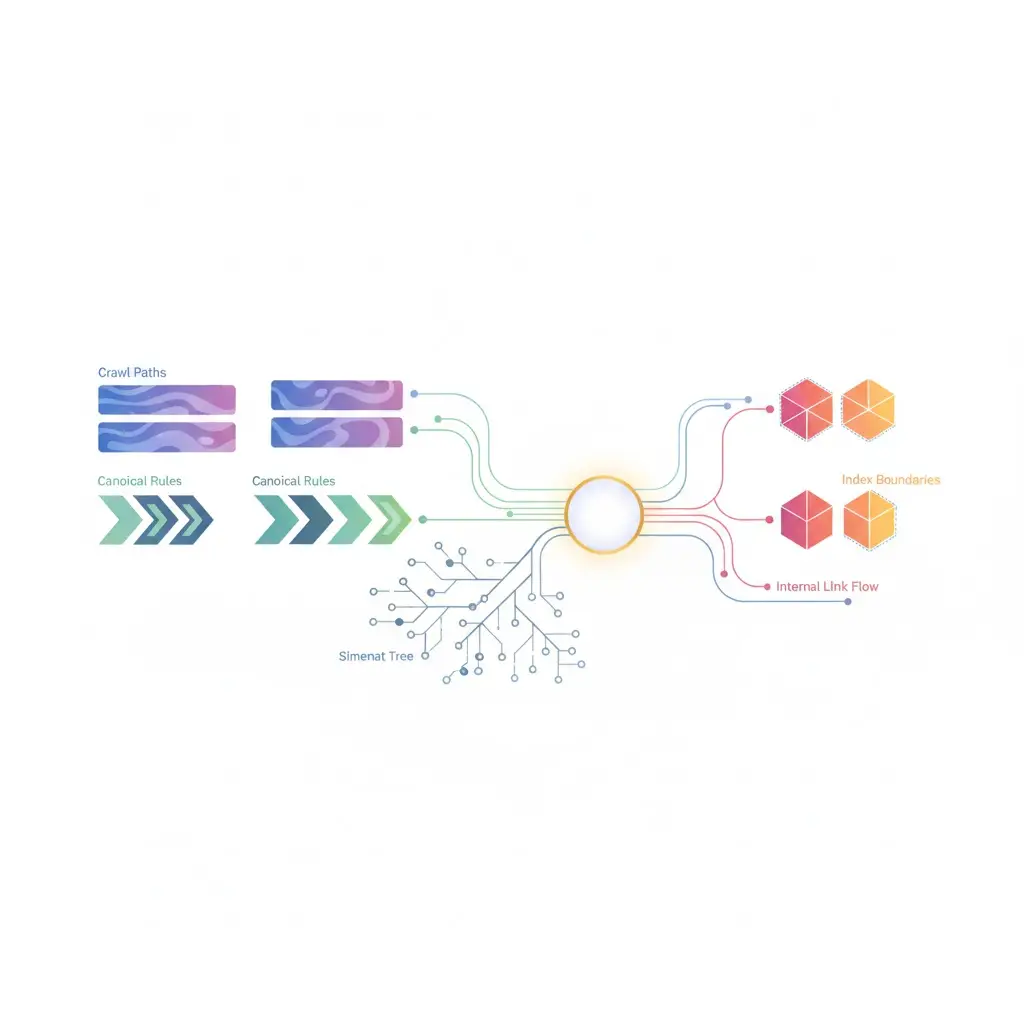
Most technical SEO failures are not caused by bad content or weak links. They are caused by architectural decisions made early in a site’s development — decisions that compound quietly until crawl waste, index instability, and signal dilution make recovery expensive.
This guide is not about structure tips. It is an Architectural Control Framework: a design system that prevents crawl path failures, canonical drift, index pollution, and equity fragmentation at the template level — before they reach production. For a complete scope of technical SEO requirements, the technical SEO checklist defines the full set of controls this framework implements.
What Technical SEO Architecture Actually Controls
Technical SEO architecture is the deliberate design of how URLs are generated, how crawlers move through a site, how indexation boundaries are defined, and how PageRank flows between documents. It operates at the system level — not the page level. Google’s own Search documentation distinguishes between crawling, indexing, and serving as three independent pipeline stages — architecture governs all three simultaneously.
Most SEO guides treat architecture as a set of advice points. This framework treats it as an operational model with inputs, failure states, and measurable outputs.
There are three architectural control planes: crawl path engineering, indexation map design, and signal flow modeling. Every architectural decision touches at least one of these planes. Misalignment between them is the root cause of most large-site SEO degradation.
Crawl Path Engineering
Crawl path failures are the most immediate and measurable architectural failure class.
Primary risk: Uncontrolled URL expansion causes crawl dilution — Googlebot spends its crawl budget on URLs that return no indexing value.
Root cause: Parameter explosion, dynamic URL generation, deep nesting, and faceted navigation without governance each expand the crawl surface exponentially. A site with 50,000 canonical pages can expose 500,000+ crawlable URLs if these systems are uncontrolled.
How to detect: Pull server logs and segment crawl requests by URL pattern. Measure crawl depth distribution — what percentage of Googlebot requests land on URLs deeper than four clicks from the homepage? Also measure crawl share by URL type: facets, parameters, paginated pages, and canonical content. Tools: Screaming Frog log analyzer, Botify, or custom log parsing via regex.
Remediation: Implement a depth ceiling model. No indexable content should require more than three to four clicks from the root. Enforce this at the sitemap level (include only URLs ≤4 clicks deep), at the internal linking level (hub pages must link forward to all primary content), and at the URL generation level (block deep dynamically generated paths at the robots.txt or canonical layer before they are ever crawled).
Indexation Map Design
Controlling which URLs enter the index is as important as controlling which URLs are crawled.
Indexation is not a passive outcome — it is a designed system. Every URL on a site must have an explicit indexation decision: indexable, canonicalized, noindexed, or blocked.
Start by creating an index inclusion matrix. Map every URL type — blog posts, category pages, tag pages, paginated archives, faceted results, author archives, search result pages, parameter variants — and assign each a directive. The decision must be made at the template level, not the individual URL level. If a template generates 10,000 URLs and the indexation decision is wrong, all 10,000 are affected.
Index drift occurs when directives applied at launch erode over time. New CMS plugins, theme updates, or developer changes silently introduce noindex tags, remove canonicals, or create new URL patterns. Schedule monthly crawls specifically targeting directive validation — not rankings, not performance, directives. The most common directive failures at the template level are documented in the technical SEO implementation mistakes reference.
Signal Flow Modeling
Once crawl paths and indexation are controlled, signal distribution becomes the third architectural lever.
Internal links are the mechanism by which PageRank distributes across a site. Architectural decisions determine whether that distribution is deliberate or accidental.
Authority silos occur when strong pages link only within a category and never forward to adjacent high-value content. This isolates equity in pockets rather than amplifying it across the domain. The fix is a cluster mesh model: primary content hubs link to supporting articles, and supporting articles link back to hubs and laterally to related supporting content.
Anchor intent alignment matters for signal clarity. Anchors that use generic text — “click here,” “read more” — fail to communicate topical relevance to crawlers. Every internal link anchor should name the destination’s primary concept. This is not a UX recommendation — it is a signal engineering requirement.
URL Structure Engineering
URL structure decisions made at launch are difficult to reverse without triggering redirect chains and crawl disruption.
URL structure is not cosmetic. It communicates hierarchy to crawlers, affects breadcrumb generation, and influences how equity flows through the domain.
Folder vs Subdomain Decision Model
| Scenario | Recommended Structure | Rationale |
|---|---|---|
| Blog, docs, resources on main product domain | Subfolder (domain.com/blog/) | Consolidates domain equity; avoids splitting PageRank |
| Separate product with distinct UX and audience | Subdomain (app.domain.com) | Justified architectural separation; accept equity split |
| Multilingual site with regional targeting | Subfolder preferred; ccTLD or subdomain acceptable with hreflang | Depends on geo-targeting strength required |
| Support center or developer documentation | Subdomain acceptable | Audience and crawl behavior is sufficiently distinct |
The default rule: when in doubt, use a subfolder. Subdomains create a separate crawl graph that does not inherit root domain equity automatically. Every subdomain deployment must be justified by a concrete architectural reason, not convenience.
Flat vs Hierarchical URLs
Flat URL structures (/topic-name/) reduce crawl depth but lose hierarchical context for breadcrumb generation and topical clustering signals. Hierarchical structures (/category/subcategory/topic/) communicate site taxonomy clearly but increase crawl depth.
The optimal model for most sites: one or two levels of hierarchy maximum for primary content (/category/page/), with flat structures for high-priority standalone content. Paginated pages should follow the root URL pattern (/category/page/2/) rather than introducing query parameters.
Breadcrumb alignment is mandatory. The URL path must match the breadcrumb trail generated by the CMS. Misalignment between URL path and breadcrumb schema creates conflicting signals about page hierarchy.
Parameter Governance Framework
Issue: Unclassified parameters expose duplicate URL variants to crawlers, consuming crawl budget without producing indexable content.
Root cause: E-commerce platforms, CMS plugins, and analytics tools each generate parameters independently. Without a governance layer, these accumulate into thousands of crawlable URL variants that mirror canonical content exactly.
Validation: Crawl the site with Screaming Frog and export the Parameters report. Cross-reference against server log data to identify parameter patterns consuming the highest crawl share. Patterns with >500 Googlebot requests per month and zero indexable content are priority targets.
What to do: Classify every parameter type and assign a directive at the template or server layer. Apply the following treatment model:
| Parameter Type | Examples | Recommended Treatment | Implementation Method |
|---|---|---|---|
| Sorting parameters | ?sort=price, ?order=asc | Canonical to base URL; do not index | Self-referencing canonical on parameterized version pointing to root |
| Faceted filters (non-indexable) | ?color=red&size=M | Canonical to category root; block in robots.txt if crawl waste is severe | Canonical + robots disallow for high-volume facet patterns |
| Faceted filters (indexable) | ?brand=nike (high commercial value) | Index with unique title/meta; self-referencing canonical | Template-level canonical; include in sitemap |
| Tracking parameters | ?utm_source=, ?ref= | Strip via canonical; never index | Canonical on all pages points to clean URL; configure in GSC parameter tool |
| Pagination parameters | ?page=2, /page/2/ | Index if content is unique; canonical series to root only if thin | Index full paginated content; do not rel=prev/next (deprecated) |
| Session IDs | ?sid=abc123 | Block entirely; never crawlable | robots.txt disallow + canonical to clean URL |
Parameter governance is a template-level concern. Applying fixes URL by URL after the fact is not scalable. Every URL generation pattern in the CMS must have a corresponding directive strategy implemented at the template or middleware layer.
Crawl Depth and Internal Link Topology
Crawl path engineering sets the ceiling; internal link topology determines how efficiently crawlers reach every indexable URL within it.
Optimal Click Depth Model
Primary risk: Important pages buried at depth five or deeper receive insufficient crawl frequency, causing ranking freshness to degrade.
Root cause: Crawl depth is the number of HTTP requests a crawler must make from the root URL to reach a given page. Depth acts as a crawl frequency multiplier — pages at depth 2 are refreshed more often than pages at depth 5. Without deliberate link injection, CMS-generated content naturally accumulates depth as site scale increases.
How to detect: Export log data segmented by URL. Map each URL’s shortest known path from the homepage using internal link graph data via Screaming Frog, Sitebulb, or a custom crawl. Build a depth distribution histogram — any cluster of indexable pages with average depth >4 represents an architectural failure requiring link injection or structural promotion. Use the technical SEO audit workflow to systematically surface depth violations across all page types.
Remediation: Identify the deepest important pages. Add them to category-level hub pages through contextual internal links. Adding links from the homepage or primary navigation to key intermediary hubs also reduces effective depth. Depth reduction does not require URL restructuring — it requires link topology changes.
Hub-and-Spoke vs Distributed Mesh
| Model | Description | Best For | Risk |
|---|---|---|---|
| Hub-and-Spoke | Central pillar page links to all supporting articles; supporting articles link back to hub only | Topical authority concentration; pillar-heavy strategies | Supporting pages receive minimal direct equity; cross-topic linking is weak |
| Distributed Mesh | Supporting articles link to hub, to each other, and to related hubs | Large content libraries; multi-cluster sites | Requires strict anchor text governance to avoid signal noise |
| Hybrid Cluster | Pillar hub links to all supporting pages; supporting pages link laterally within cluster and to adjacent cluster hubs | Enterprise sites; deep topical coverage strategies | Requires topical map to manage link relationships at scale |
Siloing — the practice of keeping internal links strictly within topic categories — was a dominant recommendation a decade ago. In 2026, strict siloing harms authority distribution on most sites. Cross-cluster links that are topically adjacent distribute equity more efficiently and align with how Google’s entity understanding models evaluate topical relationships.
Orphan Prevention System
Issue: Orphaned URLs — crawlable, indexable pages with no internal link pointing to them — exist outside the link graph and receive no equity, low crawl frequency, and poor ranking performance regardless of content quality.
Root cause: Content is published without a required linking step in the editorial workflow. Pages are reorganized or templates updated without verifying that existing internal links still resolve correctly.
Validation: Export all URLs from your sitemap. Then export all URLs discovered via crawl, and separately export all URLs in your internal link graph. The set difference between sitemap URLs and link graph URLs is your orphan population. Run this comparison monthly using Screaming Frog’s orphan detection workflow.
What to do: Build a systematic orphan prevention loop. After every content publication, the workflow must verify the new URL appears in at least one contextual internal link from an existing indexed page. Automate this check via Screaming Frog scheduled crawls or a custom script querying your internal link index. Orphan detection and remediation should be a standing item in every technical SEO audit cycle.
Canonical Architecture Layer
Canonical control is the deduplication layer of the architecture — it determines which URL version receives ranking credit for all equivalent content.
Canonicalization is a directive mechanism, not a guarantee. Google treats canonical tags as strong hints. Architectural misuse weakens their authority and causes index instability.
Self-Referencing Canonical Rules
Every indexable page must carry a self-referencing canonical. This is not optional on pages where parameter variants, session IDs, or tracking parameters might generate alternate URLs. The self-referencing canonical is the declaration that this URL is the authoritative version of itself.
Absence of a self-referencing canonical creates a signal gap — Google may resolve the canonical question independently, and its choice may not match your intent.
Canonical Consolidation Patterns
Canonicalization consolidates duplicate or near-duplicate content signals to a single representative URL. Common patterns requiring canonicalization: paginated archives (canonical to root category page if content is thin), parameter variants (canonical to clean URL), HTTPS/HTTP duplicates (resolve via 301 redirect, not canonical alone), and trailing slash variants (resolve via 301 redirect, then apply canonical).
The priority order for deduplication: 301 redirect (strongest — eliminates the duplicate entirely), canonical tag (consolidates signals but preserves the alternate URL in the crawl graph), noindex (removes from index but may still dilute crawl budget).
Preventing Canonical Chains at Template Level
Primary risk: Canonical chains — where URL A canonicalizes to URL B, which canonicalizes to URL C — cause Google to leave final canonical authority unassigned because it follows only one hop.
Root cause: Canonical chains emerge from template-level mistakes: a pagination canonical pointing to page 2 (which itself canonicalizes to page 1), or a parameter URL canonicalizing to a clean URL that has since been redirected. These errors are invisible at the individual URL level but affect thousands of URLs simultaneously when they originate from templates.
Validation: Crawl your site with Screaming Frog and export the canonical chain report. Any URL with a chain length >1 is a failure state. For a structured process to identify all canonical failure patterns across your site, run the full technical SEO audit canonical audit module.
Remediation: Resolve chains at the template level — do not patch individual URLs. Identify which template is generating the intermediate canonical, update it to point directly to the final authoritative URL, and re-crawl to verify chain length returns to 1 across all affected URL patterns.
Faceted Navigation and Large Site Control
Faceted navigation control is the most operationally intensive part of architecture management on catalog-heavy sites.
Faceted navigation is the highest-risk architectural component on e-commerce and large catalog sites. A catalog of 10,000 products with 20 filterable attributes can generate millions of unique URLs, most with no independent search demand.
Facet Classification Model
| Facet Type | Example | Search Demand? | SEO Treatment |
|---|---|---|---|
| High-value indexable | /shoes/nike/ (brand filter) | Yes — significant query volume | Index; unique title/meta; include in sitemap |
| Low-value indexable | /shoes/red/ (color filter) | Moderate — depends on category | Evaluate per category; index selectively |
| Non-indexable combination | /shoes/nike/red/size-10/ | No — near-zero query volume | Canonical to parent category; noindex if canonicalization not feasible |
| Pure UX sort/filter | ?sort=price-asc | No | Canonical to root; robots.txt disallow for high-volume patterns |
The classification decision must be made at the facet type level, not the individual URL level. Build a facet taxonomy and assign treatments before the site launches, or before the facet system generates significant crawl history.
Crawl Budget Impact Modeling
Issue: Uncontrolled facet expansion consumes a disproportionate share of crawl budget, reducing refresh frequency on canonical content pages.
Root cause: Each unique facet combination generates a distinct URL. Without canonicalization or robots.txt governance, crawlers index the full combinatorial space — a space that grows multiplicatively with every new filter attribute added.
How to detect: Measure crawl share by URL pattern using log data. Segment Googlebot requests into content types: canonical product pages, canonical category pages, faceted URLs, parameter URLs, and static assets. Calculate the percentage of total crawl requests consumed by non-indexable URL patterns. On sites with uncontrolled faceted navigation, 60–80% of crawl budget is commonly consumed by URLs that return no indexing value.
Remediation: Run the facet waste detection workflow — export log data, filter for Googlebot, segment by URL regex pattern, calculate request share per pattern, and identify patterns consuming >5% of crawl budget with zero indexable content. Block or canonicalize those patterns immediately. Verify the fix by comparing log crawl share distributions two to four weeks post-implementation.
JavaScript and Rendering Architecture Risk
Rendering architecture determines whether SEO directives are visible to crawlers at the moment of the crawl request — not after JavaScript executes.
JavaScript-heavy sites introduce rendering latency into the indexation pipeline. Google processes JavaScript-rendered content in a deferred rendering queue — the delay between crawl and render can range from hours to weeks, depending on server response times and crawl budget. The performance implications of JavaScript rendering also intersect directly with Core Web Vitals, where rendering architecture affects Largest Contentful Paint and Interaction to Next Paint scores independently of SEO directives.
SSR vs CSR Architectural Tradeoffs
| Architecture | SEO Indexation Risk | Recommendation |
|---|---|---|
| Server-Side Rendering (SSR) | Low — full HTML delivered at crawl time | Preferred for all primary content pages |
| Static Site Generation (SSG) | Very Low — pre-rendered HTML | Ideal for content-heavy sites with predictable URL patterns |
| Client-Side Rendering (CSR) | High — content invisible until JavaScript executes | Avoid for any content intended for indexation |
| Hybrid (SSR + CSR hydration) | Medium — initial HTML indexed; dynamic updates may not be | Acceptable if SEO-critical content is in SSR payload |
| Dynamic Rendering | Low for Googlebot specifically; risk of cloaking classification | Use only as temporary mitigation; migrate to SSR |
Hydration-Safe Directive Placement
Primary risk: SEO directives injected only via JavaScript may not be present when Googlebot crawls the page, causing the page to be indexed without its intended canonical, robots, or structured data configuration.
Root cause: The crawl event and the render event are separate pipeline stages. If canonical tags, meta robots directives, or structured data are applied post-hydration via client-side JavaScript, Google may process the page before the render queue completes — reading no directives at all.
Validation: Fetch the URL via curl and inspect the raw response body before JavaScript execution. Compare the raw HTML output against the rendered DOM in Chrome DevTools. Any directive present in the DOM but absent from the raw HTML is at risk of not being read at crawl time.
What to do: All SEO directives — canonical, meta robots, hreflang, Schema.org structured data — must be present in the server-side HTML response. Enforce this as a deployment requirement: no template passes review if its directives rely exclusively on JavaScript injection.
Dynamic Content Index Risk
Dynamic content loaded after page render — related posts, user-generated content, lazy-loaded sections — may not be indexed in the initial crawl. When this content contains primary keywords or internal links, its absence from the crawl payload degrades both signal flow and topical coverage.
Identify all SEO-critical content sections and verify they appear in server-side HTML via curl. Any section not present in the raw HTML is invisible to crawlers until rendering completes, and rendering completion is not guaranteed within any specific timeframe.
Enterprise-Level Architecture Governance
Governance gaps — not knowledge gaps — are the primary cause of architectural failure on large sites.
On large sites managed by multiple teams, architectural failures are rarely caused by ignorance. They are caused by process gaps — deployments without SEO review, template updates without directive validation, and infrastructure changes without crawl impact assessment. The full taxonomy of enterprise-scale deployment errors that degrade architecture is covered in the technical SEO implementation mistakes guide.
Template-Level SEO Directive Mapping
Every URL-generating template must have a documented SEO directive specification. This is not a post-launch audit task — it is a pre-deployment requirement.
For each template, document: canonical strategy (self-referencing, points to parent, or consolidated to hub), meta robots directive (index/follow, noindex, noarchive), hreflang configuration if multilingual, pagination handling, and structured data type to be applied. This template directive map becomes the SEO source of truth for engineering teams.
Deployment Guardrails
Common deployment failures with architectural impact: CMS plugin updates that modify canonical output across all templates, CDN configuration changes that alter redirect chains, staging environment content leaking into production index via missing noindex on staging, and A/B testing tools injecting JavaScript that modifies meta tags before crawl.
Each of these is a known failure pattern. The guardrail system must address them: deploy SEO directive validation into your CI/CD pipeline, monitor canonical output on critical templates post-deployment, and implement automated alerts for meta robots changes on high-priority URL patterns. Catching these failures pre-deployment is the operational mandate of the technical SEO checklist governance layer.
CI/CD SEO Checks
Build the following checks into your deployment pipeline as blocking conditions:
Canonical output validation: Crawl a sample of 50–100 URLs post-deploy and verify canonical tags match the expected template specification.
Meta robots validation: Confirm no new noindex directives have appeared on previously indexable templates.
Redirect chain audit: Run a redirect chain check on all internal links post-deploy. Any chain >2 hops is a blocking issue.
Internal link graph integrity: Verify sitemap URLs return 200 status codes with correct canonical output.
Structured data validation: Run the Schema.org validator against critical page types to confirm structured data is intact after every deployment.
These checks take minutes in an automated pipeline. The cost of missing them is weeks or months of index degradation that requires full architectural remediation.
Architecture Validation Checklist
Use this checklist before every major site launch, re-platform, or template deployment. Cross-reference it against the full technical SEO checklist for comprehensive coverage across all site health dimensions.
Crawl Depth: No indexable content requires more than four clicks from the homepage. Verified via crawl depth report.
Canonical Chains: Zero canonical chains with length >1. Verified via Screaming Frog canonical chain report.
Orphaned URLs: Zero orphaned indexable URLs. All sitemap URLs appear in the internal link graph.
Parameter Governance: All parameter types classified and assigned directive treatment. Non-indexable parameter variants canonicalize to clean URLs or are blocked in robots.txt.
Facet Classification: All facet URL patterns classified as indexable or non-indexable. Non-indexable facets canonicalized or blocked.
Template Directive Map: All URL-generating templates have documented and implemented canonical, meta robots, and pagination strategies.
JS Directive Safety: All SEO directives present in server-side HTML response. Verified via curl inspection.
Canonical Chain Absence: No URL in the sitemap has a canonical that points to a second URL with a different canonical.
Crawl Budget Distribution: Log data confirms that >70% of crawl budget is consumed by canonical content URLs, not parameter or facet variants.
Internal Link Equity Flow: Primary hub pages link to all major supporting content. Supporting content links back to hubs and laterally to related supporting articles. No authority silos confirmed.
Architecture does not degrade in a single event. It erodes incrementally across deployments, plugin updates, and content decisions made without SEO review. Implement recurring architecture audits on a quarterly cadence, enforce template directive maps as pre-deployment requirements, and treat the validation checklist above as a standing release gate — not a one-time exercise. Technical ownership of site architecture is the foundation on which all other SEO investment is built.
Frequently Asked Questions
What is technical SEO architecture?
Technical SEO architecture is the structural design of a website’s URL system, internal link topology, crawl path logic, and indexation controls. It defines how search engine crawlers discover, process, and index a site’s content — and how PageRank distributes across the domain. It operates at the template and system level, not the individual page level.
How is architecture different from a technical SEO audit?
An audit is diagnostic — it identifies what is broken after the fact. Architecture is preventive — it is the system design that determines what can go wrong. An audit finds canonical chains; architecture prevents them from being generated by templates in the first place. Both are necessary, but architecture is the upstream intervention.
How deep should a URL structure be?
No indexable content should require more than four clicks from the homepage to reach. Pages at depth five or deeper experience significantly reduced crawl frequency. The optimal structural target is three clicks for primary content, four clicks maximum for supporting content. Pagination does not count as depth if the root category page is accessible at depth two.
Do subdomains hurt SEO?
Subdomains do not automatically hurt SEO, but they divide the crawl graph. A subdomain is treated as a separate entity by Google’s crawl infrastructure. Links from the root domain to a subdomain are crawled and followed, but internal link equity does not flow as efficiently as it does within a single domain. When the subdomain contains content that would benefit from root domain authority — blog posts, documentation, resources — hosting that content in a subfolder is structurally stronger.
How do you control faceted navigation without blocking all filters?
Classify each facet type by search demand. Facets that correspond to real query patterns — brand, product type, key specifications — should be indexed with unique title and meta content, included in the sitemap, and given self-referencing canonicals. Facets that represent UX filtering with no independent search demand — size, color in isolation, sort order — should be canonicalized to the parent category and, if generating high crawl volume, blocked in robots.txt by pattern. The classification is a business and SEO research task; the implementation is template-level.
How do you verify that architectural fixes worked?
Crawl validation: Re-run Screaming Frog post-fix and export canonical chain, depth, and orphan reports. Log validation: Compare Googlebot crawl patterns in server logs two to four weeks post-fix — crawl share should shift toward canonical content URLs. GSC validation: Monitor Index Coverage report for reduction in Excluded URLs categorized as “Duplicate without user-selected canonical” and “Crawled — currently not indexed.” Render validation: Re-inspect critical templates via curl to confirm server-side directive output is correct.