
Table of Contents
- Definition
- Why It Matters
- How the System Works
- Common Problems
- Implementation Guide
- Real-World Example
- Best Practices
- Implementation Checklist
- Tools
- FAQ
Definition
Topical authority fundamentals describe the structural and semantic conditions under which a website earns sustained rankings across a subject area — not just for individual keywords, but for the entire conceptual space surrounding a topic. The term is borrowed loosely from information science, where authority refers to a source’s recognized expertise within a defined domain. In SEO, it translates to something more measurable: how comprehensively and coherently a site covers a topic relative to the competing sources Google encounters at crawl time.
The clearest working definition comes from observing how modern search engines behave. Google does not rank pages in isolation. It evaluates pages in the context of everything else a site has published on a given subject. A single well-optimized article may rank for its target query, but a site with deep, interconnected coverage across the full semantic landscape of a topic has a structural advantage that isolated pages simply cannot replicate.
Topical authority should be distinguished from domain authority, which is a backlink-derived metric invented by third-party tools. Domain authority measures link equity. Topical authority measures coverage and relevance depth. A site with relatively modest backlink profiles can outrank older, more linked-to domains if its semantic coverage is tighter and more complete. This happens regularly in specialized verticals — healthcare subdomains, fintech niches, B2B software categories — and understanding why requires looking at how Google’s systems actually process content at scale.
At its core, topical authority is about satisfying what SEOs sometimes call entity completeness: the degree to which a site’s content graph covers the entities, relationships, attributes, and subtopics that Google associates with a given subject. The more completely a site maps to Google’s internal understanding of a topic space, the more confidently the algorithm can treat that site as a primary source.
Why It Matters in SEO
The practical stakes here are significant. Sites that achieve genuine topical authority tend to exhibit ranking behavior that’s qualitatively different from sites that don’t. They rank faster for new content. They recover from core algorithm updates more reliably. They capture featured snippets and knowledge panel associations at higher rates. And they frequently rank for long-tail queries they never explicitly optimized for, simply because their content network provides sufficient contextual coverage.
This is not coincidental. Google has repeatedly signaled, through both public documentation and observable algorithm behavior, that it rewards sites demonstrating deep expertise in defined areas. The E-E-A-T framework (Experience, Expertise, Authoritativeness, Trustworthiness) formalized much of this in quality rater guidelines, but the underlying signal has been measurable in ranking data for years before that terminology became common.
From a competitive strategy standpoint, topical authority fundamentals matter because they determine how a site scales. A site relying on isolated keyword targeting has to fight for each query individually. A site that has built genuine authority within a topic cluster ranks across that cluster — including queries it hasn’t explicitly targeted. The compounding effect of this is enormous over a 12–24 month horizon.
There’s also a defensive dimension. Sites with strong topical positioning tend to absorb core update volatility far better than thin-content sites. When Google tightens its quality signals — as it does regularly — the casualties are almost always sites that ranked on technical optimization alone, without genuine depth. Topical authority acts as a structural floor that keeps rankings stable when the algorithmic environment shifts.
For anyone working in competitive niches, understanding authority signals in SEO and how they interact with content depth is increasingly non-negotiable. It’s moved from advanced strategy to baseline practice for sites that want durable organic traffic.
How the System Works
Google’s approach to evaluating topical relevance operates across several layers simultaneously. Understanding each layer helps explain why certain content investments produce outsized results while others produce almost nothing.
Entity Mapping and Semantic Graphs
Google’s Knowledge Graph maintains a structured representation of real-world entities and the relationships between them. When Googlebot crawls a site, it’s not just extracting keywords — it’s mapping the entities a site covers, how those entities relate to each other, and how completely the site addresses the semantic neighborhood of each entity. A site covering software project management, for instance, should ideally address entities like task dependencies, sprint planning, resource allocation, Gantt charts, Agile methodology, and dozens of related concepts. The more completely this graph is populated, the stronger the authority signal.
This is why entity coverage strategy has become a distinct planning discipline in serious SEO work. It’s not about synonyms or LSI keywords in the old-fashioned sense. It’s about identifying which entities Google associates with a topic and ensuring the site has substantive coverage across all of them.
Content Network Coherence
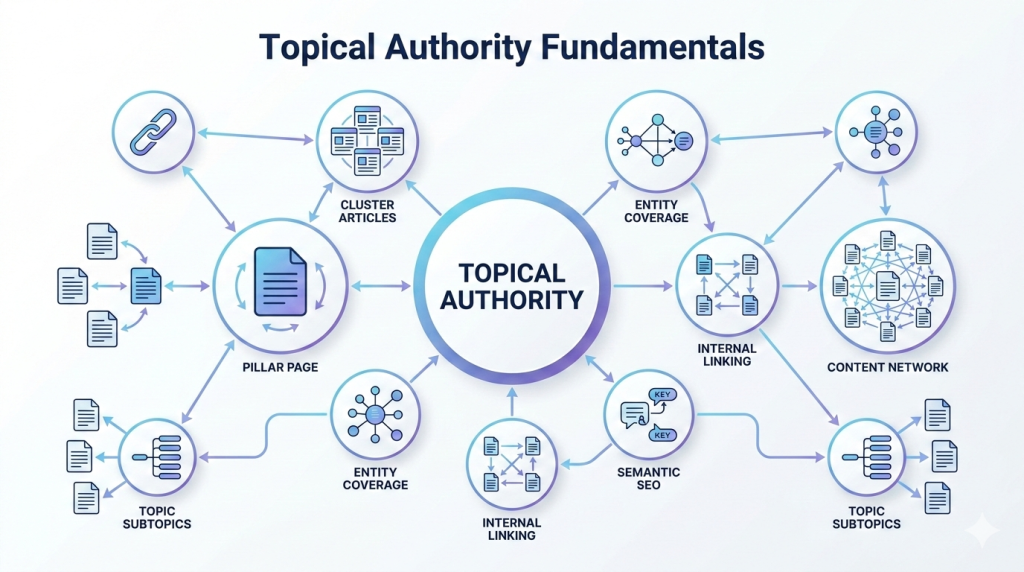
Topical authority doesn’t emerge from a collection of unrelated articles that happen to share a subject. It requires a coherent content network — a set of interlinked documents where each piece contributes to a larger semantic whole. Pillar pages, cluster articles, supporting definitions, comparison pages, case studies, and FAQ documents all serve different functions within this network. The internal linking structure between them is what allows Google to understand the hierarchy and relationships within a site’s coverage.
Internal linking is not incidental to topical authority — it’s load-bearing. A well-structured authority internal linking architecture tells Google which pages are the authoritative hubs for a given subtopic and how the surrounding content supports and deepens those hubs. Sites that treat internal links as an afterthought consistently underperform relative to their content investment.
Coverage Depth and Subtopic Completeness
One of the more counterintuitive findings in topical SEO research is that Google appears to evaluate topic coverage at a subtopic level, not just a keyword level. A site that covers 10 subtopics comprehensively outperforms a site that covers 40 subtopics superficially, even when raw content volume favors the latter. This has practical implications for content planning: going narrow and deep beats going wide and thin, every time.
Authority cluster design formalizes this by organizing content production around defined subtopic clusters before any publishing begins. Each cluster is scoped to cover its subtopic completely — not just the primary query, but supporting queries, adjacent questions, definitional content, and practical application examples. The cluster ships as a unit, and its internal linking is designed from the start.
Crawl Efficiency and Index Clarity
Beyond content, topical authority is also affected by how cleanly a site presents its structure to crawlers. Duplicate content, orphaned pages, thin supporting documents, and inconsistent canonicalization all introduce noise into Google’s understanding of a site’s topical focus. A site with authoritative content but a messy crawl architecture will consistently underperform against a structurally clean competitor with comparable content depth.
Common Problems
Most sites pursuing topical authority make a small set of predictable mistakes. Recognizing them early saves significant wasted effort.
Scattered topic targeting. Sites often publish across too many topic areas simultaneously, diluting their authority signal in each area. A site covering cybersecurity, project management, remote work productivity, and CRM software in roughly equal measure sends a weak topical signal in all four. Google doesn’t identify a clear area of expertise. Concentrating publishing effort in one or two topic clusters before expanding is almost always the right sequencing.
Missing subtopic coverage. Many sites publish pillar content and a handful of cluster articles but leave significant subtopic gaps. Google’s internal topic model for most subjects is broader and more granular than most content teams anticipate. Subtopics that seem minor or too basic are often exactly what’s missing from an otherwise strong content cluster.
Weak internal linking. Topical authority requires that Google can follow the content relationships within a site. Sites with flat linking structures, no cross-linking between related cluster articles, or inconsistent anchor text usage make it structurally harder for Google to model the site’s expertise. This is one of the highest-leverage fixes available when authority metrics plateau.
Treating authority as a single-article problem. Some content teams produce exceptional individual pieces and expect them to rank well on their own merits. In competitive niches, that rarely works. The surrounding content network provides contextual weight. A brilliant article on a topic, sitting in isolation on a thin site, will lose to a solid article on a competitor site with 40 well-linked supporting pieces.
Ignoring entity-level signals. Publishing that focuses purely on keyword matching without considering which entities to cover and how to connect them semantically produces content that reads naturally to humans but underperforms algorithmically. Entity coverage planning — identifying which named concepts, tools, frameworks, and relationships to include — is a distinct step from keyword research and shouldn’t be skipped.
Sites can also fall into the trap of building authority in the wrong direction — targeting a topic dominance model that doesn’t align with their actual conversion funnel. Authority is most valuable when it’s built in the topic areas where your target audience actually lives.
Implementation Guide
Building topical authority is a sequenced process. Trying to execute all components simultaneously typically results in inconsistent coverage and weak execution. The following sequence reflects what works in practice.
Step 1: Define Your Topical Scope
Before publishing a single piece, define the boundaries of the topic domain you’re targeting. This means identifying the primary topic, the core subtopics that constitute it, and the adjacent subtopics that support it. This scope definition drives everything downstream. Use competitor content audits, SERP analysis for your primary queries, and entity extraction tools to map the full semantic field you’re entering.
Step 2: Build a Semantic Topic Map
A semantic topic map organizes your identified subtopics into a hierarchy that mirrors how Google structures the topic internally. Pillar topics sit at the top. Supporting subtopics cluster beneath them. Definitional, comparative, and use-case content sits at the edges. This map becomes the blueprint for your content calendar and internal linking architecture. It’s also how you identify gaps before they become ranking problems.
Step 3: Design Your Cluster Architecture
For each major subtopic, design a content cluster: one primary pillar or hub document that covers the subtopic at depth, supported by 4–8 cluster articles covering specific questions, comparisons, use cases, and related entities. The pillar document links to all cluster articles. Cluster articles link back to the pillar and cross-link to each other where contextually appropriate. This structure is the foundation of a functioning authority cluster design.
Step 4: Execute Coverage Systematically
Publish clusters as units, not as individual articles scattered over time. Completing a cluster before moving to the next one allows Google to see a coherent, complete subtopic coverage at each crawl interval. It also accelerates the authority signal because the internal linking network is complete from the moment each cluster is indexed.
Step 5: Optimize Entity Signals
Within each document, ensure that the relevant entities are covered explicitly: named tools, frameworks, organizations, people, and concepts that Google associates with the topic. Use structured data where appropriate — particularly Article, FAQPage, and HowTo schema — to make entity relationships machine-readable. This aligns with entity coverage strategy principles and accelerates the time to authority recognition.
Step 6: Measure and Iterate
Track authority progression using a combination of ranking breadth (how many queries in the topic cluster is the site ranking for), SERP feature acquisition (featured snippets, PAA inclusions), and crawl efficiency metrics. Authority metrics and measurement is a distinct discipline — the goal is not just to track individual keyword rankings but to understand whether the site’s topical footprint is expanding over time.
Sites pursuing programmatic topical authority at scale need additional infrastructure — templated content systems, quality control pipelines, and monitoring frameworks — but the underlying principles remain the same regardless of production volume.
Real-World Example
Topical authority dynamics play out differently depending on site type and competitive context. Here’s how the framework manifests across three common scenarios.
SaaS Website: Project Management Software
A mid-size project management SaaS company competes against established players in organic search. Rather than targeting high-volume head terms where domain authority gaps make ranking unrealistic, the SEO team defines a topical scope around a specific methodology — Agile project management for distributed teams — and builds comprehensive cluster coverage there. Within eight months, the site ranks for hundreds of long-tail queries in that subtopic, captures PAA features consistently, and starts receiving inbound links from practitioners who cite the content as the clearest reference on the subject. The authority in the subtopic creates a halo effect, and rankings in adjacent subtopics follow without additional targeted effort.
Ecommerce: Specialty Outdoor Gear
A specialty outdoor gear retailer with a strong product catalog but thin editorial content struggles with organic acquisition despite competitive pricing and good UX. An analysis of SERP competitors reveals that top-performing sites combine product pages with deep editorial clusters covering gear selection guides, technique tutorials, environmental condition explainers, and comparison frameworks. The retailer builds a content cluster around winter mountaineering gear — not just product reviews, but comprehensive coverage of the technical decisions involved in gear selection, layering systems, crampon types, boot stiffness ratings, and seasonal condition variations. Product category pages begin ranking for informational queries they’d never appeared in before, and category page traffic increases as the editorial cluster pulls visitors into the site earlier in the buying journey.
Large Content Publisher: Financial Media
A digital financial media publisher holds rankings across hundreds of topics but notices erosion in a core category — retirement planning — following a core algorithm update. An audit reveals that while the site has many retirement-related articles, the coverage is fragmented: articles were written opportunistically over years, with inconsistent internal linking, overlapping angles, and significant subtopic gaps. A systematic rebuild of the retirement planning content cluster — consolidating duplicates, filling subtopic gaps, rebuilding the internal linking architecture from a central pillar — reverses the ranking erosion within two core update cycles and establishes a more durable ranking baseline than the site held before the initial decline.
Best Practices
The following table summarizes the core best practices for building and maintaining topical authority, organized by implementation phase.
| Phase | Best Practice | Key Consideration |
|---|---|---|
| Planning | Define topical scope before content production begins | Scope should be narrow enough to complete — avoid sprawling topic definitions |
| Planning | Build a semantic topic map using SERP and entity analysis | Map must reflect Google’s actual topic structure, not internal product logic |
| Architecture | Design cluster architecture before writing individual pieces | Pillar + cluster model should be determined structurally, not retroactively |
| Architecture | Plan internal linking as part of cluster design | Anchor text variation and link placement should be specified in the content brief |
| Content Production | Publish complete clusters, not individual articles in isolation | Cluster completeness at indexing accelerates authority signal recognition |
| Content Production | Include explicit entity coverage in each document | Named entities, tools, frameworks, and relationships should be addressed directly |
| Technical | Implement structured data for all cluster content types | Article, FAQPage, HowTo schema as appropriate per content type |
| Technical | Audit and resolve crawl architecture issues before expanding content | Noisy crawl architecture undermines authority signal even with excellent content |
| Measurement | Track ranking breadth across topic cluster, not just target keywords | Expanding footprint of ranking queries is the primary authority health signal |
| Maintenance | Audit clusters quarterly for content freshness and gap emergence | Topic landscapes evolve — gaps that didn’t exist at launch appear over time |
One practical observation worth emphasizing: the most common failure mode isn’t doing any of the above incorrectly — it’s doing all of it inconsistently. Authority building requires sustained, systematic execution over months. Sites that publish sporadically, link haphazardly, and audit only when rankings drop will consistently underperform against sites that treat topical authority fundamentals as operational discipline rather than a one-time project.
Implementation Checklist
- Define the topical scope for the primary domain area, including primary topic, core subtopics, and adjacent subtopics
- Conduct a SERP-based entity analysis to map Google’s semantic model for the target topic
- Audit existing content for topical coverage gaps, overlap, and cannibalization issues
- Design pillar-cluster architecture for each core subtopic before writing begins
- Specify internal linking structure in each content brief, including anchor text and target pages
- Implement structured data (Article, FAQPage, HowTo) across all published cluster content
- Publish content in cluster units rather than isolated articles
- Establish a tracking system for ranking breadth across the full topic cluster, not just primary keywords
- Schedule quarterly content audits to identify emerging subtopic gaps and freshness requirements
- Review crawl architecture for orphaned pages, duplicate content, and canonicalization issues that may dilute topical signals
Tools
Executing a topical authority strategy well requires tooling across several distinct functions: semantic research, content gap analysis, internal link auditing, and authority measurement.
Ahrefs and Semrush both provide content gap and keyword clustering functionality that’s useful for identifying subtopic coverage deficiencies. Their site audit tools surface internal linking gaps and crawl architecture problems. Neither was designed specifically for topical authority work, but both are useful inputs into the planning process.
Screaming Frog remains the go-to for detailed crawl analysis, particularly for sites with complex architectures. Its internal link report and orphaned page detection are especially relevant for authority cluster audits.
Google Search Console is indispensable for measuring ranking breadth — specifically, how many distinct queries in a topic area the site is appearing for, even at low positions. Expanding query footprint is one of the clearest early signals that topical authority is building.
For planning and gap analysis, GetSEO Tools offers two purpose-built tools for this workflow. The Authority Blueprint Builder generates structured authority blueprints that map topic clusters, identify semantic gaps, and produce a prioritized content architecture based on the competitive landscape of a target topic. The Internal Linking Analyzer provides visibility into how link equity flows through a content cluster and surfaces linking gaps that undermine the intended architecture. Both tools are available at getseo.tools and are designed to handle the planning and audit layers that general-purpose SEO platforms don’t address directly.
FAQ
How long does it take to build topical authority?
The honest answer depends on the competitive intensity of the topic and the starting state of the site. In less competitive niches with a structured execution approach, meaningful authority signals — ranking breadth expansion, featured snippet acquisition — can appear within 3–6 months. In competitive categories, a realistic horizon for achieving measurable topical authority is 9–18 months of consistent, systematic content production. Sites that try to compress this timeline through bulk publishing without structural quality typically see diminishing returns as Google’s quality systems filter thin content.
Is topical authority the same as domain authority?
No, and conflating them is a persistent source of strategic confusion. Domain authority, as measured by tools like Ahrefs (Domain Rating) or Moz (Domain Authority), is a backlink-derived metric. It reflects the quantity and quality of external links pointing to a site. Topical authority is a content-derived signal reflecting how completely and coherently a site covers a defined subject area. A site can have low domain authority and high topical authority in a narrow niche — and frequently outranks high-DA generalist competitors because of it.
Can topical authority be built for multiple topics simultaneously?
Technically yes, but practically it’s a dilution risk. Sites that attempt to build authority across multiple unrelated topic areas simultaneously tend to develop shallow coverage everywhere rather than deep coverage anywhere. The stronger approach is to achieve demonstrable authority in one topic cluster before expanding to adjacent areas. For large sites with separate content teams per vertical, parallel development can work — but each vertical needs to be treated as a distinct authority-building project with its own cluster architecture and measurement framework.
Does topical authority apply to ecommerce sites, or is it primarily for content publishers?
It applies fully to ecommerce, though the content mix looks different. Ecommerce sites build topical authority through a combination of category page optimization, buying guides, product comparison content, use-case articles, and technical specification resources. The cluster architecture may have product pages as leaf nodes rather than editorial articles, but the underlying logic — comprehensive coverage of the semantic neighborhood of a topic — is identical. The retailers that rank consistently for category-level queries are almost always those that have built substantive editorial depth around their core product areas.
How does topical authority interact with link building?
Links and topical authority are complementary signals, not substitutes. Links establish domain credibility and help with initial ranking access in competitive queries. Topical authority determines how broadly and durably a site ranks across a topic cluster once it has sufficient credibility to be indexed seriously. Sites that invest exclusively in links without building content depth tend to see rankings that are fragile — dependent on link equity holding up. Sites with strong topical authority attract links more naturally over time, as their content becomes the reference destination for practitioners and publishers in the space.
What’s the relationship between topical authority and Google’s core updates?
Core updates disproportionately affect sites that ranked primarily on technical optimization or link equity without genuine content depth. Sites with strong topical authority fundamentals — coherent cluster architecture, comprehensive entity coverage, clean internal linking — tend to be relatively stable through core updates or recover quickly afterward. This isn’t absolute: any site can be affected by shifts in how Google evaluates specific quality signals. But the observable pattern in post-update recovery data consistently shows that content depth and topical coherence are among the strongest protective factors.