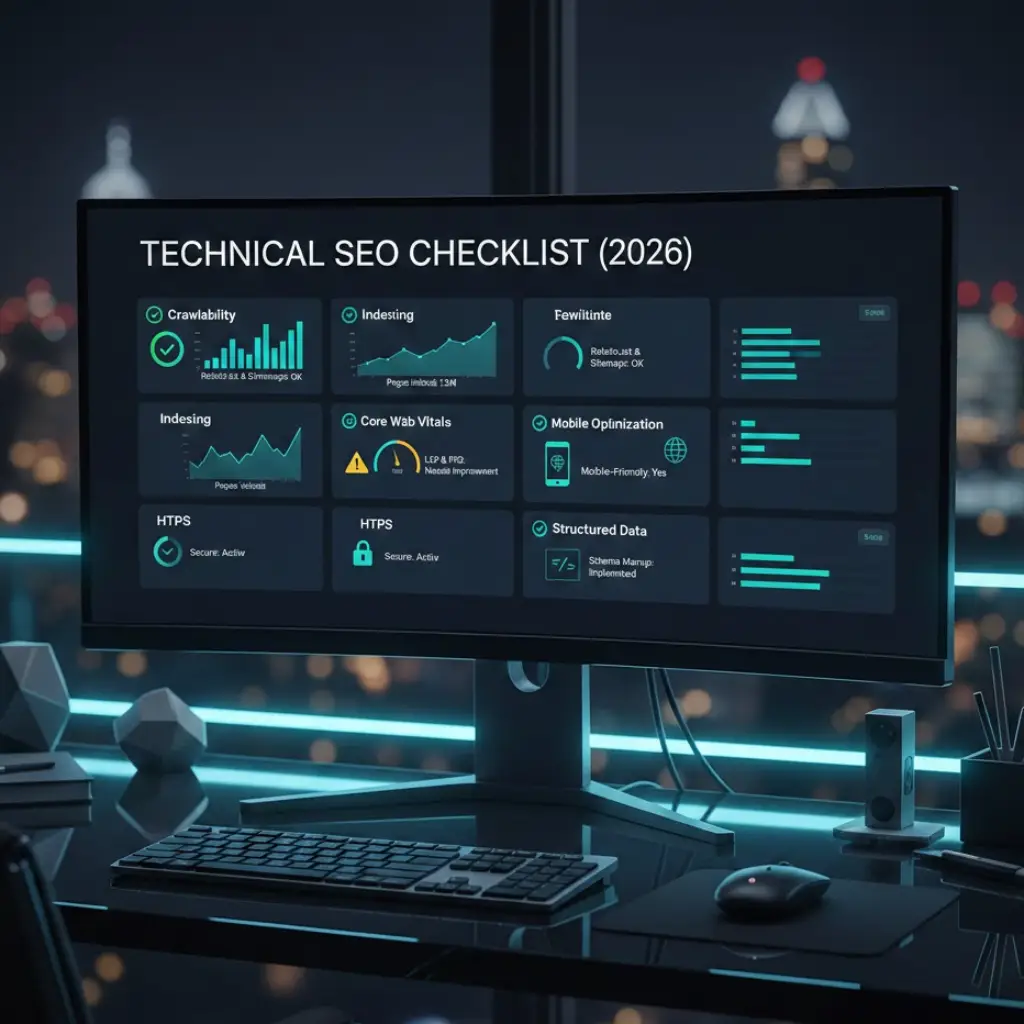
- This checklist is built around 6 real failure points I hit on my own VPS: crawlability, indexation, Core Web Vitals, mobile, HTTPS, and structured data.
- Don’t touch anything else until crawlability and indexation are clean — one bad robots.txt line wiped out an entire section of my site for three weeks.
- The 80/20 rule is real: crawl errors, duplicate URLs, LCP, and redirect chains are responsible for most of your ranking damage. Fix those first, obsess about the rest later.
- I run a full website audit checklist every quarter — monthly for my production environments because dynamic sites change constantly.
- Every single item on this list is something I can actually check, measure, and verify. No fluff.
- Introduction
- What Is Technical SEO?
- Why Technical SEO Matters
- How to Use This Checklist
- Crawlability Checklist
- Indexing and Duplicate Content Control
- Site Speed and Core Web Vitals
- Mobile Optimization
- HTTPS and Security
- Structured Data and Schema Markup
- Complete Website Audit Checklist Steps
- Technical SEO Audit Tools
- Common Technical SEO Mistakes
- Summary Table
- Frequently Asked Questions
Introduction
I run my live production environments on a self-hosted aaPanel Linux VPS, and I’ve torched enough rankings through uninformed technical mistakes to write this guide from genuine scar tissue. This technical SEO checklist is what I actually run through in 2026 — six pillars, no filler: crawlability, indexation, Core Web Vitals, mobile, HTTPS, and structured data.
If your content is good but your traffic is flat, the problem is almost always in this list. This isn’t theory — it’s the exact audit framework I use on real production sites. Whether you’re doing your first complete website audit checklist or prepping for a migration, run every item here before you mess with anything else.
Written by Maged Fayez — Full-stack dev, SEO specialist, and the person who builds and self-hosts dynamic applications on bare-metal Linux VPS servers. Every fix in this guide has been tested on a live production environment — not a staging sandbox, not a client’s site I can blame. Mine.
Last updated: April 2026 · 20 min read · Battle-tested against Google’s 2026 algorithm updates
What Is Technical SEO?
Technical SEO is everything at the server, code, and architecture level that determines whether Googlebot can actually reach, render, and make sense of your pages at scale. It’s totally separate from on-page and off-page SEO — and that distinction matters when you’re building out a real website audit checklist.
On-page SEO is what’s on the page — headings, copy, internal links, metadata.
Off-page SEO is your authority signals from the outside world — links, mentions, brand signals.
Technical SEO is the plumbing under all of it — whether Google can even get to your pages in the first place, and whether it can understand what it finds when it does.
Here’s the honest framing: technical SEO is the foundation everything else sits on. I’ve seen sites with incredible content and strong backlinks go absolutely nowhere because Googlebot couldn’t crawl them properly. Fix the infrastructure first. Then worry about everything else.
Why Technical SEO Matters
Let me walk you through the failure modes I’ve actually hit — because that’s more useful than a generic list of reasons.
Crawl Efficiency
Googlebot doesn’t have infinite time for your site. It runs on a crawl budget — a daily limit of pages it’ll process per domain. When I had redirect chains stacking up and weak internal linking across my dynamic setups, Googlebot was burning its budget on junk URLs instead of my money pages. Those pages dropped out of the index quietly, and I didn’t notice for weeks.
Indexation
Not every URL on your site deserves to be in Google’s index. Faceted navigation, session-parameter URLs, thin paginated pages — I’ve had all of these bloating my index at different points. The fix isn’t magic: proper noindex directives, canonical tags, and parameter config give you surgical control over what Google sees. Everything else is noise.
Performance
Page speed is a real ranking factor — not a soft “user experience” suggestion. Core Web Vitals (LCP, CLS, INP) are baked into Google’s Page Experience signal. On my VPS, I’ve traced ranking drops directly to TTFB spikes after a bad PHP-FPM config change. Slow server equals lower rankings, full stop.
User Experience
Technical failures kill trust before a user reads a single word. Mixed content warnings, layout shifts from AdSense loading late, broken redirect loops — I’ve shipped all of them accidentally. Google tracks behavioral signals like pogo-sticking and dwell time. Bad tech equals bad UX equals worse rankings. It’s all connected.
Ranking Stability
Sites that ignore technical SEO are sitting ducks when Google pushes a speed or spam update. A clean technical foundation doesn’t just help you rank — it makes your rankings stick and makes recovery faster when things go sideways.
How to Run This Technical SEO Checklist Without Wasting Your Time
I’ve made the mistake of treating every audit item as equally urgent. That burned weeks on low-impact fixes while the real problems kept killing my rankings. Don’t do that.
Start with the Critical items — crawlability and indexation. These are the ones that block Google from finding or ranking your content entirely. A single misconfigured robots.txt Disallow rule or a broken canonical chain can silently undo months of content work. I’ve been there. Fix these first, before you touch a single image optimization or schema tag.
Then move to High-priority items: Core Web Vitals, mobile usability, HTTPS. These directly hit your ranking signals. On my VPS, I track these systematically — I actually have Nginx configs and aaPanel tweaks for each one that keep optimization absolute.
Apply the 80/20 principle ruthlessly. On every site I’ve audited, 80% of the ranking damage traces back to: crawl errors, duplicate content, LCP bottlenecks, and redirect chain bloat. Find that 20% on your specific site first. Everything else is secondary.
The Medium-priority stuff — structured data, internal linking refinements — goes in a second pass. It compounds over time but rarely causes sudden drops on its own.
I run a full technical SEO audit on my production environments every quarter. Sites break constantly — new pages get added, plugins update, redirect chains silently accumulate. For a site that changes frequently, I also set up monthly monitoring using Google Search Console plus a scheduled crawler on a cron job. Catch regressions before they tank rankings.
Technical SEO Checklist: Crawlability (6 Checks That Actually Matter)
Googlebot can’t rank what it can’t reach. This is the one section you fix before anything else — no exceptions.
Crawlability is ground zero. I’ve had Googlebot slam my VPS at 3am generating thousands of 404s from bad internal links after a migration. Run a full crawl with Screaming Frog or Sitebulb and verify every point below on your actual production environment.
- Validate robots.txt — Hit /robots.txt directly and confirm it returns HTTP 200. Then read every Disallow line like it’s live production code — because it is. I once accidentally blocked /wp-content/ on a staging config that made it to prod. Googlebot couldn’t render a single page for days. Use Google Search Console’s robots.txt tester to verify critical paths aren’t blocked.
- Audit and submit XML sitemaps — Your sitemap should be clean: only canonical, indexable URLs returning HTTP 200. No 301s, no noindex pages, no 404s. Submit via Google Search Console and watch the “Discovered – currently not indexed” report like a hawk. That report tells you exactly where your crawl budget is being wasted.
- Fix crawl errors in GSC — Open the Coverage report in Google Search Console every week. Prioritize 404s on pages with inbound links, 5xx server errors, and soft 404s. Every unresolved error is Googlebot bouncing off a wall instead of indexing your content.
- Strengthen internal linking architecture — Every page you want to rank needs to be reachable within 3–4 clicks from the homepage. Use a logical silo or hub-and-spoke structure. I rebuilt my core internal link architecture twice — the second time using descriptive, varied anchor text instead of keyword-stuffed garbage. Rankings recovered within a crawl cycle.
- Identify and fix orphan pages — Orphan pages are pages with zero internal links pointing at them. Googlebot finds them maybe once — then never again. Screaming Frog’s Orphan Pages report (run against your sitemap) catches these fast. Either link to them from contextually relevant content, or pull them if they’re serving no purpose.
- Standardize URL structure — Lowercase, hyphens not underscores, minimal dynamic parameters, consistent trailing slash behavior. On my Nginx config, I enforce trailing slash normalization at the server level with a 301 redirect rule. Inconsistency here creates duplicate content and splits your crawl signals across URL variants that Google treats as separate pages.
Indexing and Duplicate Content Control
Getting crawled is step one. Controlling what actually competes in search results is step two — and most sites botch this badly.
Once Googlebot can reach your pages, the next question is: which pages should actually be in the index? Poor indexation control means multiple near-identical URLs fighting each other for the same query. I’ve seen this happen at scale on e-commerce builds — hundreds of parameter-generated URLs bleeding authority from the pages that actually mattered.
- Audit noindex usage — Crawl all noindex directives across meta tags and X-Robots-Tag headers with a site crawler. Confirm every single noindex is intentional — not a leftover from dev mode or a plugin gone rogue. Also verify that noindex pages aren’t simultaneously blocked by robots.txt. Those two directives together is a mess that confuses crawlers.
- Implement canonical tags correctly — Every page self-references a canonical. Cross-domain and pagination canonicals need explicit implementation. I’ve broken canonical chains before (A → B → C) and watched Google just… give up. Always point directly to the final URL. Validate using GSC’s URL Inspection tool — don’t assume.
- Resolve duplicate content at the URL level — HTTPS vs HTTP, www vs non-www, trailing slash vs none, uppercase vs lowercase — every one of those pairings can create a duplicate page in Google’s eyes. I enforce a single canonical version via 301 redirects at the Nginx config level, not just through canonical tags. Canonicals are hints. Server-level 301s are instructions.
- Control URL parameter handling — E-commerce and CMS platforms will generate hundreds of parameter-based URLs if you let them. Sorting, filtering, session IDs — I’ve seen a single faceted navigation setup generate 4,000 unique URLs from 200 products. Configure parameter handling in GSC or use rel=canonical to consolidate. Prefer URL rewriting over parameter hell for high-value facets.
- Handle pagination correctly — Avoid infinite scroll without proper URL management. For paginated series, use self-referencing canonicals on each page and make sure page 2+ contains content that’s actually unique — not just a different slice of the same listing. Google dropped rel=prev/next support — content uniqueness is the signal now.
Site Speed and Core Web Vitals
Slow sites lose rankings. Google has been saying this for years and in 2026 they actually mean it.
Core Web Vitals are a confirmed Google ranking factor. LCP (loading), CLS (visual stability), and INP (interactivity) are hard signals — not soft suggestions. I treat these thresholds as production requirements on my VPS, not aspirational targets I’ll get to eventually.
- Server response time (TTFB) — target under 600ms — TTFB is where everything starts. I benchmark with WebPageTest from multiple geographic nodes. When my TTFB crept past 800ms after a PHP-FPM misconfiguration, my LCP scores collapsed within two weeks. On aaPanel, I’ve tuned Nginx fastcgi_cache and PHP-FPM pool settings specifically to keep TTFB under 400ms for cached pages. TTFB above 1.8s makes hitting a good LCP score basically impossible.
- LCP — target under 2.5 seconds — Largest Contentful Paint is usually your hero image or your H1. Identify the LCP element with Chrome DevTools or PageSpeed Insights — don’t guess. On my production layout, my fix was: preloading the LCP image via <link rel=”preload”>, converting all hero images to WebP, and making sure my CDN was serving the LCP resource from an edge node close to the user instead of my VPS datacenter.
- CLS — target under 0.1 — Cumulative Layout Shift is the one that bit me hardest with AdSense. Ads loading without reserved space caused massive layout shifts. The fix: reserve explicit dimensions for every ad slot in CSS before the ad loads. Also set explicit width and height attributes on every image. Fonts causing FOUT? Use font-display: swap and preload your critical webfonts.
- Optimize and serve images in modern formats — JPEGs and PNGs are dead weight. I batch-convert everything to WebP or AVIF as part of my deployment pipeline. Use responsive images with srcset and sizes. An unoptimized hero image is the single most common LCP killer I see in audits. Target under 100KB for anything above the fold.
- Implement lazy loading for off-screen media — Add loading=”lazy” to every image and iframe that isn’t in the initial viewport. Critical rule: never lazy-load the LCP image. That one must load immediately. Everything below the fold gets lazy loaded — it cuts initial page weight significantly and speeds up perceived load time.
- Deploy a CDN — A CDN caches your static assets at edge nodes globally and kills geographic latency. I use Cloudflare across all my production sites. Important thing most people miss: verify your CDN is caching HTML pages too, not just CSS/JS/images. Static and semi-static pages should be served from the edge, not round-tripping to your VPS on every request.
- Implement server-side and browser caching — On Nginx/aaPanel, I set Cache-Control headers explicitly: static assets (CSS, JS, images) get cache for one year with versioned filenames for cache-busting. HTML gets a conservative 5–60 minutes depending on how often the page changes. I run Redis for dynamic page caching on PHP pages. Without this stack, every page load hits your origin server directly — TTFB goes sideways fast.
Mobile Optimization
Google indexes your mobile version first. If your mobile site is weaker than your desktop, your desktop rankings don’t save you.
Google’s mobile-first indexing means the mobile version of your site is the primary version Google crawls and evaluates. If your mobile content is different — missing structured data, fewer internal links, stripped sections — your rankings reflect the mobile version’s gaps, not your polished desktop layout.
- Confirm mobile-first indexing status — Check GSC Settings under Crawling to confirm mobile-first indexing is active on your property. Then verify your mobile site has identical content, structured data, and internal links as your desktop version. I once found a stripped-down mobile nav on an application layout that was cutting off half my internal link structure on mobile. Fixed it within a day, rankings recovered within two weeks.
- Implement responsive design — Responsive design via CSS media queries is the right approach. Separate m.subdomain setups create duplicate content nightmares and split your link equity. I test mobile rendering with Chrome’s DevTools emulation and the GSC Mobile Usability report after every significant template change.
- Fix mobile usability errors — The GSC Mobile Usability report will surface issues like: clickable elements too close together (minimum 48×48px touch targets), content wider than the screen, and text too small to read (minimum 16px body font). These aren’t aesthetic suggestions — they’re usability failures that affect rankings. Fix them systematically by error category, not one URL at a time.
HTTPS and Security
An insecure site is a trust-killer for users and a ranking penalty waiting to happen. Google has treated HTTPS as a ranking signal since 2014 — there’s no excuse for skipping this.
HTTPS has been a confirmed ranking factor for over a decade. On top of rankings, an insecure or misconfigured SSL setup triggers browser warnings that destroy your conversion rate before a visitor gets past the first headline. Every complete website audit checklist has to include a full security check.
- Validate SSL certificate configuration — Run your domain through SSL Labs’ SSL Server Test (ssllabs.com/ssltest) and shoot for an A or A+ grade. Verify the cert covers all subdomains you’re actually using, check expiry dates (I have an aaPanel SSL auto-renewal cron job for exactly this reason), and confirm TLS 1.2 or higher is enforced. TLS 1.0 and 1.1 are dead.
- Resolve all mixed content warnings — Mixed content happens when an HTTPS page loads HTTP resources — scripts, images, stylesheets. Browsers block some of it entirely. Use Chrome DevTools Console to catch it in real time. On my setups, I fixed this by doing a database search-replace on hardcoded HTTP URLs in options and post content, then verifying the CDN was forcing HTTPS on all asset requests.
- Audit and clean redirect chains — Every hop in a redirect chain burns crawl budget and adds latency. I’ve audited sites with 5-hop chains: HTTP → HTTPS → www → non-www → /old-path → /new-path. That’s five server round trips before Google sees a single byte of content. In Nginx, I consolidate everything to a single 301 to the final canonical URL. Use a crawler’s Redirect Chains report to find every chain longer than two hops.
- Implement security headers — These go in your Nginx or aaPanel config: Content-Security-Policy (XSS protection), X-Content-Type-Options (stops MIME sniffing), Strict-Transport-Security (forces HTTPS), X-Frame-Options (blocks clickjacking). Test at securityheaders.com after deploying.
Structured Data and Schema Markup
Schema is how you talk directly to Google in a language it actually understands — and it’s how you unlock SERP features that visually outrank your competitors.
Schema markup communicates your page’s meaning to search engines using the Schema.org vocabulary. Get it right, and you unlock rich results — enhanced SERP features that make your listing stand out and pull more clicks. Get it wrong, and you’re just adding broken JSON-LD that disqualifies you from the features entirely.
- Use JSON-LD format exclusively — JSON-LD is Google’s recommended format, and it’s the only one I use. It’s a self-contained script block in the <head> — you can update it without touching the visible HTML. Microdata and RDFa are legacy. Don’t start new implementations with them.
- Implement FAQ schema on qualifying pages — FAQ schema generates expandable Q&A dropdowns in SERPs — effectively doubling the screen real estate your single result takes up. Apply it only to pages with genuine Q&A sections, not fabricated padding. Always validate with Google’s Rich Results Test before pushing to production. I’ve seen broken FAQ schema kill eligibility for months because it wasn’t caught before deploy.
- Apply Article schema to blog and news content — Article, NewsArticle, and BlogPosting schema signals content type, publish date, and authorship directly to Google. Include: headline, datePublished, dateModified, author (with name and URL), publisher (with name and logo). This supports E-E-A-T signals — Google’s authorship and expertise evaluation layer.
- Add BreadcrumbList schema to all interior pages — Breadcrumb schema generates the path-style navigation display in SERPs below the page title. It improves CTR and gives Google structural signals about your site hierarchy. Implement it on every non-homepage URL. The ListItem positions must exactly match your real URL hierarchy — don’t fake it.
- Validate and monitor in GSC — The Enhancements section of Google Search Console shows structured data errors by schema type. Common failure modes: missing required fields, wrong field value types, schema applied to the wrong page type. Resolve all validation errors before expecting any rich result eligibility. I do a GSC Enhancements review every time I deploy new schema.
The Full Website Audit Checklist — Step by Step
A complete website audit checklist goes beyond just the infrastructure checks. This is the exact five-phase process I run on every site audit.
Step 1: Pre-Audit Setup (Checklist Steps 1–5)
- Connect Google Search Console and verify property ownership.
- Set up your preferred technical site crawler with GSC and PageSpeed Insights API integration.
- Pull baseline metrics: organic traffic trend, crawl errors, Core Web Vitals field data from CrUX.
- Document the current redirect map and full URL architecture.
- Identify the site’s top 20 revenue-generating or highest-traffic pages — these are your audit priorities. Everything else is secondary until these are clean.
Step 2: Technical Infrastructure Audit (Checklist Steps 6–15)
- Run a full site crawl and export all URLs by status code.
- Audit robots.txt against your list of critical pages line by line.
- Validate XML sitemap — strip out any non-canonical or non-indexable URLs.
- Find and kill all redirect chains exceeding two hops — consolidate to a single 301 in Nginx.
- Audit canonical tags site-wide using your crawler’s canonical export.
- Identify duplicate content clusters through URL parameter analysis.
- Check internal link depth — no priority page should require more than 4 clicks from the homepage.
- Run the crawler’s Orphan Pages report and either link to or remove every orphan.
- Validate full HTTPS implementation and hunt down mixed content warnings.
- Test all security headers at securityheaders.com and fix every missing header.
Step 3: Performance Audit (Checklist Steps 16–22)
- Benchmark TTFB for every key page template from multiple nodes using WebPageTest.
- Identify the LCP element on your top 10 pages using Chrome DevTools — don’t assume it’s the hero image.
- Check CLS scores — set explicit width and height on all images and iframes, reserve space for ads.
- Audit image formats — batch convert everything unoptimized to WebP or AVIF.
- Confirm loading=”lazy” is on all below-fold images — confirm it’s NOT on the LCP image.
- Verify your CDN is active and caching HTML, not just static assets.
- Check Cache-Control headers on every key page type — verify TTLs are appropriate.
Step 4: Mobile and Indexation Audit (Checklist Steps 23–27)
- Verify mobile-first indexing status in GSC Settings → Crawling.
- Work through the Mobile Usability report in GSC — resolve every error category.
- Test touch target sizes on your key conversion pages — 48×48px minimum.
- Do a content parity check: compare mobile vs desktop versions of your top pages side by side.
- Audit every noindex directive site-wide — verify every single one is intentional.
Step 5: Structured Data Audit (Checklist Steps 28–30)
- Run every schema type through Google’s Rich Results Test before and after any deployment.
- Check GSC Enhancements report — resolve every validation error by schema type.
- Confirm BreadcrumbList schema is implemented correctly on all interior pages.
The Audit Tool Stack I Actually Use
No single tool covers the whole technical SEO surface. You need a crawler, a performance analyzer, a search console, and ideally a multi-feature SEO platform running continuously. Here’s my actual stack.
- Google Search Console (Free) — The ground truth for everything: index coverage, CrUX field data for Core Web Vitals, structured data status, manual action flags, and crawl statistics. No audit starts without this open.
- PageSpeed Insights (Free) — Both lab scores (Lighthouse) and real-world field data (CrUX) for any URL. The Opportunities and Diagnostics tabs give you ranked, actionable fixes. I run this on my top 10 pages after every significant deploy.
- Screaming Frog SEO Spider (Free up to 500 URLs / Paid for full crawl) — The industry-standard crawler for a reason. Broken links, redirect chains, duplicate content, hreflang validation, missing meta tags, orphan pages — it catches all of it. I run scheduled crawls via CLI on my VPS.
- Sitebulb (Paid) — Visual crawler with priority-scored audit reports and architecture maps. The visual output is great for presenting technical findings to clients or stakeholders. Strong for large-site audits.
- Semrush Site Audit (Paid) — Cloud-based, 140+ technical checks, regression tracking over time. I use this for continuous monitoring so I catch technical regressions between quarterly audits — especially useful after plugin updates or content migrations.
Technical SEO Mistakes I’ve Made (So You Don’t Have To)
These show up repeatedly in audits across every site type. I’ve personally shipped most of them at some point. Every single one is preventable.
- Blocking CSS and JavaScript in robots.txt — Google renders your pages to evaluate content and layout. Block your CSS/JS and Googlebot sees a broken skeleton. On WordPress, this usually means Disallow rules hitting /wp-includes/, /wp-content/, or asset directories. I made this mistake migrating a staging config to production. Pages dropped from the index within days.
- Submitting non-canonical URLs in the sitemap — A sitemap stuffed with 301 redirect URLs, noindex pages, and parameter variants signals sloppy site management and wastes crawl budget. Audit your sitemap against your canonical config every single month. Automate it if you can.
- Conflicting noindex and canonical directives — You can’t have a noindex directive on a page and a canonical tag pointing to it as the authoritative source. Pick one directive as authoritative. Noindex always wins for that specific URL — Google won’t index it regardless of what the canonical says.
- Missing or duplicate title tags and meta descriptions — Auto-generated or missing title tags tank CTR and dilute ranking signals. Every indexable page gets a unique, keyword-informed title under 60 characters. This is basic — and it’s still broken on a shocking number of sites I audit.
- Using 302 redirects for permanent moves — A 302 is temporary. Google doesn’t consolidate PageRank through a 302 the way it does through a 301. Any permanent URL change, migration, or restructure gets a 301 — always. I’ve had to go back through Nginx configs and flip dozens of 302s to 301s on sites that lost significant authority because of this.
- Not setting width and height on images — Images without explicit dimensions cause layout shifts (CLS). Set width and height attributes on every img element even if you resize it with CSS. This one single fix resolved a CLS problem I had with a heavily image-based landing page.
- Ignoring soft 404 errors — A soft 404 returns HTTP 200 but has no real content. GSC flags them in the Coverage report. They dilute crawl budget, degrade index quality, and are completely invisible unless you’re actually checking GSC regularly.
- Broken internal links after URL changes — Every migration or URL restructure leaves a graveyard of broken internal links. After any significant site change, I run a full crawl filtered by 3xx and 4xx internal link destinations. Takes 30 minutes. Saves weeks of ranking recovery.
- Deploying schema with validation errors — Broken structured data — missing required fields, wrong value types — disqualifies pages from rich result eligibility entirely. Always run the Rich Results Test before pushing schema to production. I have this in my deployment checklist as a hard gate.
- Monitoring lab scores instead of field data — PageSpeed Insights Lighthouse scores and CrUX field data in GSC can be wildly different. Google ranks based on field data — real user measurements — not your lab score. I track both, but field data is the one that actually matters for rankings.
Technical SEO Checklist 2026: Priority Matrix
Use this table to triage a new audit or plan a technical sprint. This is your complete website audit checklist at a glance — same priority logic I use on every production site.
| Area | Priority | Checklist Steps | Tool | Impact |
|---|---|---|---|---|
| Crawlability | 🔴 Critical | 1–6 | Crawler / GSC | Allows Google to find and process pages |
| Indexing and Canonicals | 🔴 Critical | 7–15 | GSC / Crawler Stack | Prevents duplicate content, controls index |
| Site Speed and CWV | 🟡 High | 16–22 | PageSpeed Insights / GSC | Direct ranking factor, UX signal |
| Mobile Optimization | 🟡 High | 23–27 | GSC / Lighthouse | Required for mobile-first indexing |
| HTTPS and Security | 🟡 High | 13–15 | SSL Labs / GSC | Trust signal, ranking factor since 2014 |
| Structured Data | 🟢 Medium | 28–30 | Rich Results Test / GSC | Enables rich snippets, CTR improvement |
| Internal Linking | 🟢 Medium | 12–13 | Crawler / Visual Mapping Tools | Distributes PageRank, aids crawling |
| Duplicate Content | 🟢 Medium | 11 | Crawler Stack | Prevents index dilution |
The Bottom Line
This technical SEO checklist is not a one-time task. It’s a recurring discipline — because algorithms evolve, content scales, and infrastructure breaks in new and creative ways every quarter. Rankings shift, plugins update without warning, and every URL restructure is an opportunity for technical debt to silently accumulate in the background.
Run through the 30 checklist steps on every new site, revisit them quarterly on established ones, and make this your mandatory sign-off process before any major launch or migration. Whether you call it a technical SEO audit or a complete website audit checklist — the process is identical.
Fix the foundation first. Everything built on top of a clean technical layer performs better, ranks more consistently, and recovers faster when Google does something unpredictable.
Frequently Asked Questions
What should I check in a technical SEO audit?
A technical SEO audit should cover crawlability (robots.txt, XML sitemap, internal links), indexation (canonicals, noindex, duplicate content), site speed and Core Web Vitals (LCP, CLS, INP), mobile usability, HTTPS and security, and structured data validity. Use Google Search Console as your baseline data source, then layer in a site crawler for deeper analysis.
What does technical SEO include?
Technical SEO includes server configuration, URL architecture, crawl budget management, redirect handling, page speed optimization, Core Web Vitals compliance, mobile-first readiness, HTTPS security, canonical tag implementation, structured data markup, and XML sitemap management. It’s the infrastructure layer that makes every other SEO effort actually work.
What is a technical SEO checklist?
A technical SEO checklist is an ordered list of verifiable tasks that ensure a website is correctly configured for search engine crawling, indexing, and ranking. It works as both an audit framework and a quality control gate. Applied systematically, it catches issues before they hit rankings and gives you a repeatable process for maintaining site health over time.
What is the 80/20 rule in SEO?
In SEO, the 80/20 principle means roughly 80% of your ranking impact comes from 20% of your optimization tasks. For technical SEO, that 20% is almost always: crawl errors, duplicate content via canonicals, LCP improvements, and redirect chain cleanup. Hit those first. The rest is polish.
How often should I run a technical SEO audit?
Run a full technical SEO audit quarterly for most sites. For large or frequently updated sites, monthly monitoring via Google Search Console and a scheduled crawler is the safer baseline. Always run a complete audit before and after major site migrations, redesigns, or CMS changes — not after, when the damage is already done.
What is a complete website audit checklist?
A complete website audit checklist combines technical SEO checks (crawlability, indexation, speed, security), on-page SEO checks (title tags, meta descriptions, headings), content quality checks, and off-page signals review. The technical layer gets verified first — always. Technical errors can quietly nullify everything else you’ve built, and you won’t see it coming until rankings drop.