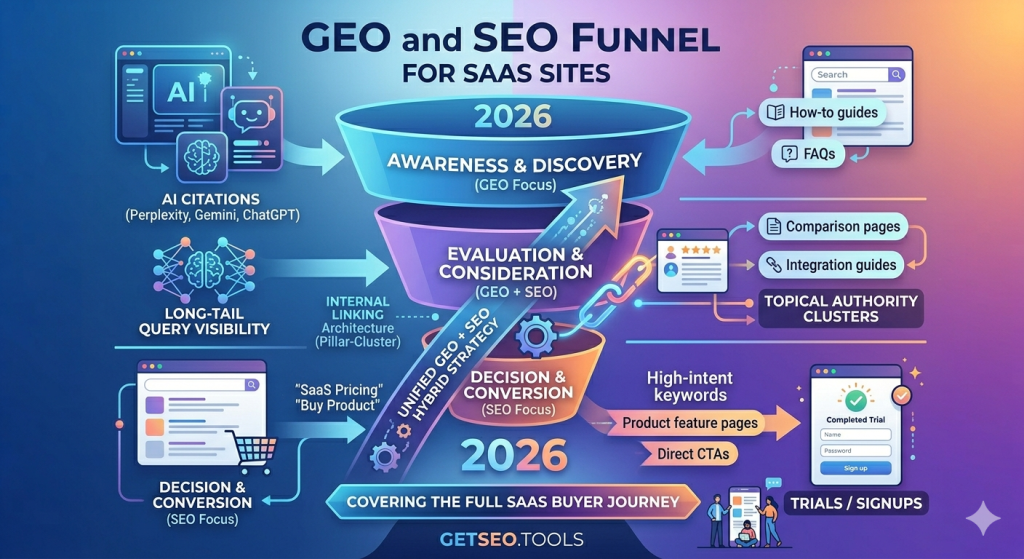
Most SaaS teams run GEO and SEO as two separate workstreams. One team focuses on Google rankings. Another experiments with AI visibility. Neither talks to the other. The result is duplicated effort, inconsistent content architecture, and a funnel with gaps at both ends. A unified GEO SEO strategy for SaaS is not about doing twice the work — it is about building content that earns Google rankings and AI citations simultaneously, through a single connected architecture. In 2026, the SaaS teams pulling ahead are not the ones running two strategies. They are the ones who figured out how to run one strategy that serves both channels at once.
Why SaaS Teams Need a Unified GEO and SEO Approach
SaaS buyers now use both Google and AI tools at different stages of their research — and a strategy that covers only one channel misses half the funnel.
The typical SaaS buyer journey in 2026 starts with awareness. A potential customer asks Perplexity or ChatGPT a broad question: “What are the best tools for managing client onboarding?” They get an AI-generated response that cites three or four products. Your brand either appears in that response — or it does not.
Later in the same journey, the same buyer switches to Google. They search for “[your product] vs [competitor]” or “[product category] pricing.” Now they are in intent mode. SEO owns this stage. A well-ranked comparison page or pricing page captures that intent and drives a trial signup or demo request.
Running only SEO means you are invisible in the awareness stage. Running only GEO means you have no conversion infrastructure when the buyer is ready to act. A unified strategy places you at both touchpoints — without requiring separate content for each.
The mechanics of why this is possible are covered in our GEO vs SEO comparison guide — which explains how the two strategies differ in signals, timelines, and success metrics. Understanding those differences is the prerequisite for combining them effectively.
💡 Pro-Tip: Map your content inventory against the buyer journey before planning new content. Mark each existing page as awareness, evaluation, or decision stage. Then check which pages are optimised for GEO only, SEO only, or both. The gaps in that map are your highest-priority content investments — not new topics, but missing channel coverage on topics you already own.
Building a Hybrid Funnel: GEO for Awareness, SEO for Intent
A hybrid GEO and SEO funnel assigns each channel to the stage it serves best — GEO captures awareness through AI citations, SEO captures intent through Google rankings.
The top of the funnel is where GEO leads. Informational long-tail content — guides, comparisons, how-to articles, FAQ-heavy pages — earns AI citations on Perplexity, Gemini, and Google AI Overviews. When a potential SaaS buyer asks an AI tool about their problem, your content is the answer. They learn about your brand through the AI response, not through a direct Google search for your product name.
This awareness stage is where most SaaS teams underinvest. They produce content for keywords with clear commercial intent and ignore the informational queries that AI systems handle directly. But awareness built through repeated AI citations compounds over time. A buyer who has seen your brand cited three times across different AI responses arrives at your product page with pre-built familiarity — which shortens the evaluation cycle significantly.
The middle and bottom of the funnel is where SEO leads. Evaluation queries — “best [category] tools for [use case],” “[product name] review,” “[product] alternatives” — still route predominantly through Google. Ranking well for these terms drives high-intent traffic from buyers who are actively comparing options. Product pages, comparison pages, and case study content all serve this stage through SEO.
The key insight is that these two funnel stages do not require separate content teams or separate content calendars. A single well-structured guide can earn AI citations for its informational content while simultaneously ranking in Google for its target keywords. The structure that serves GEO — FAQ blocks, structured headings, entity schema — also signals topical depth to Google. The optimisation work overlaps more than it conflicts.
Internal Linking Architecture That Serves Both GEO and SEO
A pillar-cluster internal linking structure serves both Google’s crawl algorithm and AI topic graph processing simultaneously — making it the most efficient architecture for a unified GEO and SEO strategy.
For SEO, internal linking passes PageRank. A pillar page with strong backlink authority distributes link equity to cluster pages through internal links. Cluster pages rank for long-tail variants of the pillar’s topic. The pillar reinforces its own authority by covering the topic at depth, supported by the cluster’s specificity.
For GEO, the same internal linking structure signals topical relationships to AI knowledge graph processing. When Gemini or Perplexity crawls a site with clear pillar-cluster architecture, it maps the topical connections between pages. A pillar page on “project management tools” connected to cluster pages on “task assignment workflows,” “time tracking integration,” and “client reporting features” creates a knowledge graph node that AI systems recognise as a comprehensive, authoritative topic hub.
Here is where most SaaS teams get the implementation wrong. They build the pillar-cluster structure for SEO — with anchor text chosen for keyword match — but neglect the topical specificity that GEO requires. For AI knowledge graph processing, anchor text should describe the destination page’s topic precisely, not just match a target keyword. “How to automate client onboarding in five steps” as anchor text signals more topical specificity to an AI system than “client onboarding guide.”
The practical rule: write anchor text as if you are describing the destination page to someone who has never seen it. That description serves both Google’s relevance signals and AI topic graph mapping simultaneously.
For the full topical authority architecture that underpins this approach, our guide on building GEO topical authority with content clusters covers pillar-cluster design, internal link topology, and the topic ownership audit that identifies gaps in your current architecture.
💡 Pro-Tip: Audit your current internal links for generic anchor text — “click here,” “read more,” “this article.” Each one is a missed topical signal for both Google and AI crawlers. Replace generic anchors with descriptive phrases that name the destination topic explicitly. This single change improves both SEO link relevance and AI knowledge graph mapping across your entire site without producing a single new page.
The SaaS Conversion Layer: Turning AI Citations into Trials and Signups
AI citations drive awareness — but converting that awareness into SaaS trials requires a deliberate conversion layer built into the pages that earn citations.
Here is the problem most SaaS teams overlook. A page earns strong AI citation visibility. Users see the brand cited in Perplexity and Gemini responses. Some of them click through to the source page. And then — nothing. The page is an informational article with no clear next step. The citation earned the visit. The page failed the conversion.
The fix is straightforward. Every page that is optimised for GEO citation — every informational guide, FAQ page, or how-to article — needs a lightweight conversion element embedded naturally into the content. Not a disruptive popup. Not a hard sales pitch. A contextual CTA that connects the page’s informational value to a relevant product capability.
For a guide on “how to track client project milestones,” the conversion element might be: “If you manage client projects, [Product Name] automates milestone tracking and sends status updates automatically — try it free for 14 days.” The CTA is relevant, low-friction, and positioned after the informational value has been delivered. It does not interrupt the reading experience — it extends it.
The goal is not to turn every GEO page into a sales page. It is to ensure that the awareness GEO creates has somewhere to go. A buyer who discovered your brand through an AI citation and lands on a page with no conversion path is a lost opportunity. A buyer who lands on the same page with a relevant, contextual CTA has a clear next step.
Tracking whether those AI-cited visits are converting requires a separate measurement layer from standard SEO analytics. For teams building that tracking infrastructure, our guide on how to track AI citations for free covers the monitoring workflow that connects citation frequency to measurable traffic and conversion outcomes.
Unified Strategy: How Each Content Type Serves GEO and SEO
| Content Type | GEO Value | SEO Value | Funnel Stage | Conversion Element |
|---|---|---|---|---|
| Long-tail how-to guide | High — matches AI prompt patterns precisely | Medium — ranks for specific long-tail queries | Awareness | Contextual CTA linking to relevant feature |
| FAQ page | High — FAQPage schema provides discrete citation units | Medium — FAQ schema improves rich result eligibility | Awareness / Evaluation | Free trial link after key answers |
| Comparison page | Medium — cited in AI responses to “X vs Y” queries | High — high-intent ranking target for evaluation queries | Evaluation | Direct CTA — demo or trial |
| Pillar topic guide | High — signals topical authority to AI knowledge graphs | High — earns backlinks and distributes authority to cluster | Awareness / Evaluation | Newsletter signup or lead magnet |
| Product feature page | Low — product pages rarely earn AI citations directly | High — commercial intent ranking target | Decision | Primary CTA — trial, demo, or purchase |
| Case study | Medium — cited when AI systems recommend proof points | Medium — earns branded and long-tail ranking | Evaluation / Decision | Social proof CTA — similar results for your team |
| Integration guide | High — cited in AI responses to tool-specific queries | High — ranks for “[product] + [integration]” queries | Evaluation / Decision | Contextual CTA linking to integration setup |
Frequently Asked Questions
How do GEO and SEO work together for SaaS sites?
GEO captures awareness at the AI citation layer — users discover your brand through Perplexity, Gemini, and ChatGPT responses. SEO captures intent at the Google ranking layer — users find your product pages when they are ready to evaluate options. Together, they cover the full funnel from discovery to conversion.
What internal linking structure works for both GEO and SEO simultaneously?
A pillar-cluster architecture serves both goals. Pillar pages earn Google ranking authority through backlinks and topical depth. Cluster pages earn AI citations through long-tail specificity and structured content. Internal links between them pass authority for SEO while signalling topical relationships for AI knowledge graph processing.
Should SaaS product pages be optimised for GEO or SEO?
Primarily SEO. Product pages target commercial intent queries that still route through Google. However, adding FAQ schema and structured content to product pages creates GEO visibility for comparison and evaluation queries — users asking AI systems which tools to consider for a specific use case.
How long does it take to see results from a unified GEO and SEO strategy?
GEO results — AI citation appearances — can emerge within days to weeks for well-structured long-tail content. SEO results for competitive terms take 3 to 12 months depending on domain authority and competition. Running both simultaneously means early GEO wins can build brand recognition while SEO authority accumulates.
What is the biggest mistake SaaS teams make with GEO and SEO together?
Treating them as separate workflows with separate content. The most efficient approach produces content that serves both channels simultaneously — structured for AI citation extraction, optimised for Google ranking signals, and connected through internal linking that serves both crawl paths. Separate content for each channel doubles the workload with diminishing returns.
Key Takeaways
- SaaS buyers use both channels at different stages — AI tools for awareness and research, Google for evaluation and purchase decisions. A single-channel strategy misses half the funnel.
- GEO owns the top of funnel — informational long-tail content earns AI citations that build brand familiarity before buyers ever search for your product directly.
- SEO owns the middle and bottom of funnel — comparison pages, feature pages, and case studies rank for high-intent Google queries from buyers actively evaluating options.
- Pillar-cluster architecture serves both channels simultaneously — internal links pass SEO authority while signalling topical relationships for AI knowledge graph processing.
- Descriptive anchor text beats keyword-matched anchor text for a unified strategy — it serves Google’s relevance signals and AI topic mapping at the same time.
- Every GEO page needs a conversion element — AI citations drive awareness visits that go nowhere without a contextual, low-friction CTA connecting the page’s informational value to a relevant product capability.
- The most efficient SaaS content strategy produces pages that serve both channels — the structure that earns AI citations overlaps significantly with the structure that earns Google rankings.