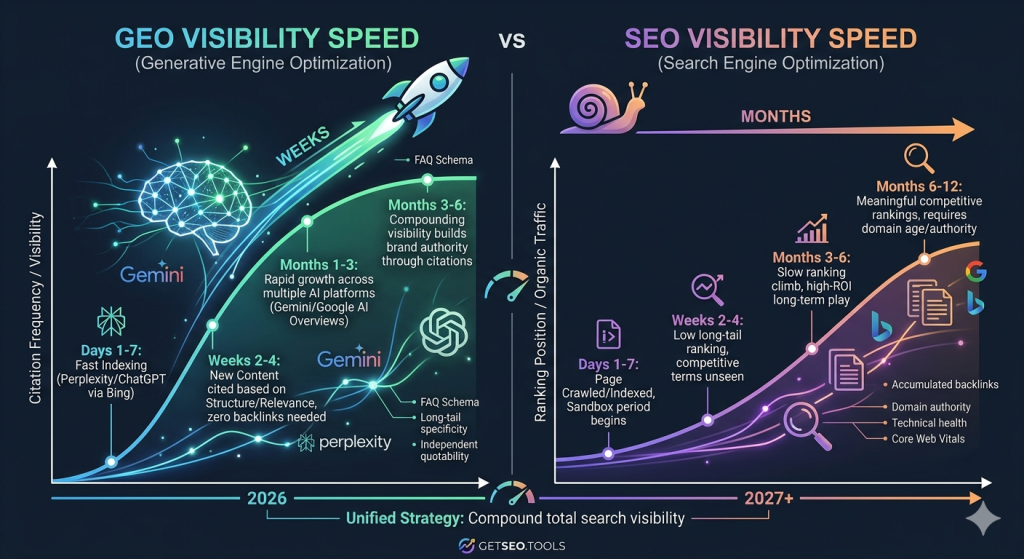
New sites wait months before Google takes them seriously. That is not a bug in SEO — it is the system working as designed. Google’s authority model rewards accumulated trust, and trust takes time to build through backlinks, engagement signals, and domain age. GEO does not work that way. A brand-new site with zero backlinks and no domain history can earn citations in Perplexity and ChatGPT within weeks of publishing — if the content is structured correctly. That speed gap is why GEO faster than SEO is not just a slogan. It reflects a fundamental difference in how AI indexing systems evaluate content versus how Google does. Understanding that difference changes how you sequence your content investments.
Why GEO Beats SEO on Speed — The Core Mechanism
GEO produces faster visibility than SEO because AI citation systems evaluate content structure and topical relevance — not accumulated domain authority built through backlinks over time.
Google’s ranking algorithm is built on trust signals that take time to earn. A new page needs backlinks from authoritative domains. A new domain needs time to prove consistent quality. Google applies what practitioners call a “sandbox” effect — new sites rarely rank competitively for significant terms within their first six months, regardless of content quality.
AI citation systems work differently. Perplexity does not weight a page lower because the domain is six months old. ChatGPT does not deprioritise content because it has no backlinks. These systems evaluate whether the content answers the query well — and whether the structure makes that answer easy to extract. A new page that does both gets cited. A well-established page that does neither does not.
This is not just theory. We see it consistently across new site launches. Pages published on domains with minimal authority appear in Perplexity citation responses within two to three weeks — while the same pages sit on page four or five of Google results waiting for authority signals to accumulate.
The practical implication is significant. GEO is the highest-ROI strategy for early-stage sites, new product launches, and teams that cannot wait 6 to 12 months for SEO authority to build. It does not replace the long-term SEO investment — but it produces real visibility while that investment matures.
💡 Pro-Tip: For new sites or new content clusters, publish in long-tail first. A single broad pillar page takes months to rank on Google and weeks to appear in AI citations. Ten specific long-tail pages on the same topic can each earn individual AI citations within days — generating compound visibility while the pillar page accumulates the authority it needs for Google ranking.
AI Indexing Speed: How Perplexity and ChatGPT Work Differently
Perplexity runs a continuous freshness-focused crawl cycle. ChatGPT pulls citations through the Bing index. Both systems surface new content significantly faster than Google’s authority-weighted crawl.
Perplexity’s crawler — PerplexityBot — operates on a high-frequency cycle that prioritises topical freshness. When a new page is published on a topic Perplexity actively covers, the crawler can reach it within days. More importantly, it does not need to wait for backlink accumulation before including the page in citation consideration. If the content is well-structured and topically clear, it enters the citation pool immediately.
According to BrightEdge’s 2025 AI search research, Perplexity reindexes actively covered topics every 30 to 90 days on average — with fresh, high-relevance content entering the citation pool faster than that window suggests for priority topics.
ChatGPT routes citations through Bing’s index. Bing indexes new content faster than Google for most domains — often within 24 to 72 hours of publication for sites with active sitemaps. This means well-structured content published today can appear in ChatGPT citation responses within days, not months. The Bing connection is one of the most underestimated speed advantages in the GEO toolkit — and one of the least tracked by teams focused exclusively on Google Search Console data.
Google’s AI Overviews operate on a different timeline. They pull from Google’s existing index, which means they are subject to the same crawl and authority evaluation cycles as traditional Google rankings. AI Overviews are faster than traditional ranking for informational queries — but they still reflect Google’s underlying authority model, making them slower than Perplexity or ChatGPT for new content.
Long-Tail Query Velocity in AI Search
Long-tail content earns AI citations faster than broad content because AI prompt patterns are inherently specific — and specific content wins structural matches against general pages.
When a user asks Perplexity “what schema markup should I use for a SaaS how-to guide,” that is a specific, long-tail prompt. Perplexity is looking for content that answers that exact question — not a broad overview of schema types. A page that targets that specific query with a direct answer in the first paragraph and FAQ schema structured around that question wins the citation over a more authoritative broad guide that buries the answer in paragraph twelve.
This is the velocity mechanism. Long-tail content matches AI prompt patterns more precisely. That precision produces citation wins faster — often within the first crawl cycle after publication. Broad content requires the AI system to infer relevance from general topical signals, which introduces uncertainty and slows citation selection.
The compounding effect matters too. A site that publishes ten specific long-tail guides earns ten separate citation opportunities — one per guide, across different specific queries. A site that publishes one broad pillar page on the same topic earns one citation opportunity. Even if the pillar page earns citations faster on its main query, the ten long-tail pages generate more total citation surface area in less time.
For the full framework on how long-tail cluster architecture drives AI citation velocity across Perplexity, Gemini, and ChatGPT simultaneously, our GEO vs SEO comparison guide covers the query type mapping and citation speed differences in detail.
💡 Pro-Tip: Write the first paragraph of every long-tail page as a direct answer to the page’s target query. Keep it under 50 words. Make it self-contained. This single structural choice dramatically increases how quickly Perplexity and ChatGPT identify and extract the page as a citation-worthy source — because the AI crawler finds the answer immediately rather than parsing the full page to locate it.
Visibility Timeline: GEO vs SEO Side by Side
The timeline gap between GEO and SEO visibility is most pronounced in the first six months — which is exactly the window where most new sites and content investments need traction most.
| Timeline | GEO Visibility | SEO Visibility |
|---|---|---|
| Days 1–7 | PerplexityBot and Bing crawl new content. Structured long-tail pages enter initial citation consideration. | Google crawls the page. No ranking signal yet — page is indexed but not competitive. |
| Weeks 2–4 | First citation appearances possible in Perplexity and ChatGPT for well-structured long-tail content. | Page appears in Google results for low-competition queries. Competitive terms show no ranking. |
| Months 1–3 | Citation frequency builds across Perplexity and ChatGPT. Gemini citations begin as E-E-A-T signals accumulate. | Rankings improve gradually for long-tail terms. Competitive terms still require more authority signals. |
| Months 3–6 | Established citation presence across multiple AI platforms. Brand recognition builds through repeated citation exposure. | Meaningful rankings for medium-competition terms on established domains. New domains still building authority. |
| Months 6–12 | Citation patterns stabilise. Freshness maintenance required to retain citation share as new content enters the pool. | Competitive term rankings become achievable on established domains with consistent link building. |
| 12+ months | GEO authority compounds — cited sites earn more citations as brand recognition feeds back into AI knowledge graph confidence scores. | SEO authority compounds — established domain rankings become more defensible with accumulated link equity. |
The table makes the opportunity clear. In months one through three, GEO consistently outperforms SEO for new content on new or low-authority domains. By month six, both channels are producing meaningful visibility — but through different mechanisms and for different query types. By month twelve, both are compounding in ways that reinforce each other.
For teams tracking how GEO visibility metrics develop over time, our guide on AI visibility and citation benchmarks for 2026 covers the citation rate data and industry benchmarks that let you measure whether your GEO timeline is on track.
What Fast GEO Visibility Actually Requires
Fast GEO visibility requires three things simultaneously: content that matches specific AI prompt patterns, structure that enables clean extraction, and schema that confirms topic and authority signals.
Content match comes first. A page that targets a vague broad topic will not earn early citations. A page that targets a specific question — the kind a user would type into Perplexity — gives AI systems a clear relevance signal on the first crawl. Write for the specific prompt, not the broad keyword.
Structure comes second. The first paragraph must answer the target query directly. Subheadings must reflect the specific questions and subtopics the page covers. FAQ schema must be present and valid. Each section must be independently quotable — self-contained enough that an AI can extract it without needing surrounding context to make sense of it.
Schema confirmation comes third. FAQPage and Article schema tell AI systems what type of content the page contains and where the answers are. Without schema, AI crawlers have to infer structure from HTML formatting alone — a slower, less reliable process. With schema, the extraction map is explicit and immediate.
All three elements must be present simultaneously. Strong content with weak structure earns slower citations. Strong structure with no schema misses the confirmation layer. Schema on thin content provides no extraction value. The fastest GEO results come from pages where all three are built correctly from the start — not retrofitted after the fact.
According to Search Engine Land’s 2025 GEO performance analysis, pages with all three elements — topically specific content, self-contained paragraph structure, and valid FAQ or HowTo schema — appeared in AI citations an average of 3.4 weeks faster than pages missing any single element. The gap is not marginal. Missing one component delays the entire citation timeline.
Frequently Asked Questions
How fast can GEO produce visibility compared to SEO?
Well-structured long-tail content can appear in Perplexity and ChatGPT citations within days to weeks of publishing. SEO ranking for competitive terms typically takes 3 to 12 months depending on domain authority and competition level. GEO does not require the link-building cycle that SEO needs before visibility begins.
Why does Perplexity index content faster than Google?
Perplexity runs a continuous crawl cycle focused on freshness and topical relevance — not a periodic authority-weighted crawl like Google’s. It does not need to evaluate domain authority through backlink accumulation before surfacing content. A new page with strong structure and clear topic signals can enter Perplexity’s citation pool within days.
Does long-tail content rank faster in GEO than in SEO?
Yes. In SEO, long-tail pages on low-authority domains still face competition from established sites. In GEO, long-tail content wins by structural match — if your content answers the specific AI query better than alternatives, it gets cited regardless of domain age. The barrier to entry is content quality and structure, not accumulated authority.
What types of content get GEO visibility fastest?
FAQ-structured content, step-by-step guides, and definition-first how-to articles get GEO visibility fastest. These formats match AI prompt patterns precisely and provide self-contained extraction units. Broad topic pages with no clear question-answer structure take longer to appear in AI citations regardless of content depth.
Can a new site get GEO visibility before it ranks on Google?
Yes. This is one of the most significant practical advantages of GEO for new sites. A new domain with zero backlinks can earn Perplexity and ChatGPT citations within weeks through well-structured long-tail content — while Google ranking for the same content may take 6 months or more to materialise.
Key Takeaways
- GEO produces faster visibility than SEO because AI citation systems evaluate content structure and topical relevance — not accumulated domain authority built through backlinks over time.
- Perplexity reindexes actively covered topics every 30 to 90 days — new structured content can enter the citation pool significantly faster than that window for priority topics.
- ChatGPT cites through Bing — and Bing indexes new content within 24 to 72 hours for sites with active sitemaps. This is one of the most underestimated speed advantages in GEO.
- Long-tail content earns AI citations faster than broad content — AI prompt patterns are inherently specific, and specific content wins structural matches against general pages on the first crawl.
- New sites can earn GEO citations before they rank on Google — zero backlinks and minimal domain authority are not barriers to AI citation visibility the way they are to Google ranking.
- Fast GEO visibility requires three simultaneous elements: topically specific content, self-contained paragraph structure, and valid schema. Missing any one delays the citation timeline by an average of 3.4 weeks.
- GEO and SEO timelines converge by month six — GEO wins the early months, SEO builds sustained traffic floor over time. Running both from day one gives you coverage at every stage.